Irrigation and Sprinkler Repair · Phoenix
Sprinkler Repair in Phoenix, AZ
Sprinkler repair in Phoenix runs into the same handful of failures every summer, and the bill is set by access rather than by parts. Call (747) 243-2089 and describe which zone is failing.
Costs
What does a sprinkler repair cost in Phoenix?
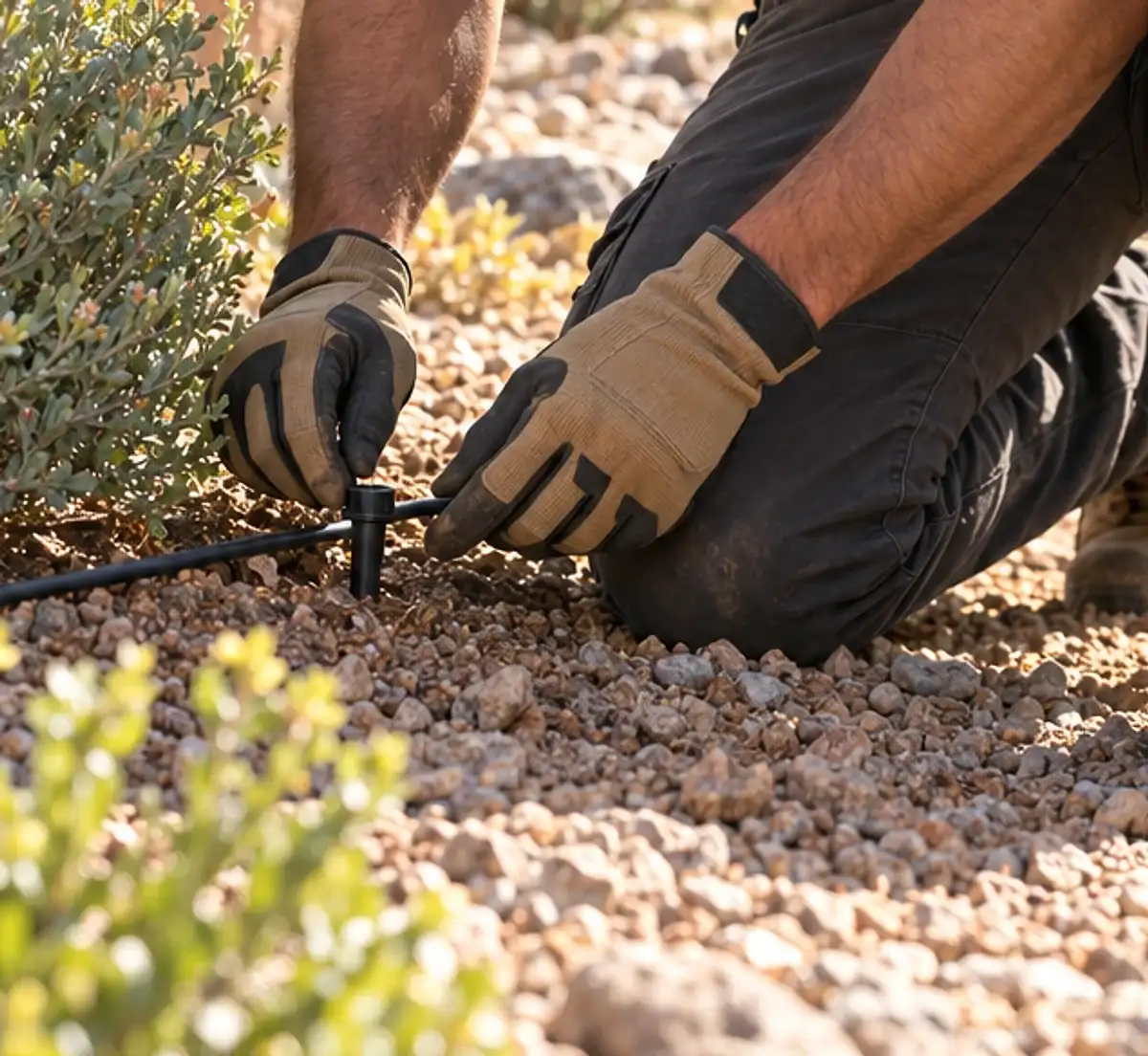
A repair call runs $137 to $422, with an average of $278, according to a national cost guide. Published market ranges, not a quote: the final price is set after an on-site assessment. Broken out by part, the same guide lists a head at $65 to $90, a valve at $75 to $300, a line leak at $120 to $400, a controller at $100 to $500 and a backflow preventer at $450 to $1,700. That spread explains most bills. A head is a quick swap with the part in hand. A backflow assembly is a test with paperwork attached. What separates a small bill from a large one is access: a valve box under 4 inches of gravel, a lateral under a driveway, a run pinned in caliche. An ordered part can turn one visit into two.
Timeline
Why does a Phoenix water bill jump in summer?
Because the city prices water by season on top of a fixed charge, and summer is the highest of 3. Phoenix bills in units of 748 gallons, and the volume price is $4.93 per unit from December through March, $5.65 in April, May, October and November, and $6.13 from June through September (City of Phoenix, water and sewer rates (opens in a new tab)). The monthly service charge already includes 5 units, or 3,740 gallons, from October through May, and 8 units, or 5,984 gallons, from June through September. An environmental charge of $0.62 per unit applies to all usage. The structure matters for repairs: a zone that runs 20 minutes too long in July costs more than the same mistake in January, and a leak that starts in June is worth more to find than one that starts in December.
Costs
What does a weeping valve cost me in a Phoenix summer?
About $390 a month at the summer rate if the valve weeps a gallon a minute, a rate picked for the arithmetic. That is 1,440 gallons a day, 43,200 gallons a month, or 57.8 units. At the $6.13 summer volume price plus the $0.62 environmental charge, that lands near $390 before the service charge (City of Phoenix, water and sewer rates (opens in a new tab)). A slower weep at a quarter gallon a minute still costs about $97 a month. The city notes that about half the water used in a typical residential home goes to outdoor landscaping or a pool, so an outdoor leak hides inside a bill that already looks normal. The meter is the only honest witness. Read it with every fixture off and the clock unplugged, and note whether the leak indicator moves.
Contact
What can I check in 10 minutes before I call anyone?
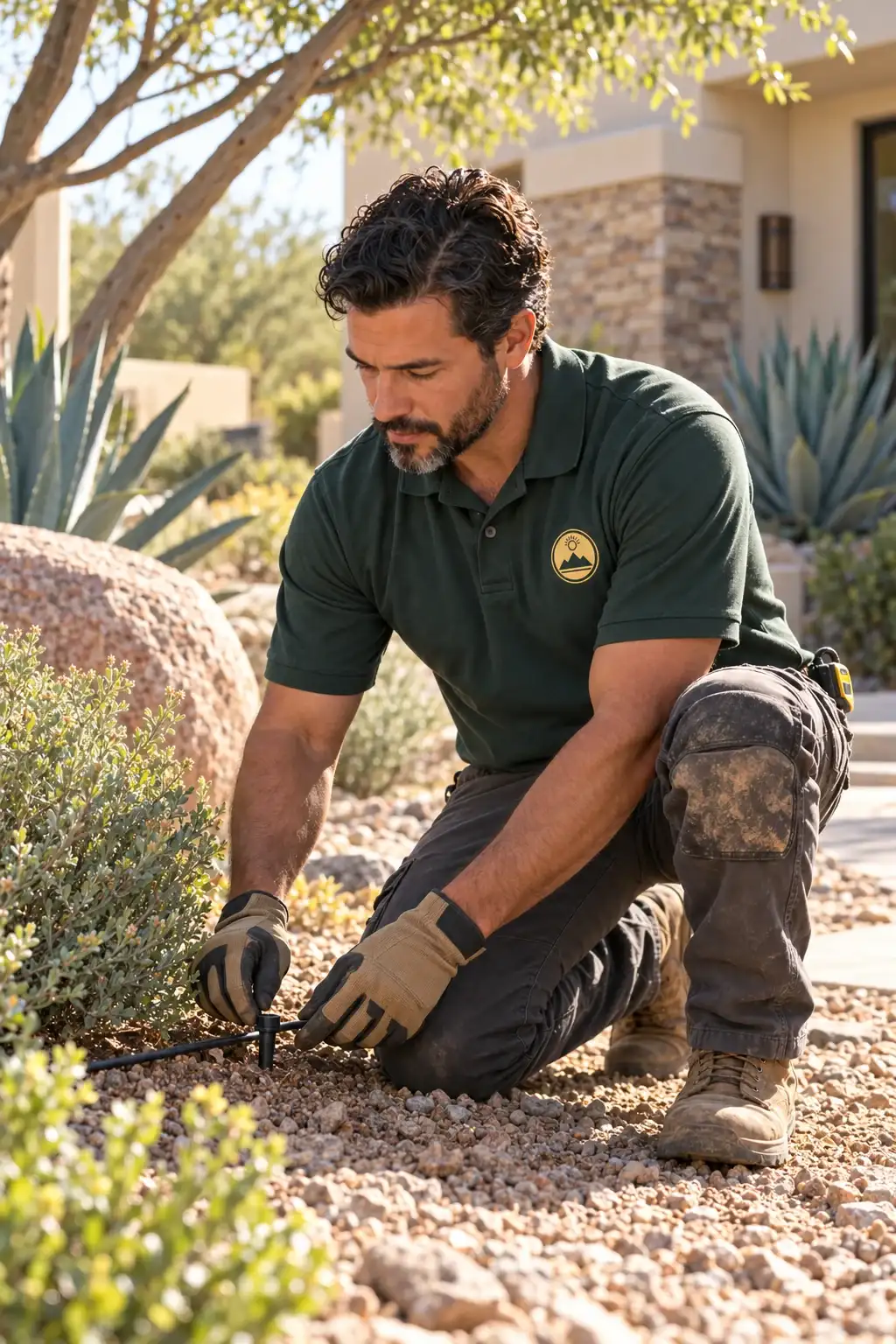
5 things, in this order: controller, valve, zone, head, leak. At the controller, confirm the display is live, the seasonal adjust is not at zero, and the problem zone is not switched off. Unplug the controller and open the valve by hand. If the zone runs by hand but not on the program, the fault sits in the clock or the wiring, not the water. If it runs on neither, the valve is the suspect. Walk the zone while it runs and look for a head throwing sideways, a geyser at a cracked riser, or a head that never pops. Shut everything, then watch the meter for 10 minutes. Movement with the system off is a leak, and the rate tells you whether to dig.
Water
Why do heads and valves scale up in Phoenix?
The water is hard, and hardness leaves a film on every part it touches. Phoenix's 2025 water quality report lists total hardness from 172 to 302 parts per million, which is 10 to 17.6 grains per gallon, and total dissolved solids from 464 to 716 ppm (City of Phoenix, 2025 water quality report (opens in a new tab)). Scale builds on a valve seat until the rubber cannot seal, and it plugs a drip emitter first because that orifice is the narrowest passage in the system. A scaled nozzle throws a ragged stripe instead of a fan, so the lawn grows a wet band beside a dry one. Vinegar and a brush clean a nozzle. They do not save a torn diaphragm. On an older system, a filter ahead of the drip zone and an annual flush cost less than replacing clogged emitters.
Ground
How does caliche change a line repair?
It turns a short dig into an afternoon. Caliche is soil cemented by calcium carbonate into a layer that can stop a shovel and restrict drainage, and the University of Arizona advises breaking it up and removing as much as practical when digging a planting hole (University of Arizona, managing caliche (opens in a new tab)). For a repair, that means the hole gets wider than the leak, because the walls will not crumble back. A lateral pinned under the layer has to be cut further back to lift it enough to fit a coupling. The layer also changes where water shows: a leak under a pan can travel along the top of it and surface away from the pipe, so the wet spot is a direction, not a location. Probe with a screwdriver before committing to a trench line.
Water
My neighborhood still gets flood irrigation. What changes?
The delivery is someone else's water and your pipe. SRP moves close to 800,000 acre-feet a year through 131 miles of canals and 1,000 miles of laterals, and a zanjero opens the neighborhood gate on a scheduled day (SRP, irrigation 101 (opens in a new tab)). Past that gate the system is private, owned and maintained by the properties it serves, which is why a broken lateral on your side is your repair. A delivery puts 2 to 3 inches of water across the yard in one pass (SRP, irrigation resources (opens in a new tab)). What fails is berms, yard valves and the pipe under them, not sprinkler heads. Before a delivery, walk the berm line and close the gaps, because water follows the low spot to the wall or the neighbor's slab. A yard valve that will not shut wants parts ordered before the next date.
Water
What should I change on the controller when the monsoon starts?
Cut the run time and fit a rain sensor, because the storm does the watering. The monsoon runs June 15 to Sept 30, and the Phoenix metro area recorded above normal rainfall in 2025, driven by a couple of intense events in September, while much of the Desert Southwest ran below normal (National Weather Service, 2025 monsoon review (opens in a new tab)). The storms that matter do not follow the season total: a heavy downpour runs off a sun baked yard and carries gravel to the street. Two changes help. Set a seasonal percentage on the controller and drop it after a storm rather than rewriting every zone. Then clear the swale or channel that carries water away from the house, since a head or a berm that blocks it sends water into the stucco. Open the valve boxes after the first storm, because a box full of muddy runoff hides a valve that will not seat.
Water
Does a sprinkler system freeze in Phoenix?
Rarely, and a single night is enough. Phoenix averages 0.6 days a year with a minimum at or below 32 F, and the January normal low is 46 F (National Weather Service, 2024 climate year in review (opens in a new tab), National Weather Service, January 2026 climate summary (opens in a new tab)). An average hides the event. On a clear winter night the ground radiates heat, the air at the surface falls below the airport reading, and an above ground backflow assembly or a brass valve body is the first thing to split. The damage shows up weeks later as a zone that will not hold pressure or a wet patch at the side of the house. When a hard freeze is forecast, shut the irrigation off, drain the assembly and wrap it. Then run each zone by hand for a minute before the next scheduled cycle.
Costs
Is Phoenix still in a drought stage, and will the city pay for a smart controller?
Yes on both. Phoenix is in a Stage 1 Drought Alert, which the city describes as an intensive public education push for voluntary conservation plus more resources to enforce the existing codes that cover water use and waste (City of Phoenix, water questions (opens in a new tab)). Separately, the Colorado River basin is in a Tier 1 shortage for 2026, and nearly all of Arizona's reduction has been taken by Central Arizona Project water users (Central Arizona Project, Colorado River operations (opens in a new tab)). On the money side, Phoenix pays up to $75 for an EPA WaterSense labeled smart irrigation controller and estimates about 10,000 gallons saved a year per device (City of Phoenix, toilets and smart controllers (opens in a new tab)). Applications go through myPHX311. Confirm the terms before buying, and keep the receipt with the model number.
Costs
Does a new drip system cost less than repairing an old sprinkler system?
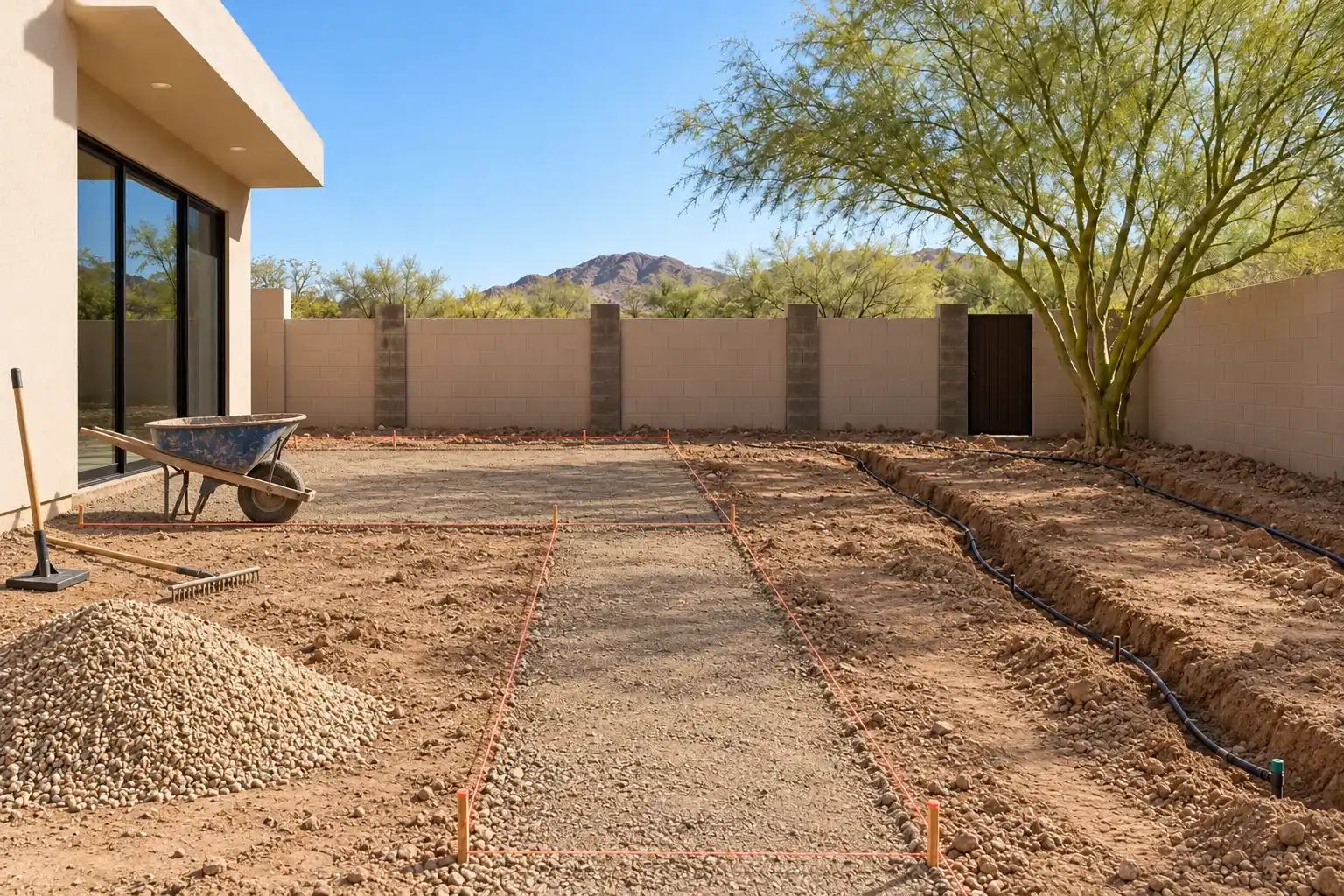
Sometimes, and the square footage decides. A new drip system on a quarter acre runs $450 to $625, while installing a full sprinkler system prices at $1,636 to $3,595 for a house lot, or $0.20 to $1 per square foot of turf, according to a national cost guide. Published market ranges, not a quote: the final price is set after an on-site assessment. Drip wins on a bed heavy yard because the pipe is cheap and the trench is shallow. Sprinklers win where there is lawn to cover, because heads cover ground that emitters cannot. The cheap path on an existing system is conversion: the trench, the valve and the tap are already paid for, so the money goes into a filter, a regulator and emitters.
Good to know
Which parts should be replaced at the same time?
The ones that fail as a set. A valve that has been rebuilt 2 times is a valve to replace, and the manifold feeding it usually goes with it, since a national cost guide prices a manifold at $75 to $200 and a valve at $75 to $300. Doing both in 1 visit costs less than 2 separate trips. A backflow preventer is the exception that sets the schedule: at $450 to $1,700 it is the largest single part on a residential system, and it is the one part tied to a test. If the assembly holds and the test is current, leave it alone. Wiring is the third piece. A lateral cut by a shovel rarely harms the wire, but a valve box that floods does, so replace the splice and the connectors rather than the whole run.
Mistakes
When is a repair the wrong answer?
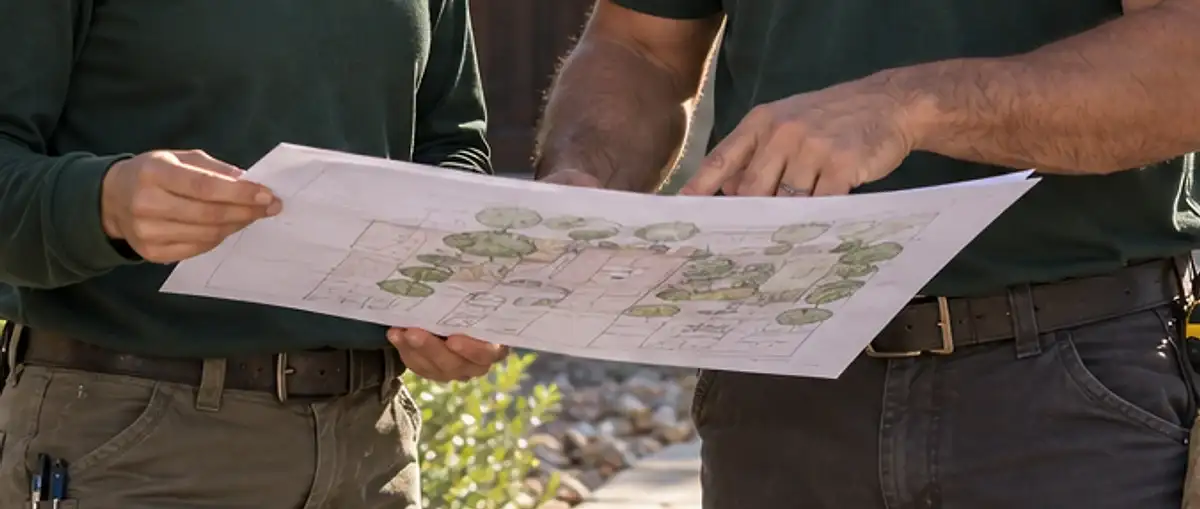
When the layout, not the part, is the problem. A repair is right when 1 valve, 1 lateral or a few heads have gone bad while the rest of the yard still runs at steady pressure. It is wrong when a single valve feeds both a lawn and a bed of desert trees, when the pipe size changes 3 times across the yard, when every valve box sits buried in dirt with no lid, or when the controller has no seasonal adjust. Age is not what decides it. A 20 year old system with matched heads and clean valves still runs fine. The test is whether water arrives where the plant list needs it. If 3 or more zones fail that test, repair money is rent, and rebuilding the wet side is the smaller number over time.
3 questions
Questions people ask
Still have a question? Call (747) 243-2089 and describe the yard.
Why is one zone wet for days after the clock moves on?
A valve that never fully shuts. Sand or scale on the seat holds the seal open a hair, so water keeps passing after the run time ends. The line is usually fine. Test it by closing every other zone: if the wet spot dries, the valve is the fault, and a rebuild kit costs less than a new lateral.
How long does a valve replacement take?
Often a short job once the box is open and the water is off. Finding the box is the variable, because gravel, turf and mature plantings hide lids. A valve set in caliche or under a paver takes longer, and a part that has to be ordered adds a second visit.
Can a line under a concrete patio be repaired?
Yes, by rerouting around it in most cases. Cutting a slab is expensive and hard to match afterward, so the cheaper answer is often a new run along the edge with the zone split.
Same service in other cities