Service area · Fountain Hills, AZ
Landscaping in Fountain Hills, AZ
Landscaping in Fountain Hills starts with a slope above the valley floor, and many yards carry a grade change. EPCOR delivers the water, the town zoning ordinance has a chapter on outdoor lighting, and town hall sits a few hundred feet above Scottsdale. Granite ground and lighting rules drive the rest.
Rules
What do the lots look like on a hillside street?
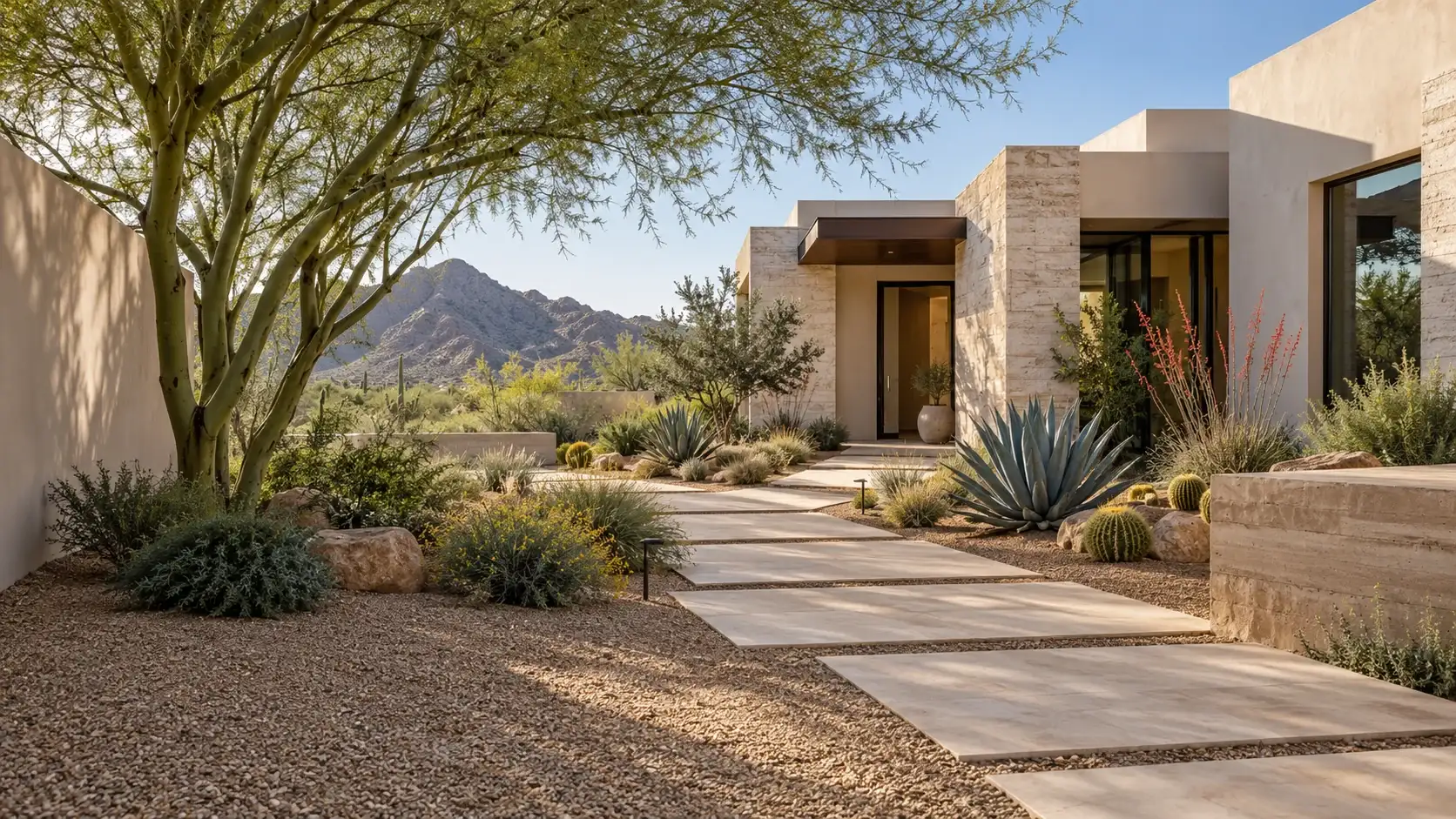
Fountain Hills is a master planned community, and its homes share 1 ZIP code, 85268. McCulloch Properties established it in 1970, and Charles Wood Jr. designed it (Fountain Hills, about the town (opens in a new tab)). On a hillside street, a driveway can be steeper than the pad it serves. Many yards are cut into the slope on a bench, with a retaining wall at the back and a view fence at the edge. Many homes step down the hillside instead of sitting level with the street. A drop somewhere in the yard is common, so the plan handles grade, wall and drainage before color. Flat lots exist near the lake and the golf courses.
Water
Who runs the water system, and why does pressure vary?
EPCOR owns and operates the Chaparral District that serves the town, so one utility supplies the meter and the pressure (Fountain Hills, EPCOR water management (opens in a new tab)). Reclaimed water fills the lake at the center of town and irrigates the park and the golf courses, and that is a separate system from the one at your hose bib. The green core is not a guide to what a private yard can do on potable water. Ask for the static pressure at the meter before a plan is drawn. Houses at the top of a street often run lower than the flat lots by the lake, and a low pressure head needs larger pipe or fewer heads per zone.
Ground
How does granite change a planting plan?
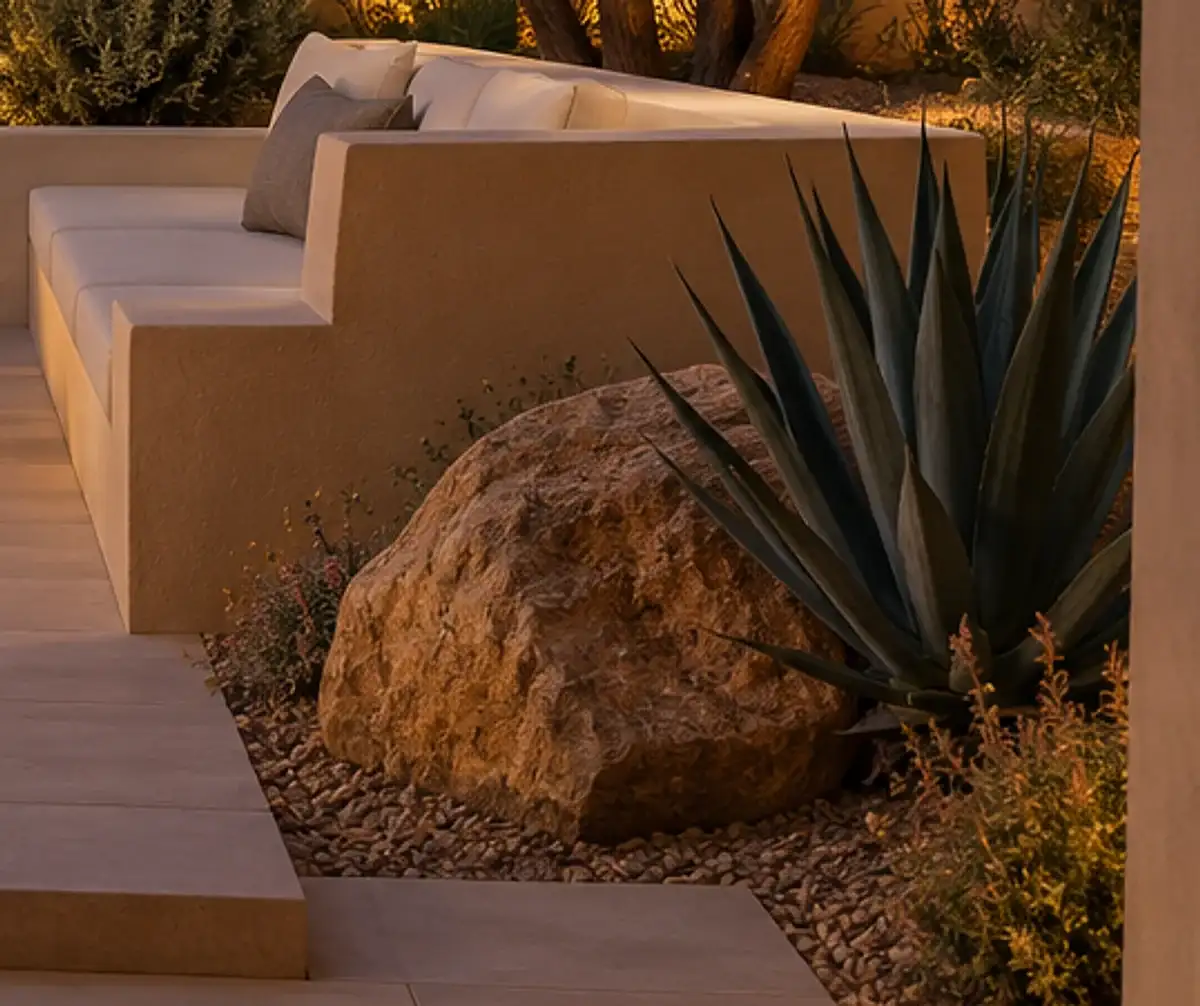
The town sits on granite, and the soil above it is decomposed granite, granite mixed with sand, and pockets of caliche. Decomposed granite drains fast and holds almost no nutrient, so a plant installed in it needs organic matter worked into the pit and a mulch layer that gets replenished. Caliche does the opposite and can stop water, so two lots on the same street can behave in opposite ways (University of Arizona, managing caliche (opens in a new tab)). A drainage test settles it: 4 inches of drop in 4 hours. On a slope water moves before it soaks, so a basin on the downhill side of every plant is the detail that carries a planting through June.
Rules
What does the dark sky ordinance require?
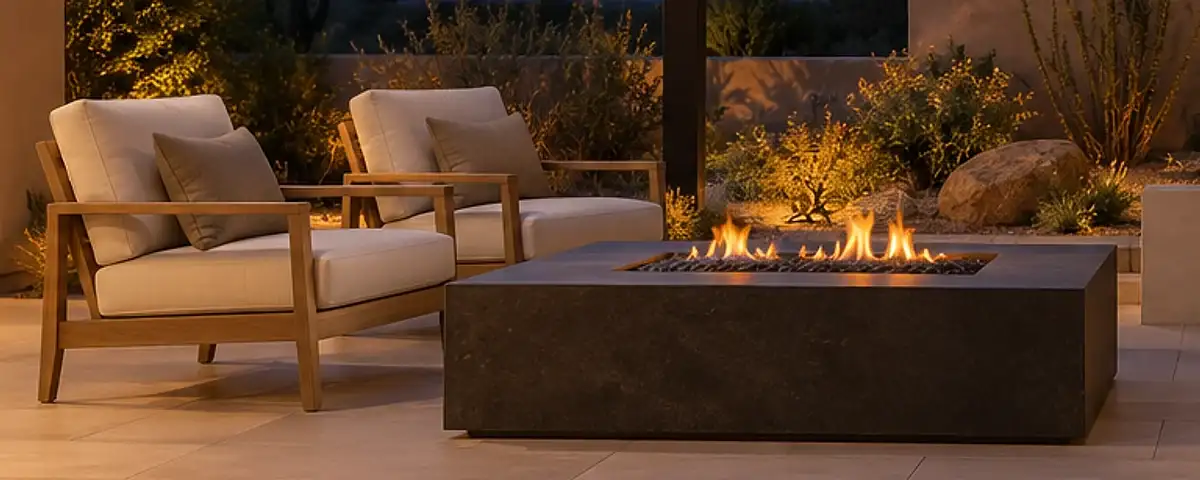
Outdoor lighting follows Chapter 8 of the town's zoning ordinance. Fixtures over 2,250 lumens must be fully shielded, fixtures from 1,125 to 2,250 lumens must be at least partially shielded, color temperature cannot exceed 3000K, and spill onto adjacent properties is to be minimized (Fountain Hills Zoning Ordinance, Section 8.02 (opens in a new tab)). Unshielded lighting of a building or landscaping is limited to fixtures under 1,125 lumens, with 1,125 lumens combined within a 25 ft radius (Section 8.03 (opens in a new tab)). The town was designated a DarkSky International community in 2018 (Experience Fountain Hills, dark sky (opens in a new tab)). Plan the fixtures with the planting, because a light chosen after the trees go in can be the one that fails. Moving a saguaro taller than 4 ft takes a state permit, a tag and a seal (A.R.S. 3-906 (opens in a new tab)).
Climate
What does the extra elevation change?
The town sits a few hundred feet above Scottsdale, and the gap shows up at night more than at noon. Cooler nights stretch the fall planting window and shorten the run of heat stress in June, so a plant that struggles down in the valley can have an easier summer here. The same elevation gives a better chance of frost in a cold snap, especially in the low ground near a wash. Wind is the other local factor. Exposed ridge lots take it across open slope, and a young tree may need staking for its first 2 seasons. Irrigate for wind as well as heat, because a windy 105 degree day pulls water out of a leaf faster than a still one.
Costs
What does a retaining wall cost on a slope?
Retaining walls carry most of the cost on a slope lot, priced by height. A national cost guide puts a wall at $40 to $360 per linear ft depending on height, labor at $15 to $50 per sq ft, and the average project near $6,083, with most between $3,191 and $9,202. The same guide puts a 2 ft wall at $40 to $200 per linear ft and a 6 ft wall at $360. A pair of terraced walls can cost more than 1 tall wall, and terracing is often how a steep cut is held. Published market ranges, not a quote: the final price is set after an on-site assessment. Add engineering and review before the first block.
Planning
What should be mapped before work starts?
Start with a survey that shows slope, not just lot lines. A 2 ft contour map tells you where water goes, where a wall is needed and where a patio can sit without a 3 ft drop at its edge. Then confirm the pressure at the meter and the size of the service, because a hillside irrigation plan lives or dies on that number. Check light fixtures against the town's outdoor lighting rules before the planting plan is final, because a late swap is a redo. Check whether the parcel touches a wash or holds a protected plant, and price the saguaro tag if one is moving. Plan equipment access last: a narrow drive on a steep street limits the machine that reaches the back.
3 questions
Questions people ask
Still have a question? Call (747) 243-2089 and describe the yard.
Why is the water pressure lower at the top of the street?
Because the town is built on a slope. A house high on a street can see less static pressure than a lot by the lake, and the difference shows up as heads that mist instead of throw. Ask EPCOR for the static pressure at the meter, then size the zones to it.
What outdoor lights are allowed?
Shielded fixtures, with the level of shielding set by brightness. Under the town's zoning ordinance, fixtures over 2,250 lumens must be fully shielded, fixtures from 1,125 to 2,250 lumens must be at least partially shielded, color temperature cannot exceed 3000K, and glare from a fixture cannot be visible from an adjacent property. Plan lighting with the planting so a tree does not grow into the beam.
Is the lake water used on the golf courses?
Yes. Reclaimed water fills the lake at the center of town, and it also irrigates the park and the golf courses. That is a separate system from the potable water at a private meter, so a yard cannot tap it. A home landscape is designed on the EPCOR supply and pressure.
Keep reading
- Landscape Installation: for what a rebuild involves.
- Irrigation and Sprinkler Repair: for pressure and zones.
- Patios and Pavers: for walls and grade.
- Landscaping Cost: for every published number.
- North Scottsdale: for the neighboring area.
- Sod vs Seed in Scottsdale:
- Pavers vs Concrete Patio in Scottsdale: