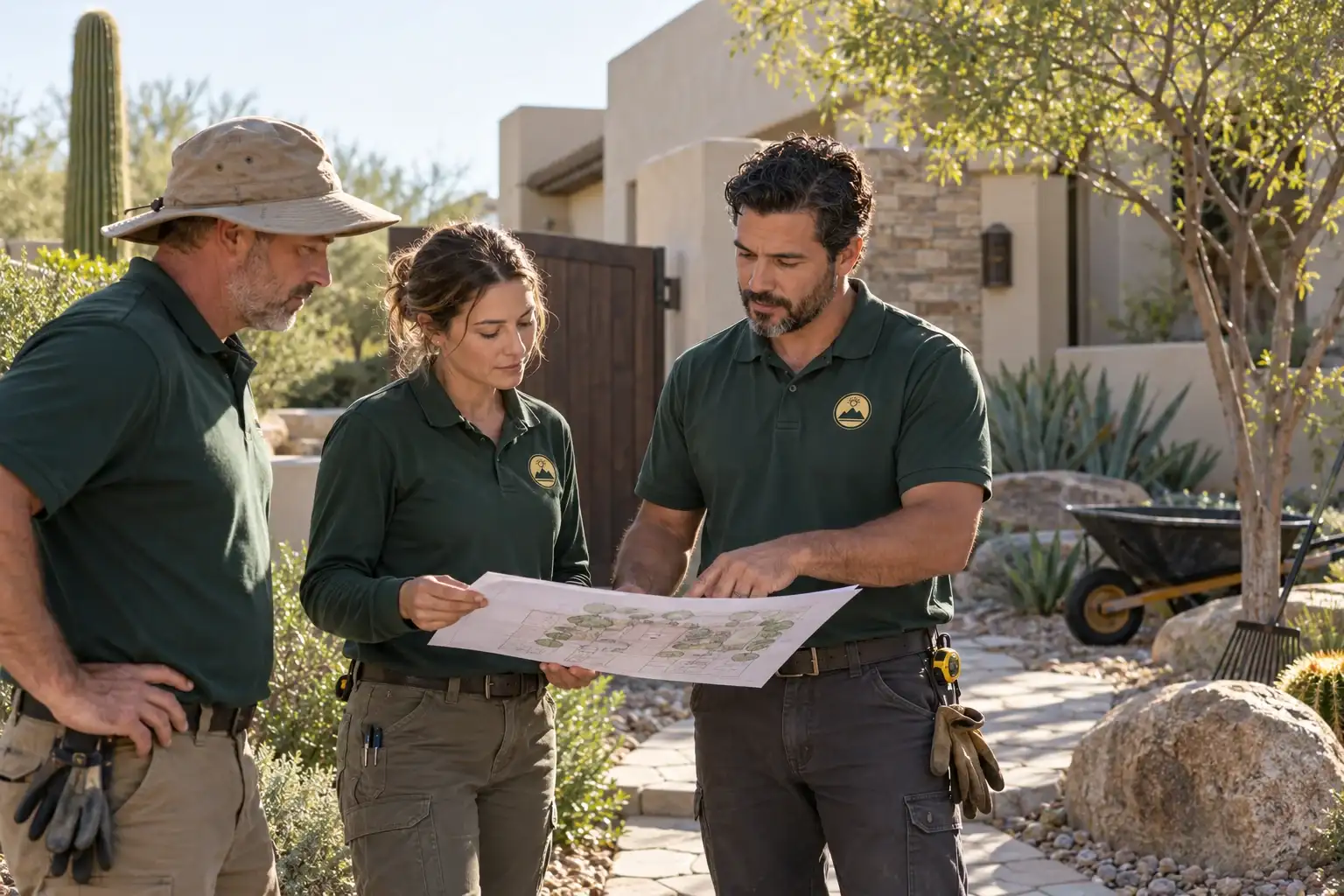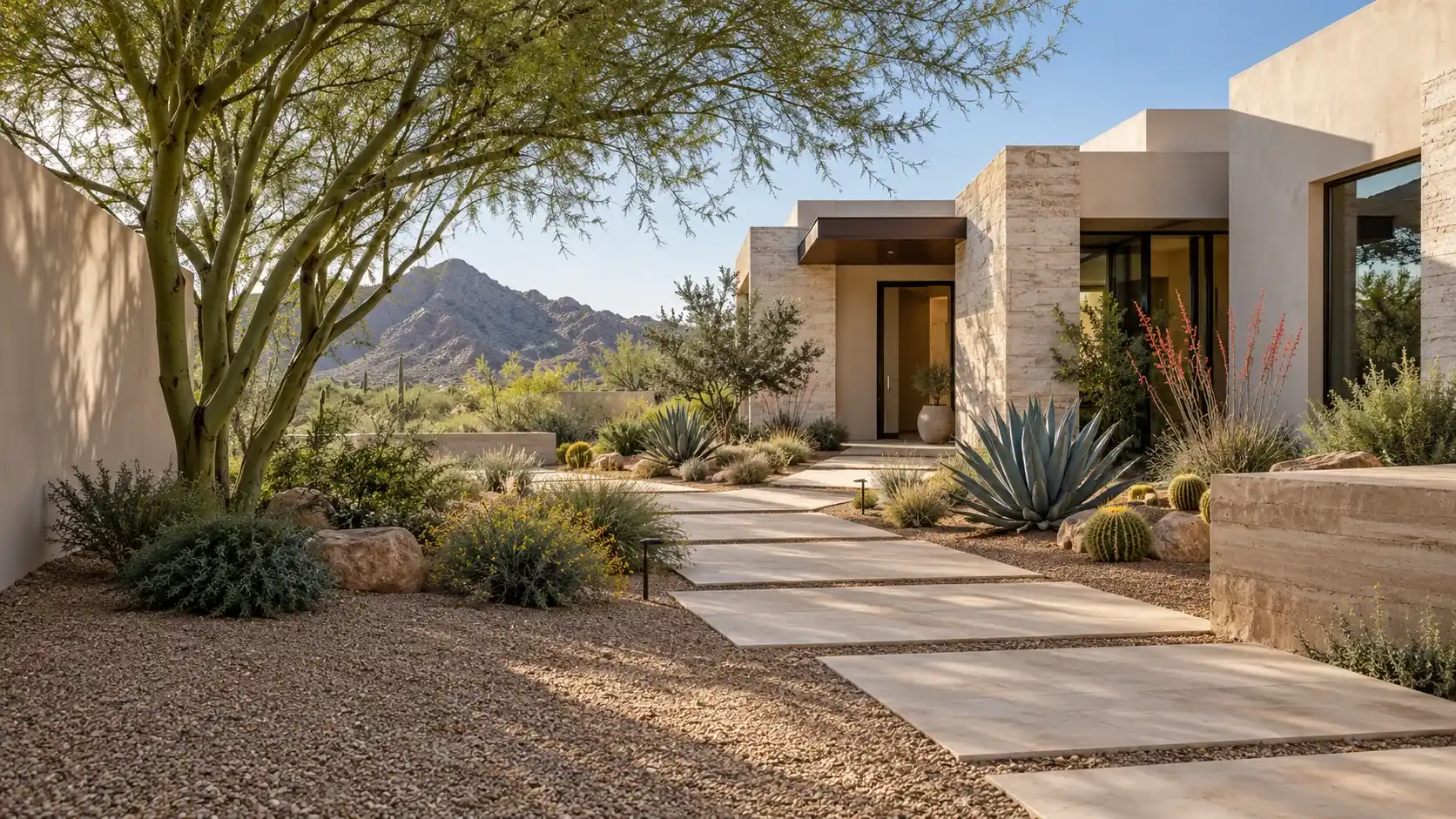
Service area · Cave Creek, AZ
Landscaping in Cave Creek, AZ
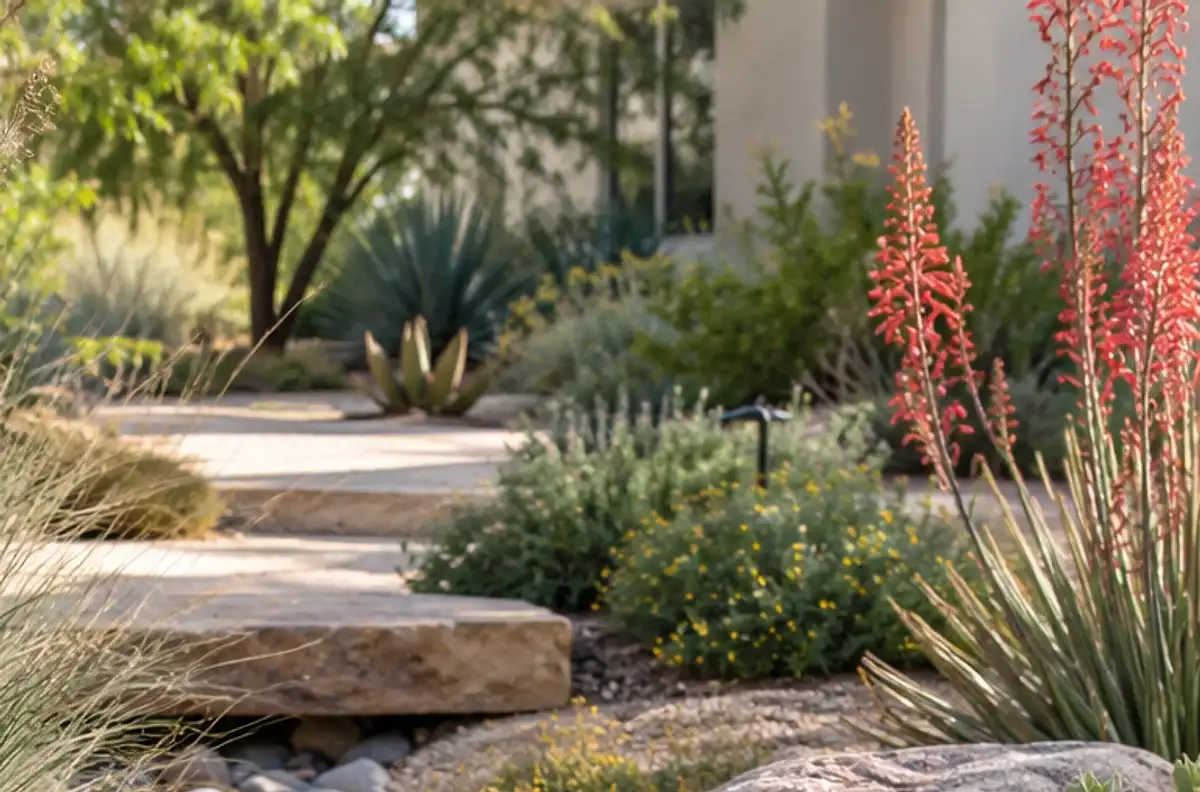
Landscaping in Cave Creek means acre lots, dirt drives, and a town water system that stops at the edge of some parcels. The 12 ft native habitat corridor runs inside the property lines of Desert Rural lots, and that first strip of a yard stays in its natural state. Wells, corridor setbacks and haul distance set the budget.
Service area
How large are the lots, and what does that allow?
Cave Creek lots run from DR-43 at 43,000 sq ft up to DR-190 at 190,000 sq ft, and that range sets the character of the town (Cave Creek residential zones (opens in a new tab)). A 4 acre lot is not a farm, but it is enough for a horse, a shop, a long dirt drive and a yard nobody mows in one pass. Fences sit 12 ft inside the property line on Desert Rural lots, so the street reads as open desert rather than a row of walls. Much of the town has no sidewalk, and many shoulders are graded gravel. Landscaping is usually a choice between keeping that open look and fencing a smaller area close to the house.
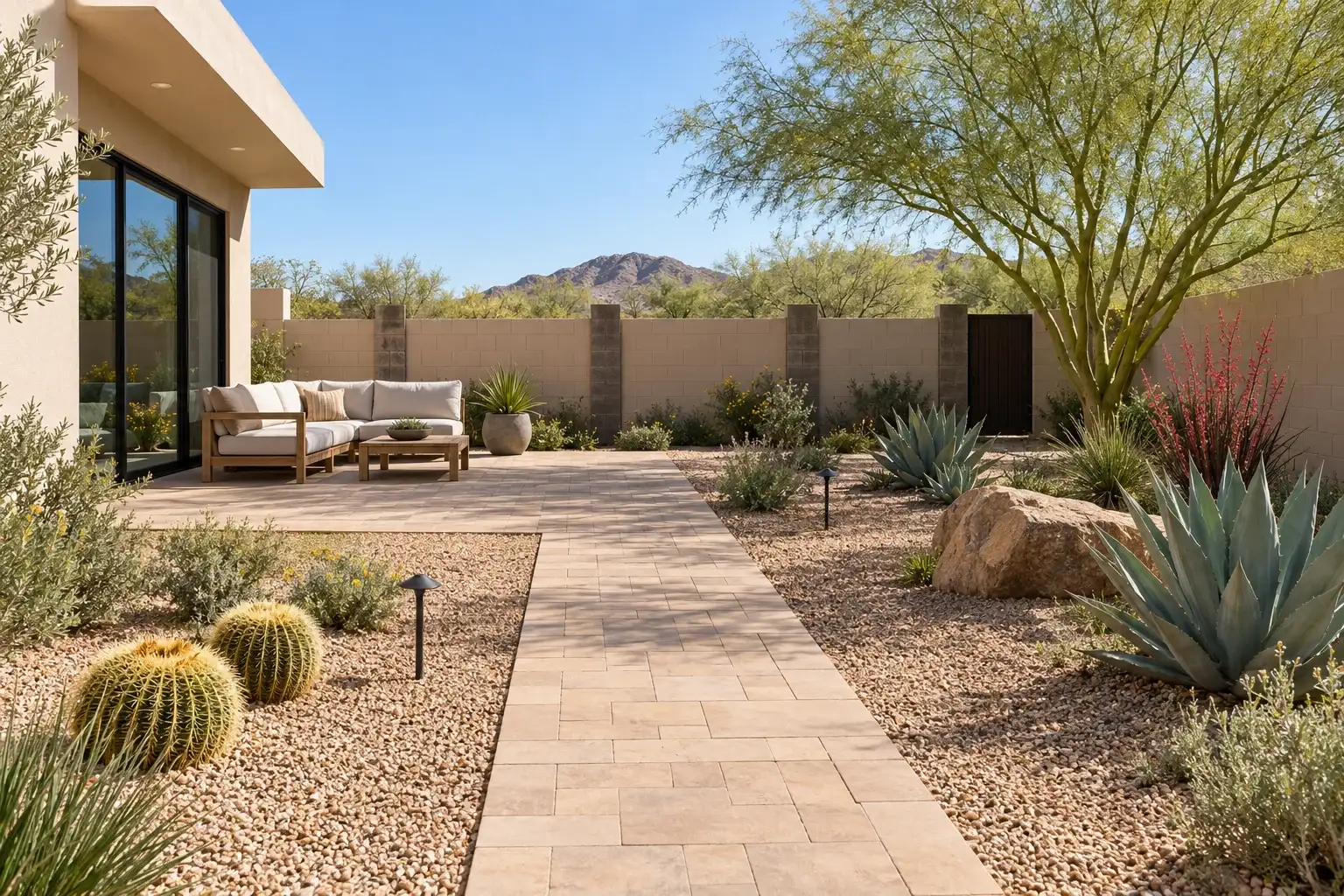
Water
Is the water from the town system or a well?
The town utility runs on the Central Arizona Project for about 95 percent of supply and has no active wells of its own, serving 2,549 customers, or 4,371 with the Desert Hills system (Cave Creek water supply FAQ (opens in a new tab)). Outside that service area, residents draw from private wells in the same shallow aquifer. That split decides how an irrigation system is designed. A town meter delivers a known pressure and flow; a well delivers what the pump and the water table give you that month, and the number can change after a dry spring. Test the well before you plant: flow in gallons per minute, static level and recovery. Hauled water is an option on some properties and is priced by the load.
Ground
What does the ground do to a planting plan?
The ground is granite, decomposed granite and caliche in the flats, with boulders that were in the hillside before the lot was graded. Decomposed granite drains fast and caliche can block drainage (University of Arizona, managing caliche (opens in a new tab)). Both can sit on the same acre, which is why a planting plan done from a photo can fail. The field test is a hole that drops 4 inches in 4 hours. Washes cross a lot of these parcels, and a wash is not a drainage ditch. It is a natural channel that should stay clear, because an obstruction can move floodwater toward the house instead of past it. Check for one before siting a wall.
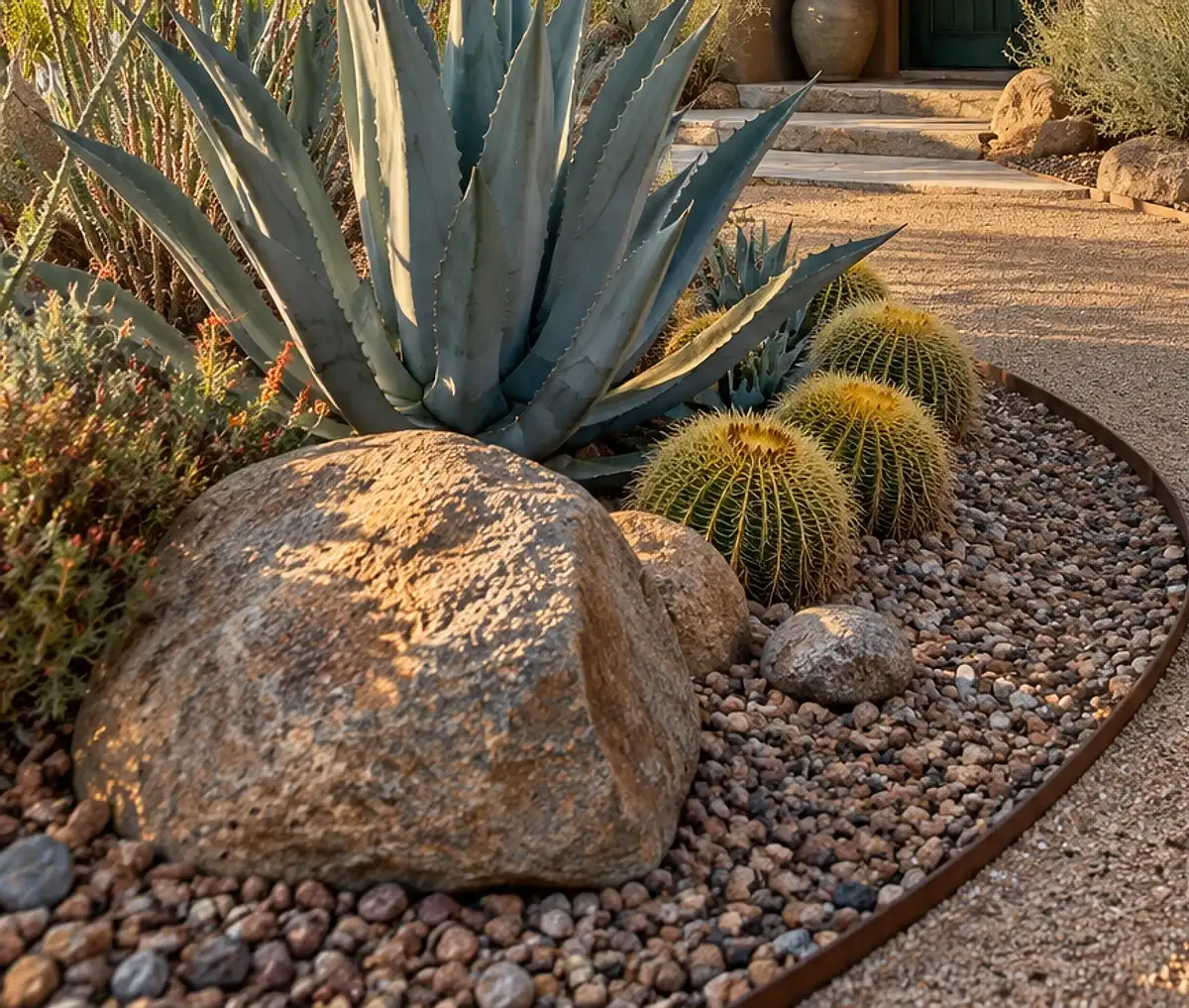
Rules
How does the native habitat corridor change a yard?
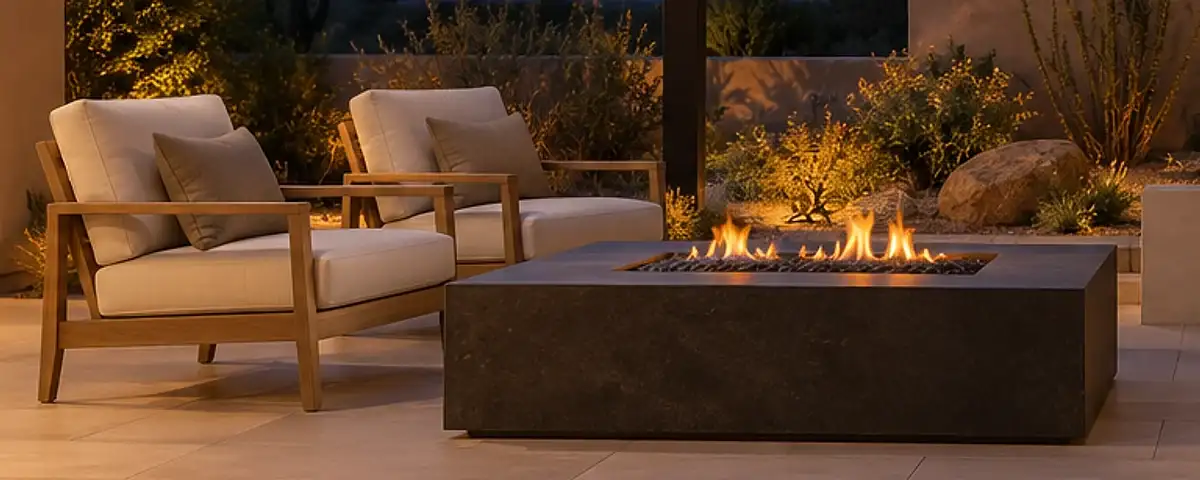
The 12 ft native habitat corridor shapes how a Cave Creek yard is laid out. Every Desert Rural lot keeps a 12 ft strip inside all property lines in an undisturbed natural state, with exceptions such as driveway access and utility lines, and any revegetation uses plants from the town's landscaping guideline (Cave Creek residential zones (opens in a new tab)). A fence, wall or gate needs a Zoning Clearance, a fence above 5.5 ft or a wall above 4 ft also needs a building permit, and Desert Rural fences sit at least 12 ft inside the line, which puts the fence at the inner edge of the corridor. Outdoor lighting has to be fully shielded and aimed down, with the bulb not visible from the street or a neighbor, and dusk to dawn lights are prohibited (Cave Creek outdoor lighting (opens in a new tab)). Read those three together before you draw anything, because they overlap.
Climate
How do the nights differ from Scottsdale?
At about 2,130 ft, the town runs roughly 870 ft above Scottsdale, and the nights are the first difference you notice. Summer evenings cool off enough to sit outside, and the fall planting window runs longer than it does down in the valley. Winter is another matter: at this elevation a clear still night can drop below freezing, and a plant that comes through a valley winter can be damaged here. Wind crosses the open lots with nothing to break it. Monsoon rain arrives in short hard bursts, and on ground this steep most of it runs off rather than soaking in, so berms and drainage matter more than a longer irrigation schedule. Design for a freezing night and a 105 degree afternoon.
Costs
What does xeriscape cost on an acre?
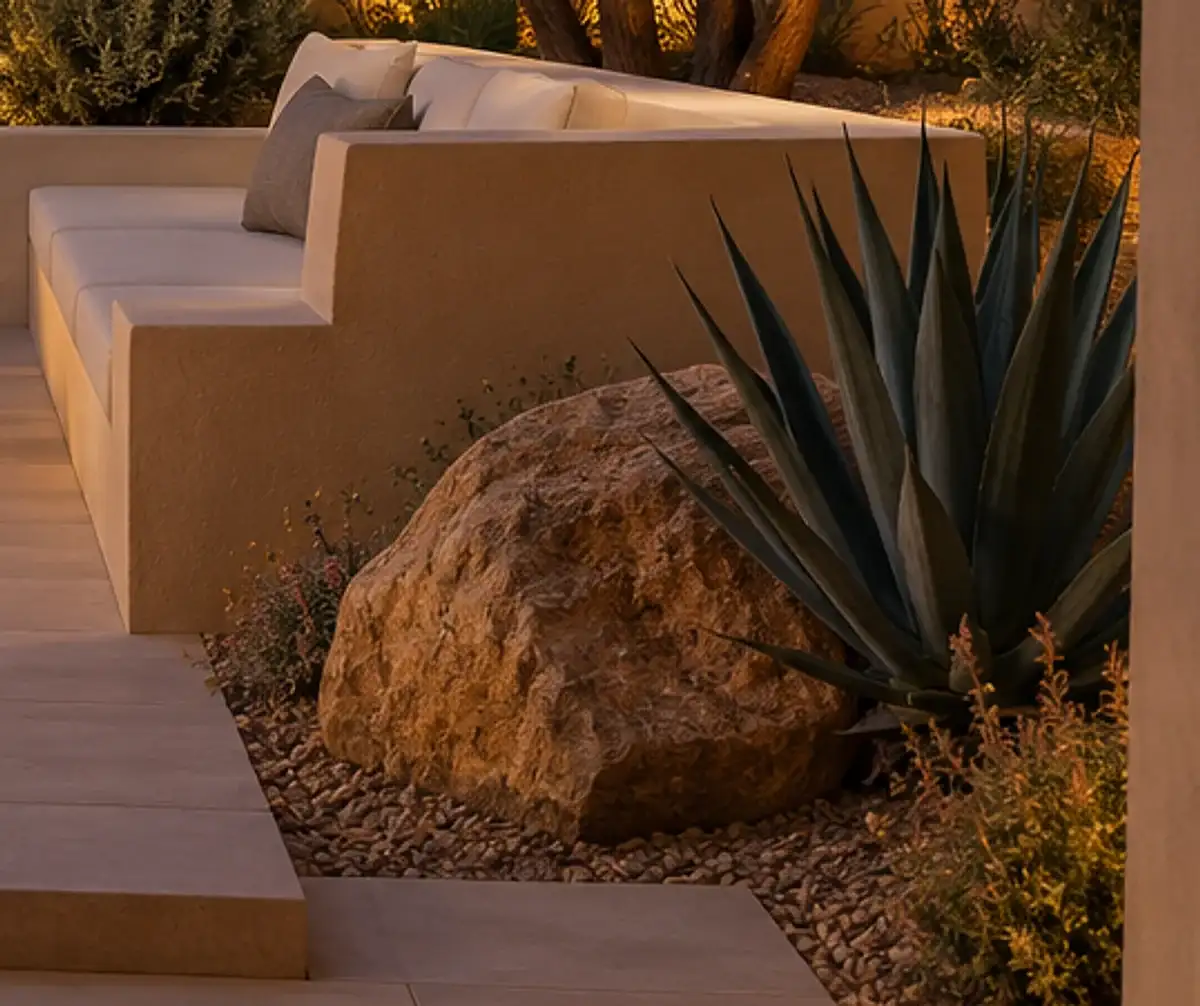
Xeriscape is a common scope on an acre, and it is priced by the square foot of ground actually treated. A national cost guide puts the range at $5 to $20 per sq ft, or $5,000 to $24,000 for a project, with an average near $17,000, and desert style work quoted separately at $8,000 to $18,500. On 43,000 sq ft the whole parcel rarely gets treated. The number that matters is the area around the house; the rest stays native with a few cleared paths. Published market ranges, not a quote: the final price is set after an on-site assessment. The low end can be gravel and small plants, and the high end boulders, specimen cacti and a sculpted wash.
Planning
What has to be in place before work begins?
Order matters here more than on a flat lot. Confirm the water source first, because a well and a town meter lead to different irrigation designs. Pull the zoning and draw the 12 ft corridor on the site plan before anyone stakes a fence; the fence, the wall and the plantable area all move inward once that line is on paper. Decide the lighting early, since shielded fixtures and a dusk to dawn prohibition limit what a security plan can do. Price a well test if the parcel is outside the town system. Plan the drive and the turnaround for a truck and a trailer, because on 4 acres the delivery is the easy part and the last 200 ft is not.
3 questions
Questions people ask
Still have a question? Call (747) 243-2089 and describe the yard.
Do I need a permit to fence my lot?
The town requires a Zoning Clearance before a fence, wall or gate goes up. A fence above 5.5 ft or a wall above 4 ft also needs a building permit, and on Desert Rural lots a fence sits at least 12 ft inside the line, at the inner edge of the native habitat corridor. Ask before you set posts, because moving a line later is the expensive version.
Why is my well water different from my neighbor's?
Wells draw from the same shallow aquifer, but depth, casing and pump settings differ, so two neighboring wells can deliver different flow and different mineral content. Test flow, static level and recovery before an irrigation design. A system sized for 15 gallons a minute fails on a well that makes 6.
What outdoor lighting is allowed?
Fully shielded fixtures aimed down, with the bulb not visible from the street or from a neighbor's property. Dusk to dawn lights are prohibited outright. Set the fixtures before the trees go in, and ask the town about a fixture before you buy one.
Keep reading
- Landscape Installation: for the build sequence.
- Irrigation and Sprinkler Repair: for zones and pressure.
- Patios and Pavers: for walls and paving.
- Landscaping Cost: for the published table.
- North Scottsdale: for the area south.
- Xeriscape vs Gravel in Scottsdale:
- Drip Irrigation vs Sprinklers in Scottsdale: