Guide 03 · 5 min read
Drip Irrigation vs Sprinklers in Scottsdale, AZ
Drip puts water at the roots, slowly, and sprinklers throw lawn sized water through the air where the July heat evaporates it. After a lawn to xeriscape conversion, sprinklers left in place drown the new plants on one side and starve them on the other, which is the failure this page is really about.
Good to know
The short answer
Drip wins for trees, shrubs, and anything planted in a xeriscape, and it loses the second hard water and caliche show up unchecked. Sprinklers belong on grass, and almost nowhere else. The right choice depends on the soil, what is planted, and whether the system is being built or just left over.
Water
Drip irrigation: what it actually is
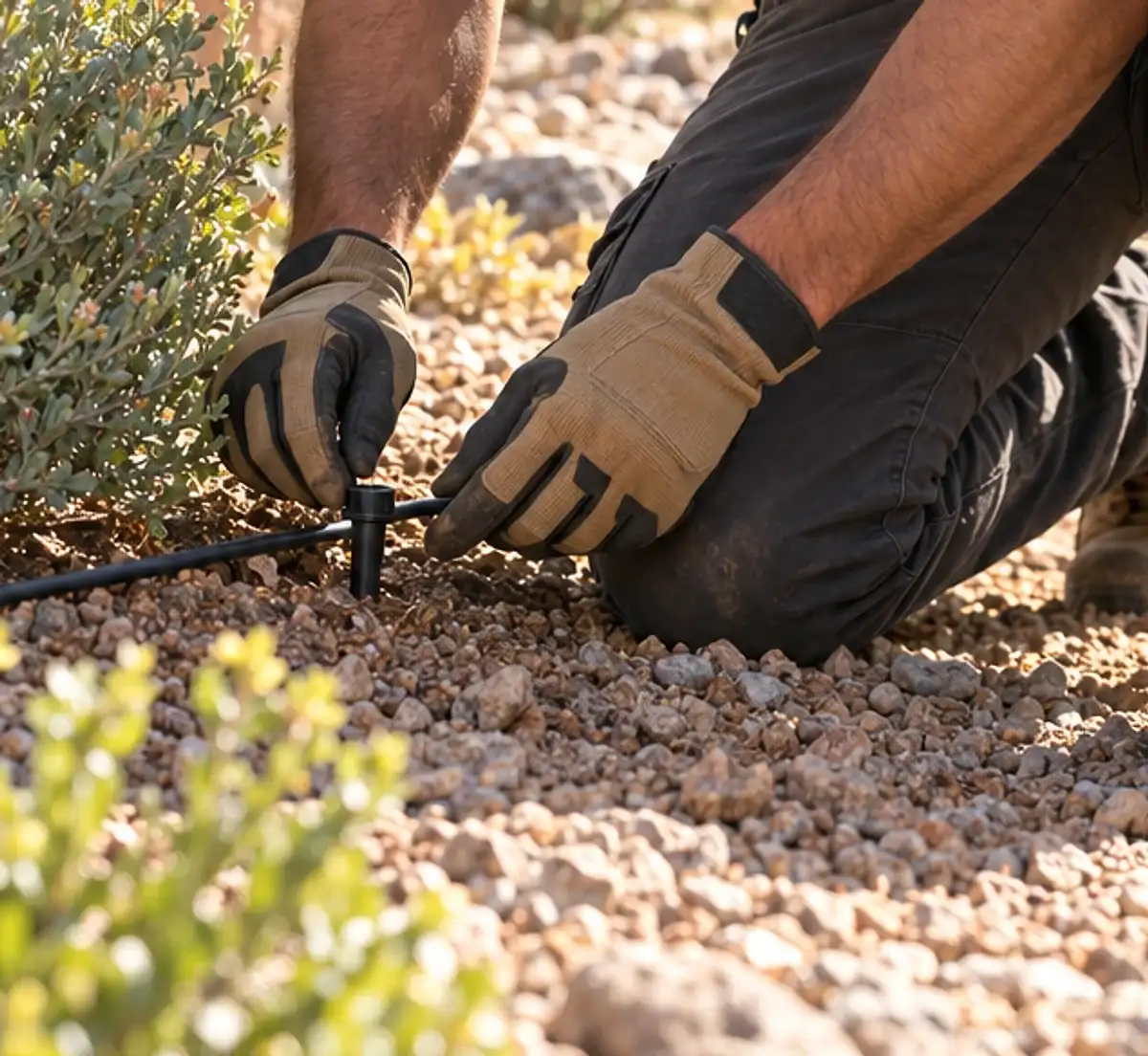
Drip is a low pressure network of tubing and emitters that delivers water one drop at a time to the root zone of a specific plant. Little water, applied slowly, at the root. Nothing thrown in the air, almost nothing lost to evaporation, and the plant gets deep slow drinks instead of a splash. That is the whole mechanism.
The tradeoff is the emitters. They clog, and in Scottsdale hard water is the clogger. The mineral content in the water leaves scale on everything it touches, and a drip emitter is a tiny hole built for scale to find. Scale builds fast in summer when the system runs often, and a filter that nobody checks is the same as no filter at all.
Water
Sprinklers: what it actually is
Sprinklers are heads that throw water through the air in a pattern, usually sized for turf. The throw is the point and the problem. Water arcs, wind moves it, and in a Scottsdale summer a share of it evaporates before it lands. What lands lands everywhere, not at a root, which is fine for grass and wrong for nearly everything else.
The deeper problem is what a sprinkler system assumes. It assumes a lawn. The zones, the run times, and the head spacing were all chosen for turf, and they do not translate to a planted xeriscape bed. In a zone 9b summer the air that water passes through is doing the yard no favors either.
Water
Where drip irrigation fails here
Hard water is the first failure. Scale builds in emitters and lines, and a single clogged emitter starves one plant while the rest of the zone looks fine. The failure is quiet, because the plant browns slowly, and by the time it is obvious the emitter has been blocked for weeks. The answer is filtration and a maintenance schedule, which most systems do not get.
Caliche is the second. The cemented calcium layer under much of the East Valley stops water infiltration, so a drip emitter on top of it wets a plate, not a root zone. The planting holes have to be dug through the caliche and the emitters placed where the water can actually move, or the water is wasted where the plant cannot reach it.
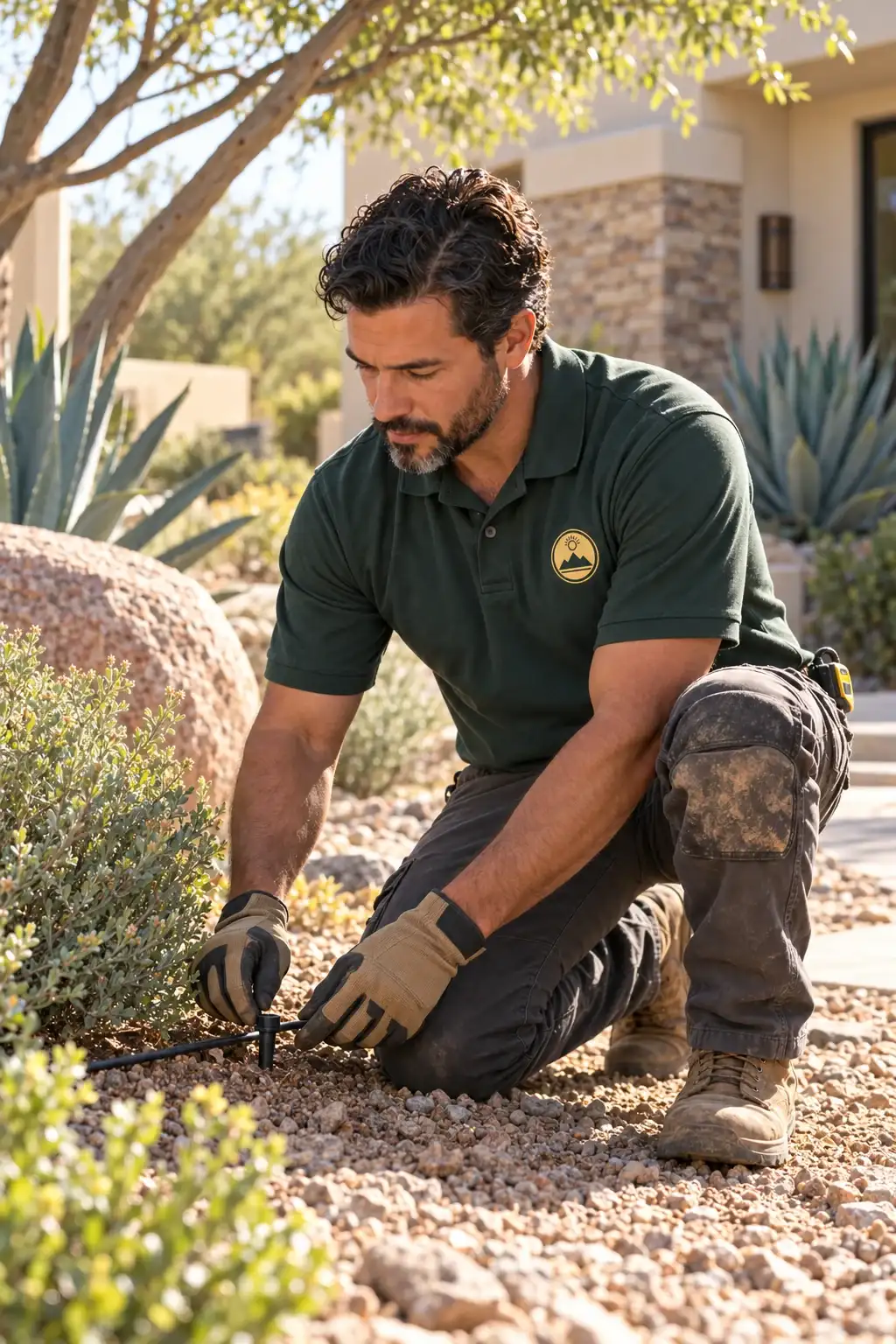
Neglect is the third. Drip is buried and quiet, and nobody checks it until something dies. Granite that migrates without edging buries and kinks the tubing, and a buried emitter waters gravel instead of a plant. The schedule gets set once and forgotten, the seasons change, and the plants quietly run out of water. A drip system needs a look every season, not just when something turns brown.
Water
Where sprinklers fail here
Evaporation. Air in July runs past triple digits, and water thrown through it loses a share before it lands. In the monsoon, the wind arrives first, and the same throw that covers the lawn covers the block wall, the paver edge, and the neighbor's side of the fence instead.
Overspray. Hard water makes the overspray permanent: every head that throws onto a stucco wall, a window, or a pool tile leaves mineral scale, and the stain stays. In a city with the strictest design review in the Valley, a scale stained wall on a front yard is exactly the kind of thing that gets noticed.
The lawn mindset. Sprinkler heads sized for a lawn stay in place after a conversion, and the new plants get lawn water: too much on one side, none on the other, because the zones were drawn for grass, not for plants with their own water needs. That is the number one irrigation failure in Scottsdale yards, and it is a design problem wearing a hardware disguise. Fix the heads and you fix the symptom. Redraw the zones and you fix the yard. Most conversions do the first and skip the second, and the water bill shows it.
Costs
What it costs and what drives the number
Drip costs more in parts and less in water, and over a Scottsdale summer the water side of the ledger is the one that moves. Sprinklers cost less to put in and more to run, and the evaporation loss means you pay for water the plants never see. The drivers are the same as any yard system: how many zones, how much caliche has to be dug through for the lines and the holes, and whether the controller is set for the yard as it is now.
The conversion is the expensive case. Reworking a lawn system to drip is real work, and the landscaping cost page covers what a conversion runs. Skipping the conversion is more expensive, because the plants bought for the new yard die on lawn water. Whatever the number, the range matters less than the design. Two systems can cost the same and water completely different yards, because the design decides where the water goes, not the hardware.
Good to know
What good work looks like in Scottsdale
- The irrigation is designed around the plant list, not the other way around, with drip on the planting and sprinklers only where grass remains.
- Filtration and a maintenance schedule are part of the plan, because hard water and scale are the local clogger.
- Planting holes get dug through caliche and emitters placed where water can move, not on top of a sealed layer.
- The controller is set for the yard as it is now, not as it was, so nothing gets lawn water after the lawn is gone.
6 questions
Drip Irrigation vs Sprinklers: your questions
Still have a question? Call (747) 243-2089 and describe the yard.
Is drip or sprinkler better in Arizona?
Drip, for everything except grass. The evaporation loss on sprinklers in summer heat is real money, and drip puts water at the root where the plant can use it.
Do I still need sprinklers after a xeriscape conversion?
Only where grass remains. The old turf zones need to go, because they deliver lawn water to plants that do not want it. See xeriscape vs gravel for how the conversion fits together.
Does hard water clog drip systems?
Yes, and scale is the main local clogger. Filtration and a maintenance schedule are what keep emitters open, and without them one clogged emitter starves one plant quietly.
Can I water native plants with sprinklers?
Poorly. Natives want deep infrequent water at the root, and sprinklers throw shallow water everywhere. The plant survives, but it is the wrong water in the wrong place.
How often should drip run in Scottsdale?
It varies by plant, season, and soil, and the caliche depth changes it lot by lot. The schedule is set per zone, not per neighborhood, which is why a one size answer is the first sign of a bad design.
Does drip cost less than sprinklers to run?
Yes, usually, because less water goes into the air. The parts cost more up front, and the savings show on the water bill through summer. If grass is staying, the sod vs seed question comes first.