Service 04 of 06 · Scottsdale, AZ
Irrigation and Sprinkler Repair in Scottsdale, AZ
You have a wet patch, a dry zone or a clock that runs while the yard stays dry. Tell us which zone is failing, and someone from our team will call you back to plan the fix.
What you get
Sprinklers that water the yard, not the sidewalk
Sprinkler problems in Scottsdale often show up as a wet patch, a dry zone or a clock that runs while the yard stays dry.
- The valve, line or head that failed, found and replaced
- A valve that closes, so the zone stops when the clock moves on
- Drip in the beds and spray or rotors on the turf, so each plant gets its own kind of water
- Valves split by plant type, so a mesquite and a lawn stop sharing one schedule
- Run times set for each season, and a smart controller when you want one: the city lists a rebate of up to $250
Check your yard
5 signs your sprinklers need repair
- A wet patch that stays wet for days after the clock moves on.
- A dry zone, even though the clock says it ran.
- Water on the sidewalk or the wall from a head that sank or tilted.
- A strip of greener grass or a sunken line of gravel over a pipe.
- A July clock still running in January.
3 steps
How it works
Tell us what you need
Send the form or call. Give the address, the ZIP code and what the yard should do.
We call you back
Someone from our team goes over the project, the budget and the timing with you.
Your repair gets planned
The zone, the fix and the price are set in writing and put on the calendar.
Costs
What does a sprinkler repair cost in Scottsdale?
A sprinkler repair runs $137 to $422, with an average of $278, and repair labor is $50 to $100 an hour, according to a national cost guide. Published market ranges, not a quote: the final price is set after an on-site assessment. The hourly rate explains the small jobs. Many companies carry a 1 hour minimum and bill in 15 or 30 minute increments after that, so a 20 minute fix lands as an hour plus the drive. The part is rarely the cost. A valve or a handful of drip emitters is a few dollars, and the labor is finding the valve under gravel, tracing a lateral through caliche, or digging out a head a mower buried. The minimum, the travel time and a second trip for parts are the lines that change a small repair bill.
Water
What breaks most often in a Scottsdale irrigation system?
4 failures are common. Clogged drip emitters are the first: this water carries dissolved calcium, and an emitter rated at 1 gallon an hour can clog. A valve that will not close is second, usually a torn diaphragm or grit on the seat, and it shows as a zone that stays wet for days. Third is a lateral line cracked by a shovel or lifted by a tree root, and mesquite and palo verde roots travel wide enough to find a trench. Fourth is a head that has sunk or tilted, which throws water onto the sidewalk or the wall. Heads settle when the soil under them erodes, and a mower clips the ones that sit too high. None of the 4 is usually expensive to fix. Finding the problem is the hard part.
Water
Water is running and will not shut off at the head. What do I do first?
Close the zone valve, not the head. Walk the valve box, usually a green or gray round lid near the street or at the corner of the lawn, lift the lid, and turn the solenoid a quarter turn or tighten the bleed screw on top. That usually stops the zone. If the box is full of water or the valve will not move, go to the irrigation shutoff at the point of connection: a ball valve on the riser beside the water meter, often in a concrete box at the front of the lot, sometimes below a backflow assembly. Turn it a quarter turn. If the lid is buried under gravel, a screwdriver finds the edge faster than a shovel. If that fails, shut the house main at the wall. Then describe the problem by phone or form.
Water
How do I find an irrigation leak without digging up the yard?
The 2 tests take about 20 minutes. Meter test: shut every fixture and the irrigation clock, then watch the leak indicator on the meter for 10 minutes. Any movement means water is passing somewhere. Zone test: with the clock off, open one zone valve at a time by hand and watch the meter, then close it. A zone that keeps the meter moving after the valve is shut points at that valve. A zone that moves it only while running points at the line or the heads. Then walk the yard. A strip of greener grass, a sunken line of gravel or a soft spot over a lateral narrows the search to a few feet. Note which zones moved it and how fast. That list is the diagnosis. Probe with a screwdriver, not a shovel.
Water
Drip, spray or rotors: which one belongs in my yard?
Drip for shrubs, trees and anything in a bed. Spray heads and rotors are for turf. A spray head throws a short distance and puts out gallons per minute, a rotor throws farther and turns slowly, and drip emits gallons per hour at the plant. The difference matters here because spray loses water to wind and evaporation before it lands, and this water leaves a calcium film on walls and car glass. Drip puts water at the root zone with no overspray, so a bed can run at 6am in a breeze and still deliver what the clock promises. Rotors are the better turf choice on a large lawn, since they cover more ground per head with less mist. A bed with spray heads is the first thing to change.
Water
Can I convert a spray zone to drip, and what does the work cover?
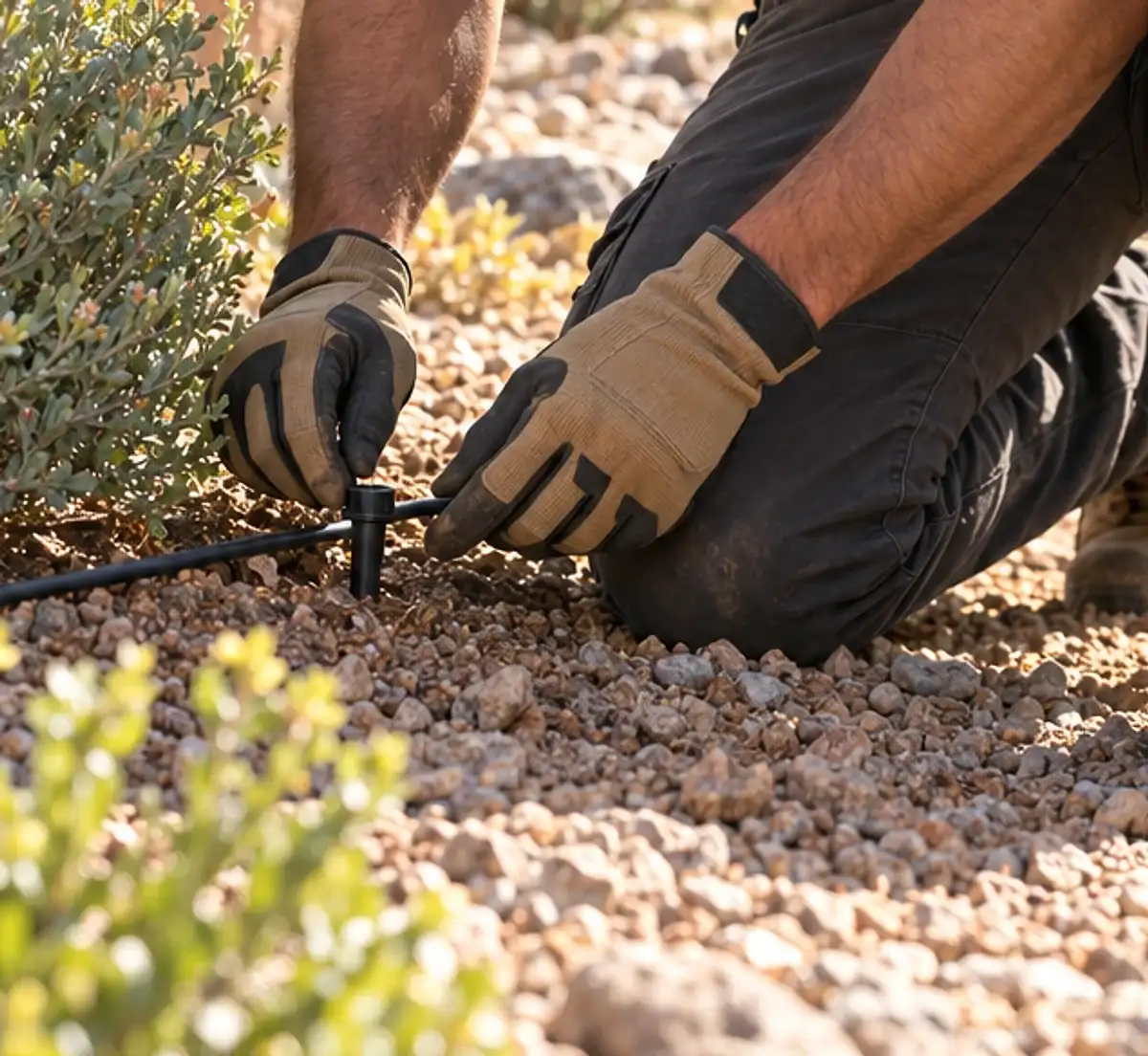
Yes, and it is often the cheapest water saving move on an older lot. A zone conversion runs $300 to $1,200, and a drip system on its own is $200 to $850, with an average of $350, or $0.50 to $5 per square foot, according to a national cost guide. Published market ranges, not a quote: the final price is set after an on-site assessment. The work: cap or remove the spray heads, tie half inch poly into the existing lateral, add a filter and a pressure regulator at the valve, punch in emitters sized to each plant, flush the line, then set the run time. The trench and the valve already exist, which is why conversion beats a new system.
Water
What is a hydrozone, and why can't trees and turf share one?
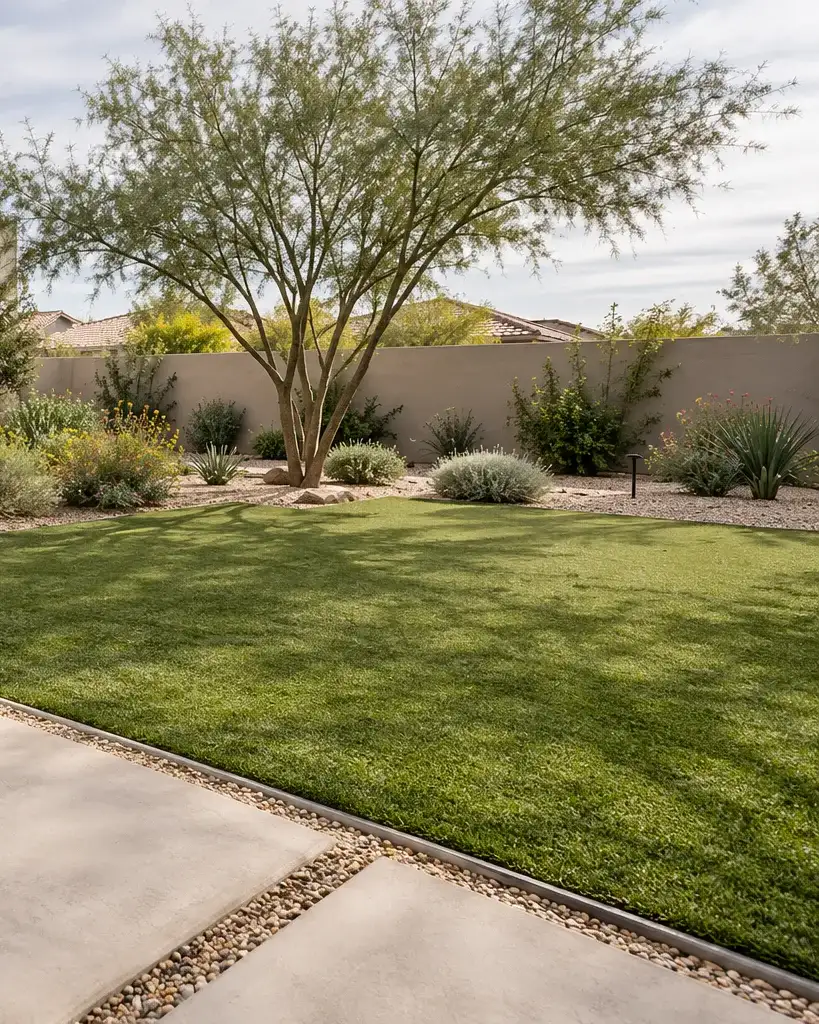
A hydrozone is a set of plants with the same water demand, on their own valve. Turf is the thirstiest thing on a Scottsdale lot: a Bermuda lawn with overseed takes over 55 inches of irrigation a year, while a xeriscape planting stays under 18 (University of Arizona, turf and xeriscape water use (opens in a new tab)). Put a mesquite on the turf valve and one of them loses. The lawn sets a frequent summer schedule, which is far more water than a desert tree wants, and the tree can pay for it in root rot or a shorter life. Split the valves by plant type, sun exposure, soil depth and slope. A slope makes it worse, because water runs off before it soaks in. Give each valve its own run time.
Timeline
How should I reset the clock for each season?
Set the minutes by month, not once in spring. January needs a fraction of July: Bermuda is dormant, the desert trees are slow, and the air is cool. A common waste is a July clock still running in January, which pours summer minutes onto a dormant yard, keeps the soil cold and wet, and can run much of it off the curb. Many controllers have an adjust button that shifts every run time by a percentage. Use it in October and again in March. Run turf and beds between 4am and 7am, when wind is low and pressure is steady. Add a rain sensor, then shut zones off by hand after a storm, because the monsoon runs June 15 to Sept 30 and, across most of the Desert Southwest, brings about half the year's rain (National Weather Service, monsoon (opens in a new tab)).
Water
Do smart controllers help, and is there a rebate?
Yes, and the city pays part of it. Scottsdale lists a WaterSense smart controller rebate of up to $250 on its residential rebate page (City of Scottsdale, residential rebates (opens in a new tab)). It also offers an Outdoor Water Efficiency Check for Scottsdale Water customers, one per property, where staff read the meter and the irrigation clock with you (City of Scottsdale, water conservation for homeowners (opens in a new tab)). A smart controller earns its price 2 ways: it adjusts run time to the weather instead of the calendar, and it shows a zone using more water than it should. A model that reports flow, not just one that reads the weather, can help find a weeping valve before the bill arrives. Confirm the current terms on the city page before you buy.
Bids and scope
Is irrigation repair enough, or does my old system need a redesign?
Repair it if one valve, one line or a set of heads has failed and the other zones still run at steady pressure. Redesign it if the parts have outlived the layout. The signs: valves buried in dirt with no box, one valve feeding both a turf lawn and a bed of desert trees, pipe sizes that change 3 times, a backflow assembly that no longer holds, and a controller with no seasonal adjust. Age alone is not the test, since a 25 year old system with matched heads and clean valves can still run. A redesign keeps the trench and the tap and replaces the wet side: valves, lateral, heads, drip and a clock with more than one program. That is the point where a repair bill stops being the smaller number.
Costs
What does a new irrigation system cost?
A full sprinkler installation runs $1,636 to $3,595, with an average of $2,549, or $0.20 to $1 per square foot of lawn, according to a national cost guide. Published market ranges, not a quote: the final price is set after an on-site assessment. The per square foot number moves with shape and access. A yard cut into strips by a driveway, a pool and a wall takes more heads, more pipe and more fittings for the same square footage than one open rectangle. Add the drip zones for the beds, priced separately, and a backflow assembly if the property does not have one. Small yards can pay the high end, because the tap, the backflow and the valve box do not shrink with the lawn.
Rules
Where does Scottsdale's water come from, and what are the rules?
About 90 percent of the city's drinking water is surface water from the Central Arizona Project and the Salt River Project, and CAP alone supplies about two thirds (City of Scottsdale, water supply (opens in a new tab)). Scottsdale is in Stage One now, which is monitoring, not cutbacks (City of Scottsdale, drought stage (opens in a new tab)). The plan lists watering day limits only at higher stages: 3 days a week at Stage 2, 2 days at Stage 3, and an end to turf irrigation at Stage 4 (City of Scottsdale, Drought Management Plan (opens in a new tab)).
4 questions
Questions people ask
Still have a question? Call (747) 243-2089 and describe the yard.
How long does a sprinkler repair take?
A single zone repair is often a short job once the valve is found. Finding it is the variable. A valve box under gravel or a lateral run through caliche can add time.
Why is one zone wet all the time?
A valve that does not close all the way. Grit on the seat or a torn diaphragm lets water creep past, so the zone seeps for hours after the clock moves on. It reads as a leak in the line, but the line can be fine. Rebuild the valve rather than digging.
Can I water in the middle of the day?
The Drought Management Plan lists no time of day rule, and its watering day and duration limits start at Stage 2, while Scottsdale is in Stage One. Midday water still costs you, because wind and sun take a share before it reaches the root. Early morning is cheaper.
How often should drip run in summer?
Established trees and shrubs need water about once a week in summer, and desert-adapted plants even less often (AMWUA, summer watering (opens in a new tab)). New plantings can need more frequent cycles for the first summer. Check the soil at 6 inches with a finger or a trowel before adding water.
Keep reading
- Landscaping Cost: for repair and install prices.
- Landscape Installation: for a full yard rebuild.
- Desert Landscaping vs Xeriscape: for plants that need less water.
- Trees That Grow in Scottsdale: for roots near buried lines.
- FAQ: for common questions.
- Sprinkler Repair in Phoenix: for Phoenix water rules and leaks.
- Drip Irrigation vs Sprinklers in Scottsdale:
- Xeriscape vs Gravel in Scottsdale: