Guide 03 · 6 min read
Desert Landscaping vs Xeriscape
In Scottsdale, desert landscaping and xeriscape get used as if they mean the same thing, and on an invoice they often do. They do not. One describes a palette, the other describes a method, and the gap between them is where gravel yards with 3 plants come from.
Good to know
What does each word actually mean?
Desert landscaping describes a palette: plants that come from the Sonoran Desert. Xeriscape describes a method: any planting designed to use less water than a conventional lawn, in any climate. The word was coined in Denver in the early 1980s by Denver Water, with the Denver Botanic Gardens and Colorado State University Extension, to promote native and drought tolerant planting (Denver Water (opens in a new tab)). It comes from xeros, Greek for dry. That history matters, because xeriscape was never meant to be desert specific. A xeriscape in Minnesota uses different plants from a xeriscape in Scottsdale and the same 7 principles. Desert landscaping, on the other hand, can waste water: a bed of desert plants on spray heads running daily is desert landscaping and a poor xeriscape at once. Both words get printed on the same invoice, and only one tells you what the yard costs to keep.
Planting
What are the 7 principles of xeriscape?
7 principles, and they are plain: plan the whole yard before planting; test and improve the soil; pick plants that fit the exposure and the water budget; keep turf only where it does a job, such as a play area; irrigate by zone with drip or matched heads; cover bare soil with mulch, at least 4 inches of organic mulch or at least 2 inches of rock or gravel (Denver Water, xeriscape principles (opens in a new tab)); and maintain at the level the planting needs. Gravel is one kind of mulch, not the plan. Turf is the principle that moves the water bill: a small lawn in the right place costs less to keep than a large one in the wrong place. Maintenance is the principle that is easiest to forget. A xeriscape pruned hard every spring stops being a xeriscape.
Good to know
Why is it misleading to use the words interchangeably?
Because gravel and 3 plants can be sold as xeriscape, and the label still sounds right. The result is a yard with no canopy, bare soil that bakes in summer sun, spray heads on a timer, and a homeowner who concludes that low water means ugly. That yard can waste water, because spray heads lose output to wind before it lands. The words also hide a design difference. Desert landscaping answers what belongs here. Xeriscape answers how much water the whole scheme consumes. A yard can be one, the other, both or neither, and the invoice rarely says which. The label also hides the biggest variable: a drip line laid on a schedule set in July stays wrong in December.
Planting
What does a real desert planting look like next to a gravel yard?
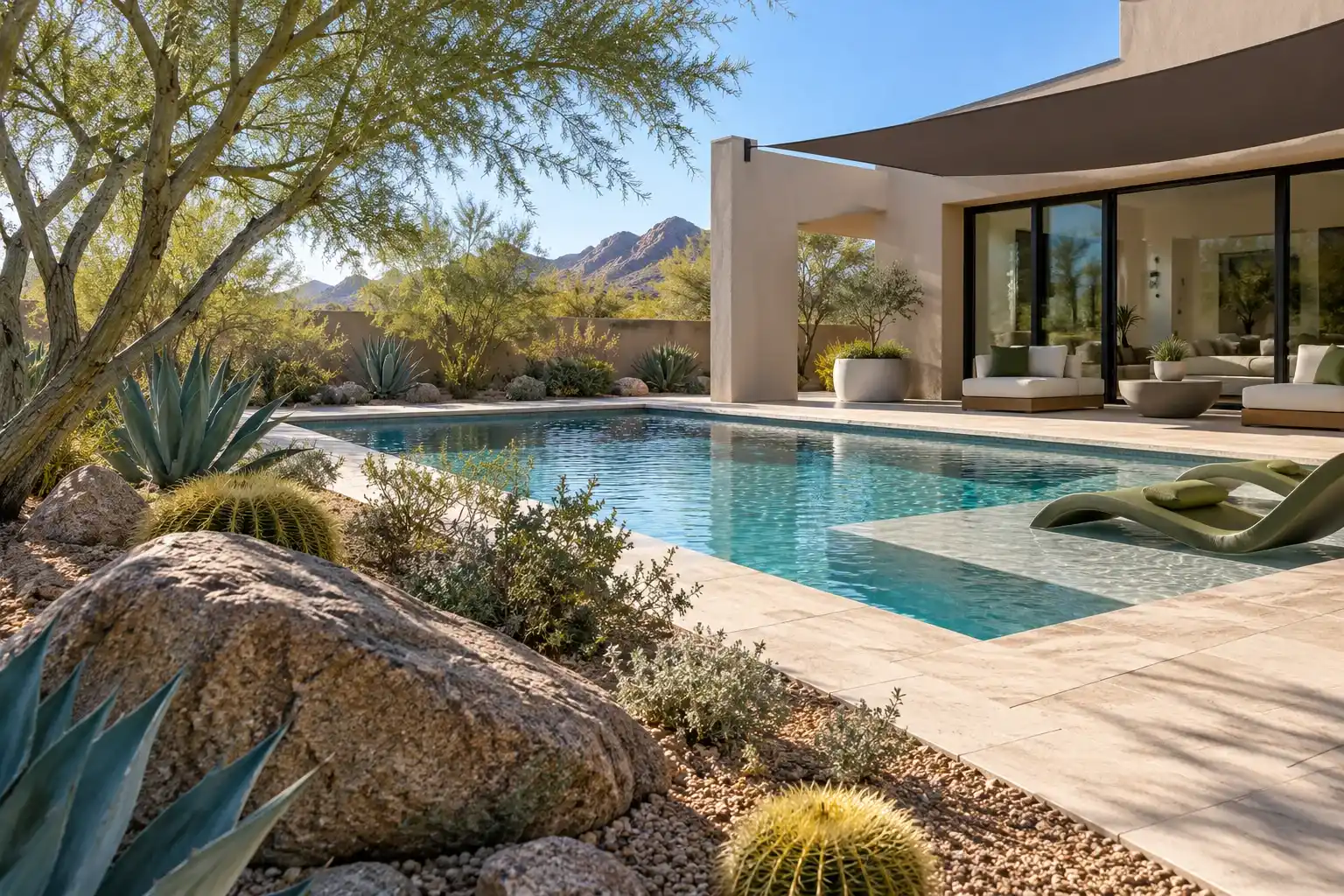
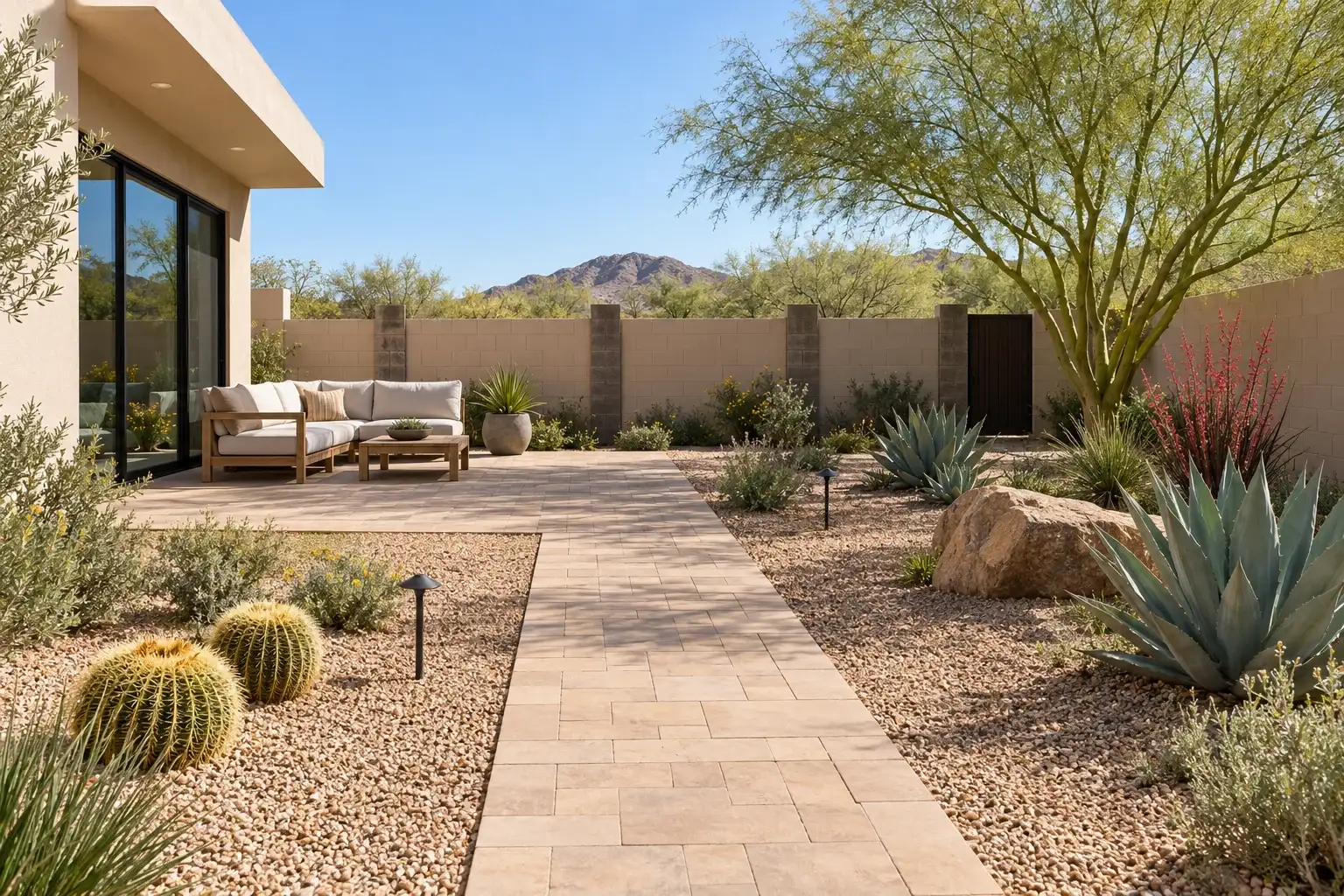
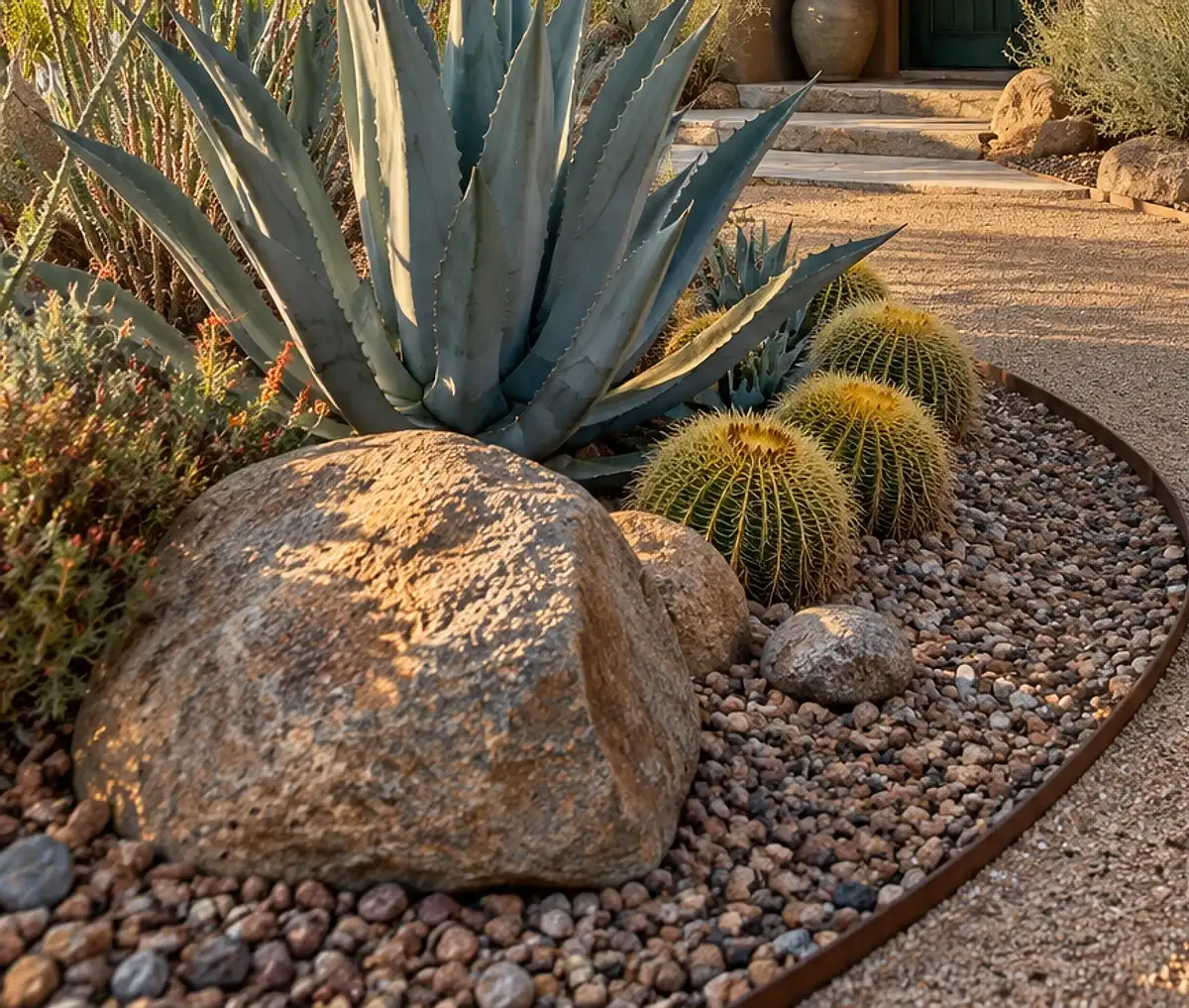
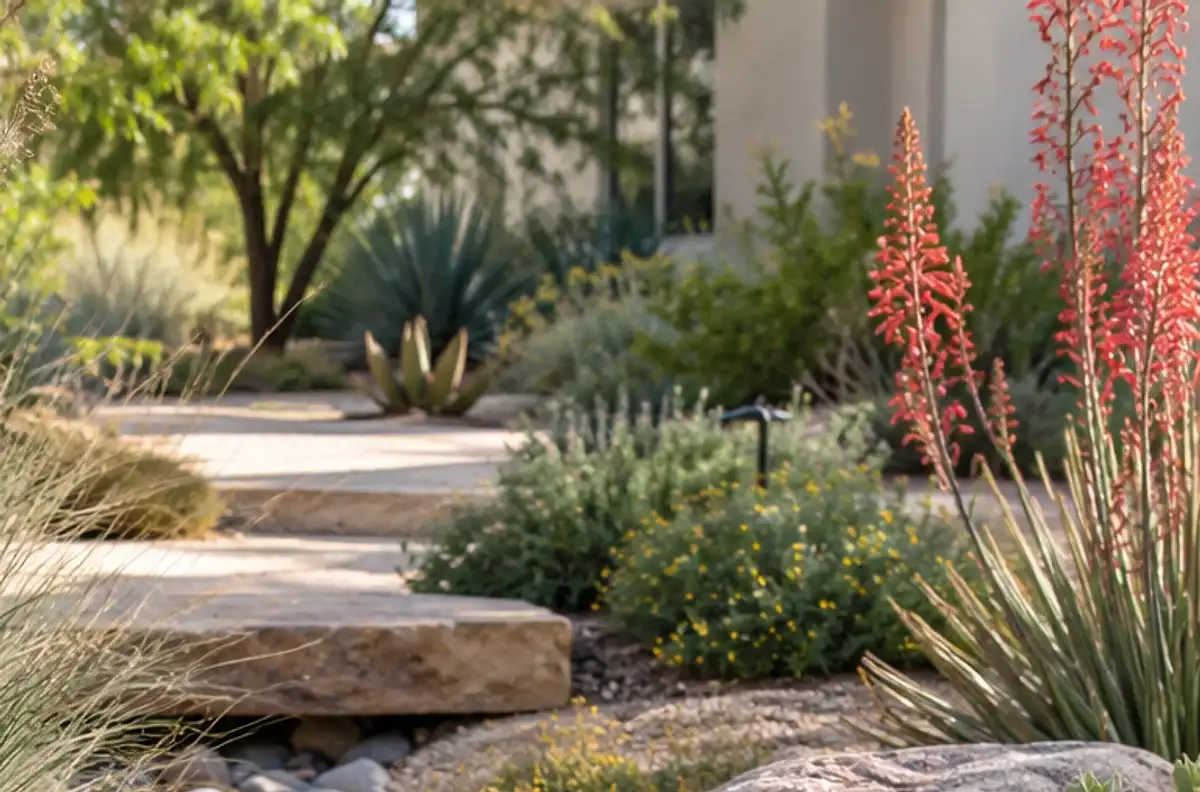
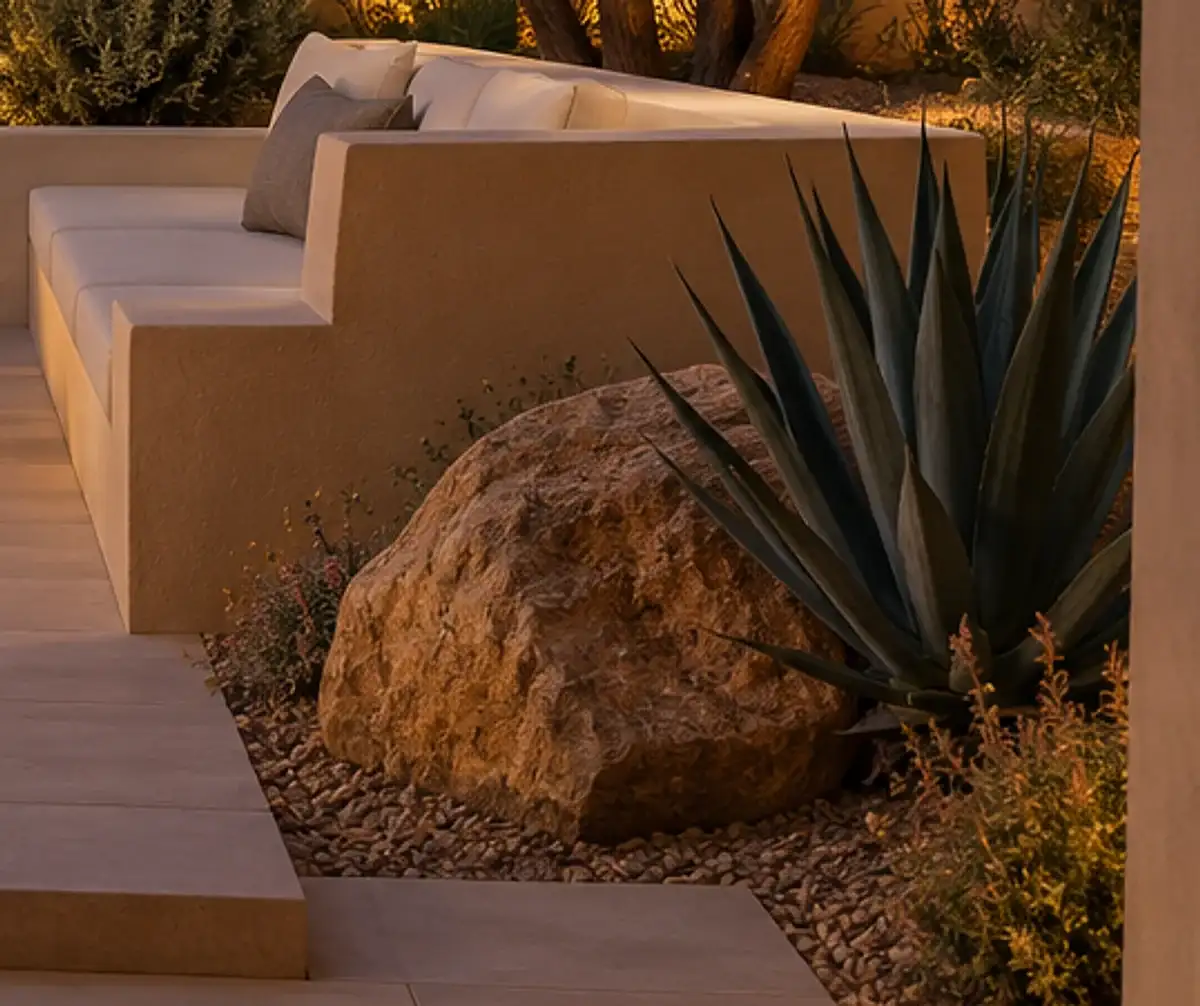
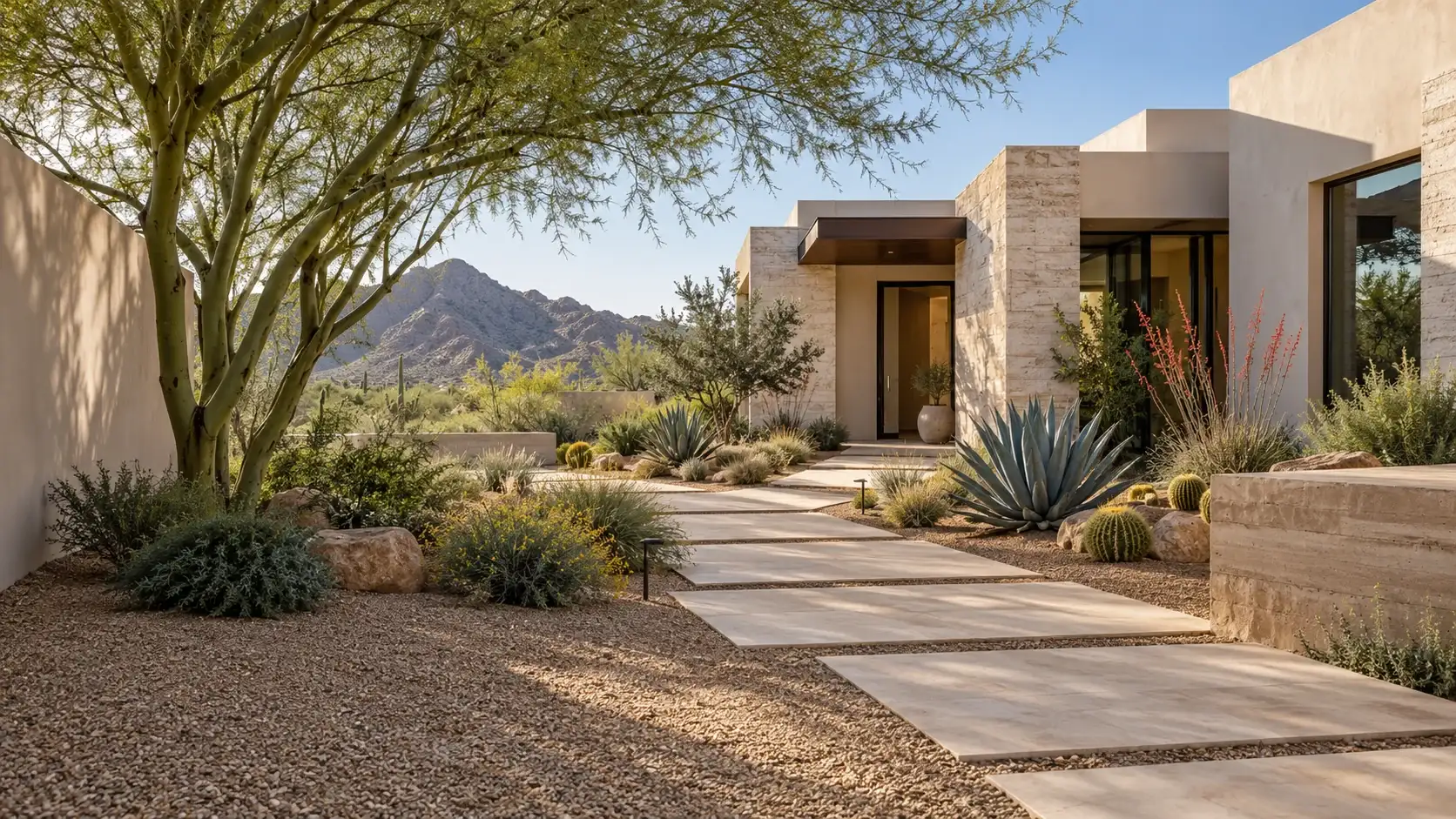
Count plants per 100 square feet. A gravel yard with 3 plants has about 3. A planted desert bed has many more, in 3 layers: a canopy tree, shrubs at a third of the tree height, and groundcover or accent succulents between them. Mulch covers the bare soil between plants, at least 4 inches if organic and at least 2 inches if rock (Denver Water, xeriscape principles (opens in a new tab)). There are berms and shallow swales that move monsoon water to the plants instead of the street. Boulders sit where the grade breaks. Irrigation is drip on separate zones, so the palo verde and the desert willow are not on the same clock. And the bed has a shape, not a straight line of gravel against a wall.
Costs
How much water does each approach actually use?
A Bermuda lawn with overseed takes over 55 inches of irrigation a year. An average xeriscape takes under 18 (UA Extension, turf versus xeriscape (opens in a new tab)). That is a 3 to 1 gap, and the same source says converting turf to xeriscape can reduce outdoor water use by 50 percent. The 55 inch figure includes winter overseed: a green January lawn adds watering on top of the summer Bermuda schedule. A xeriscape has no overseed season. It also needs far less mowing, edging or aerating, which is the part that shows up on a Saturday rather than a bill. Over 10 years the gap is the water bill, the mower and the overseed seed.
Rules
What local rules push a Scottsdale yard one way or the other?
Scottsdale is in Stage One of its Drought Management Plan, which the city describes as increased monitoring and evaluation (City of Scottsdale, drought (opens in a new tab)). The plan's residential options menu lists watering limits for the later stages: 3 days a week at Stage 2, 2 days a week at Stage 3 and no turf irrigation at Stage 4 (City of Scottsdale, Drought Management Plan (opens in a new tab)). That is an argument for drip and low water planting, because the last stage on the menu ends turf irrigation. The rebates are the other nudge. The city lists rebates of up to $250 for a WaterSense smart controller, up to $1,500 for a pool removal and up to $100 for a smart water monitor (City of Scottsdale, rebates (opens in a new tab)). The same page lists a Grass Removal Rebate of up to $5,000, but its notice says that rebate closed on October 31, 2025, that the other removal rebates closed on March 31, 2026, and that the removal and smart monitor rebates return with the next rebate season, while its table still shows later deadlines. Confirm which rebates are open before you budget any of them.
Costs
What does each approach cost, and who should pick which?
A national cost guide puts xeriscape at $5 to $20 per square foot, $5,000 to $24,000 per project, $17,000 average, and a desert style planting at $8,000 to $18,500. This Old House puts artificial turf at $15 to $19 per square foot installed, so xeriscape is usually the cheaper surface and often the cheaper habit. Invoices rarely separate the 2 labels, because the planting, base and drip go in either way. Who it suits: households with dogs or small children often keep one small lawn panel and xeriscape the rest. Households that travel, or that are done with mowing, can go all desert. A pool patio is already most of the yard, so the planting becomes a border, and the border is where the water and litter decisions get made. Published market ranges, not a quote: the final price is set after an on-site assessment.
4 questions
Questions people ask
Still have a question? Call (747) 243-2089 and describe the yard.
Is a gravel yard a xeriscape?
Usually not. Gravel with 3 plants fails several of the 7 principles: no soil work, no real plant selection, and irrigation that is absent or aimed at bare rock. Gravel counts as one kind of mulch in a xeriscape, but the savings come from plants, soil work and drip.
Can I keep a small lawn and still call it xeriscape?
Yes. The principles ask for practical turf areas, not zero turf. A 300 square foot panel where kids actually play, on its own zone with a smart controller, is a xeriscape detail. A half acre of Bermuda kept green through August is not, whatever the plant list says.
How long does a conversion take?
A front yard with drip and a controller swap is a shorter sequence than a backyard with hardscape, and the scope sets the length. Planting in October gives roots a full cool season before the first summer, and that matters more than the month on the invoice.
Will xeriscape hurt resale?
Not if it looks planted. Buyers can react to canopy, shade on the west wall and a yard that reads as finished. A gravel pad with 3 plants reads as unfinished. Keep the tree canopy and the shade, and the water bill can become a selling point.
Keep reading
- Landscaping cost in Scottsdale: What each costs.
- Landscape installation: Design, soil and drip.
- Artificial turf: The other way to drop a lawn.
- Irrigation and sprinkler repair: Zones and controllers.
- Trees that grow in Scottsdale: Canopy that holds up.
- Xeriscape vs Gravel in Scottsdale:
- Landscaping Rock vs Mulch in Scottsdale: