Service 01 of 06 · Scottsdale, AZ
Landscape Design and Installation in Scottsdale, AZ
You have a yard that needs a rebuild, from drainage to planting. Tell us what it does wrong and what you want it to do, and someone from our team will call you back to plan the project.
What you get
A yard rebuilt in the right order
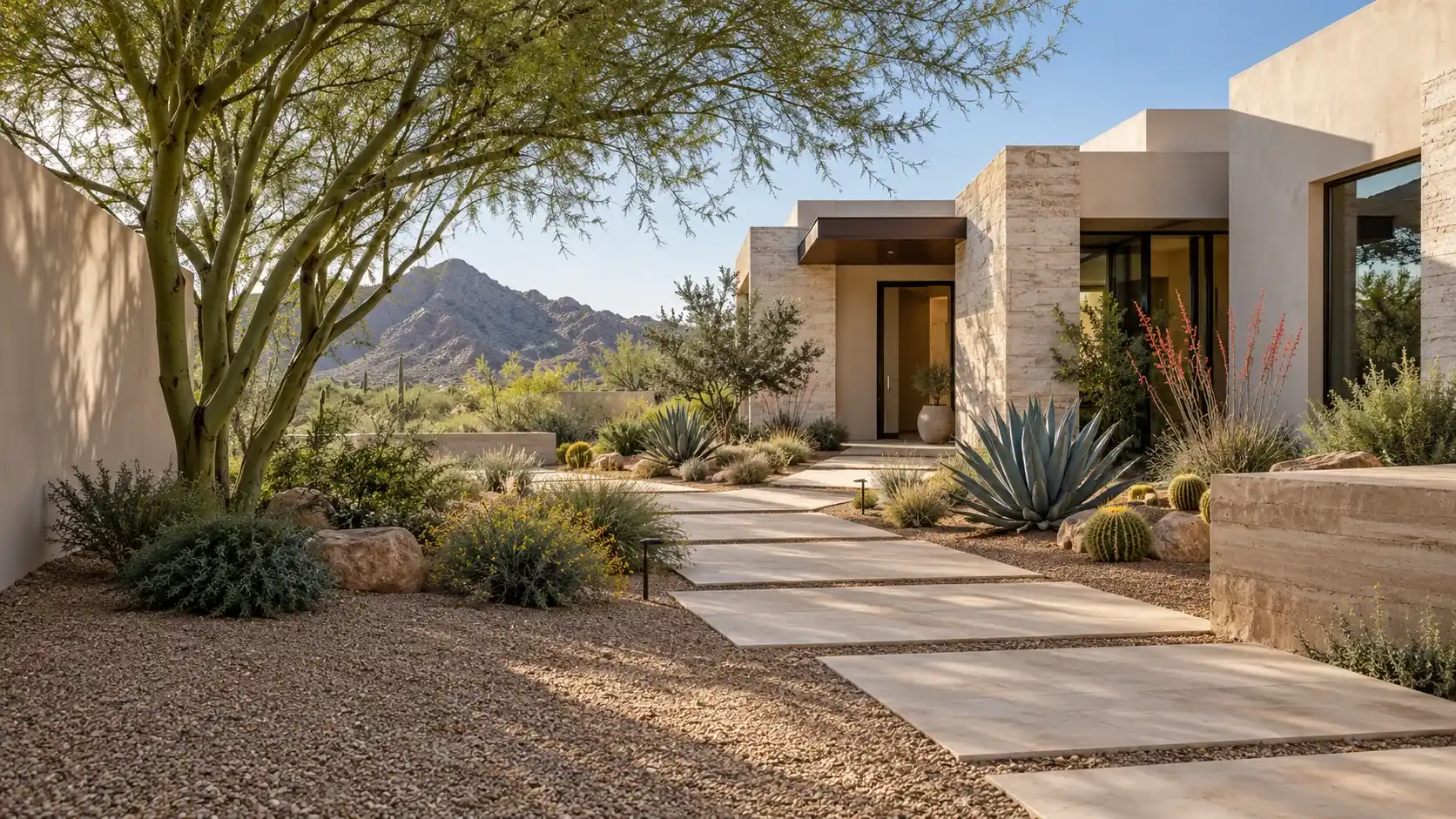
A full landscape installation in Scottsdale is demolition, drainage, grading, irrigation, hardscape and planting, in that order, and the order is what keeps a yard from being built twice.
- A drainage test before the design, so the plan fits your soil
- A grade that sheds monsoon water away from the house
- Plants chosen for the sun on each side of the yard
- Drip zones split by plant type, each with its own run time
- HOA approval and city permits settled before anything is ordered
Check your yard
5 signs your landscape needs a rebuild
- Water sits against the house after a storm.
- Plants die in the same spot every summer.
- One valve waters the lawn and the desert trees together.
- A front lawn nobody stands on, with the water bill to match.
- Bare gravel that heats up and grows weeds.
3 steps
How it works
Tell us what you need
Send the form or call. Give the address, the ZIP code and what the yard should do.
We call you back
Someone from our team goes over the project, the budget and the timing with you.
Your yard gets planned
The order of work, from drainage to planting, is set in writing with the price and put on the calendar. HOA and city approvals come before anything is ordered.
Costs
What does a landscape installation cost in Scottsdale?
A front yard project runs $1,500 to $5,000, and basic landscaping runs $4.50 to $12 per square foot, with a tear out or an outdoor kitchen build reaching $40, according to a national cost guide. Published market ranges, not a quote: the final price is set after an on-site assessment. At the low end that is gravel, a few plants and a drip line. At the high end it is demolition, grading, irrigation, specimen trees and hardscape. Caliche, narrow access, a wall permit and an HOA review each add equipment time or a review step that a national average does not carry. Design billed separately runs $50 to $150 an hour, according to a national cost guide.
One backyard, 4 stages
What does a full landscape installation include, and in what order does the work happen?
An installation runs in a fixed order: tear out, soil and drainage check, grading, irrigation, hardscape, planting, then mulch and cleanup. The order is not a matter of taste. Anything buried goes in before the surface above it, so a drip line added after a patio means cutting the patio open. Day one is demolition, which can mean breaking out old concrete, loading out old gravel and cutting out a root bound hedge. Haul off is a real cost, not a rounding error. The drainage test comes next, because the result decides whether the yard needs a swale, a dry well or a raised bed. Grading follows, because water runs downhill, and the drip line goes in after the grade is final since emitters do not care where the low spot is.
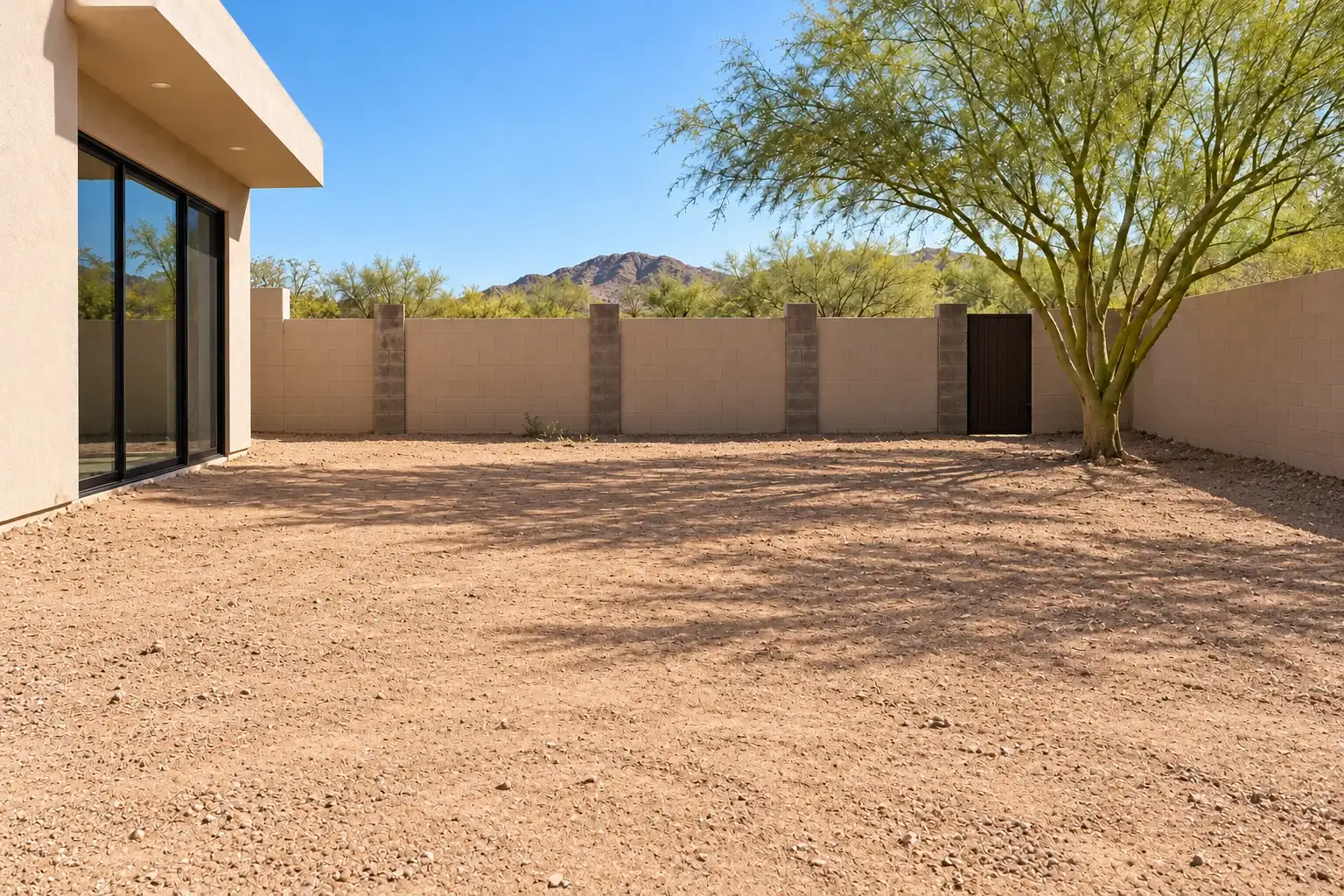
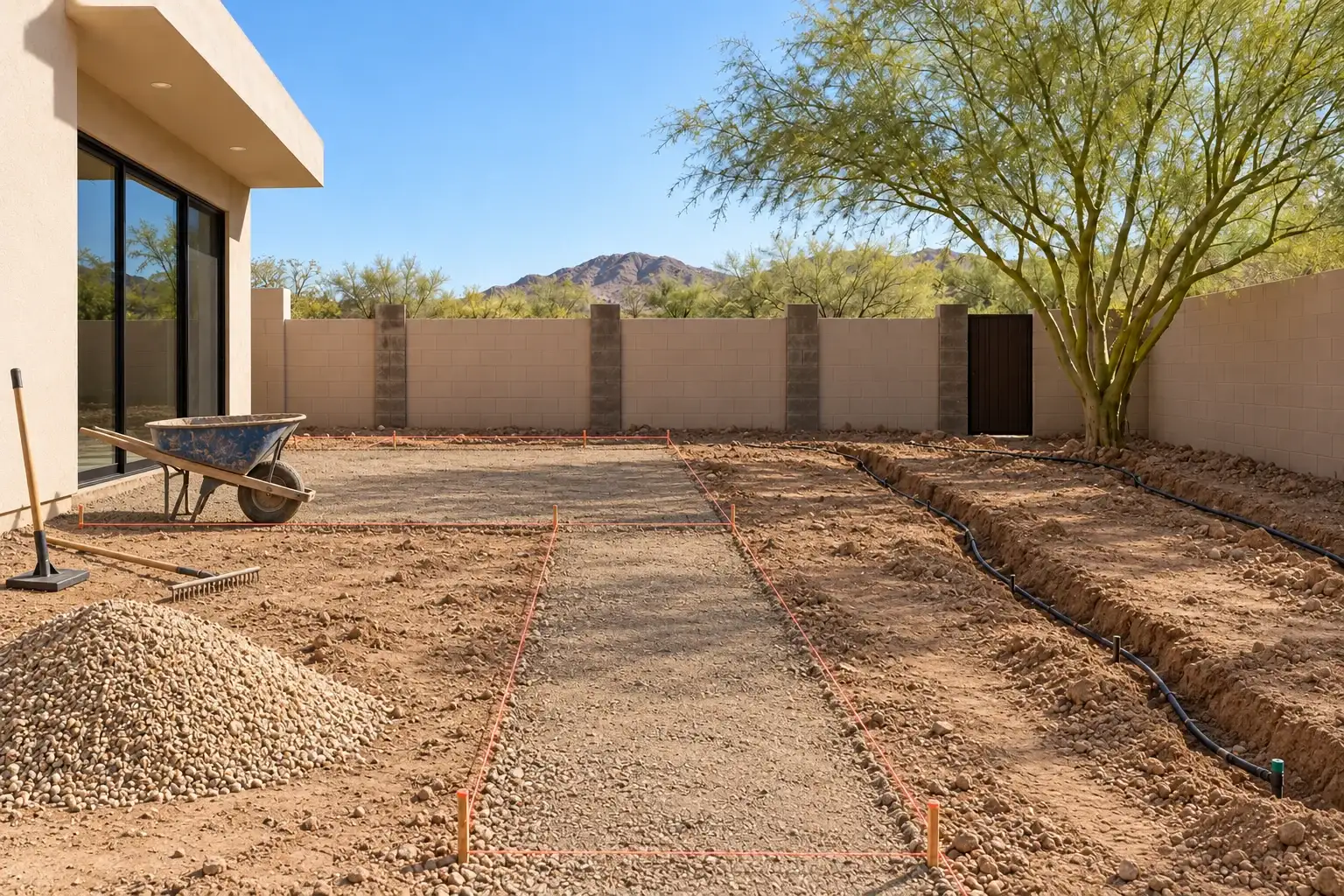
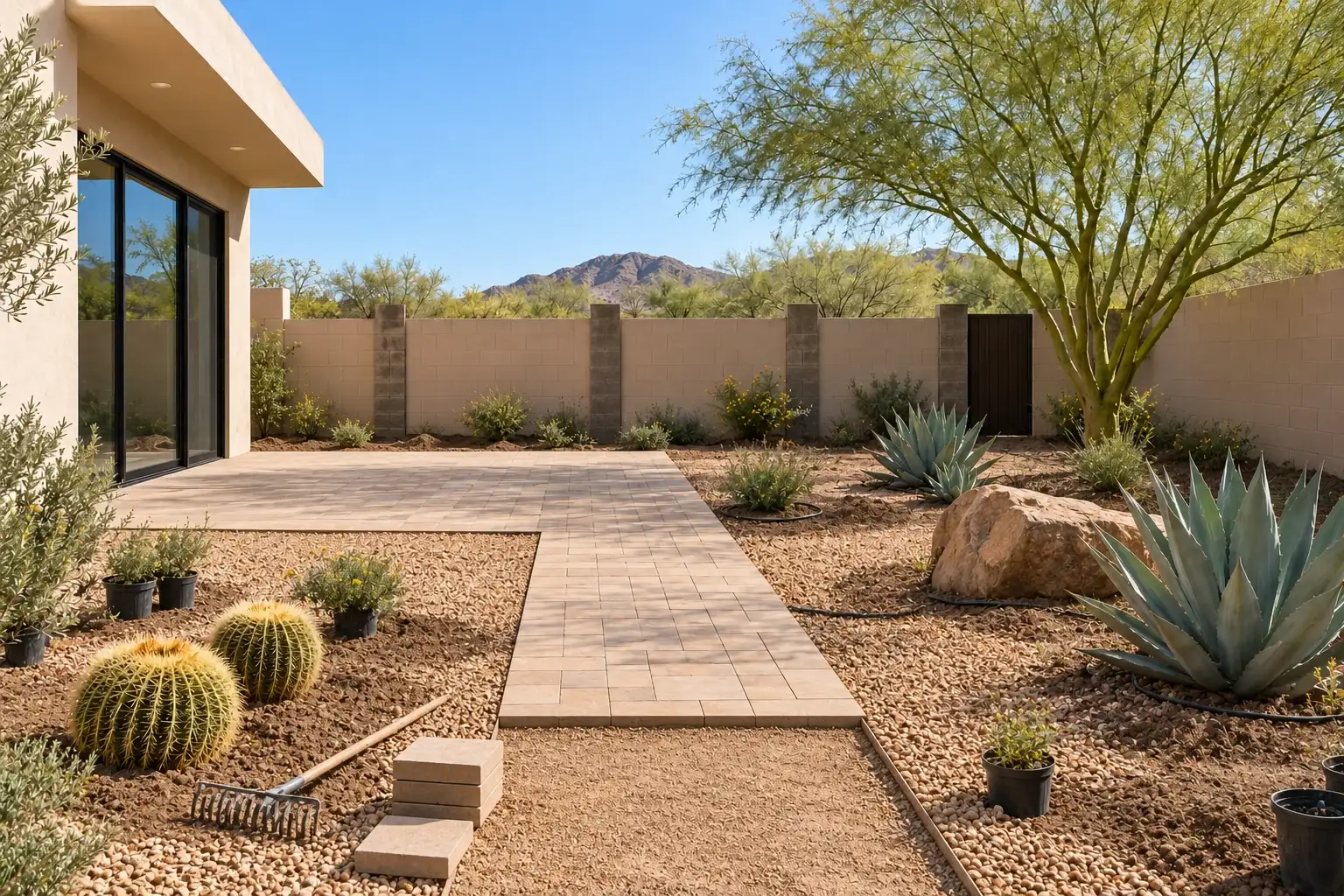
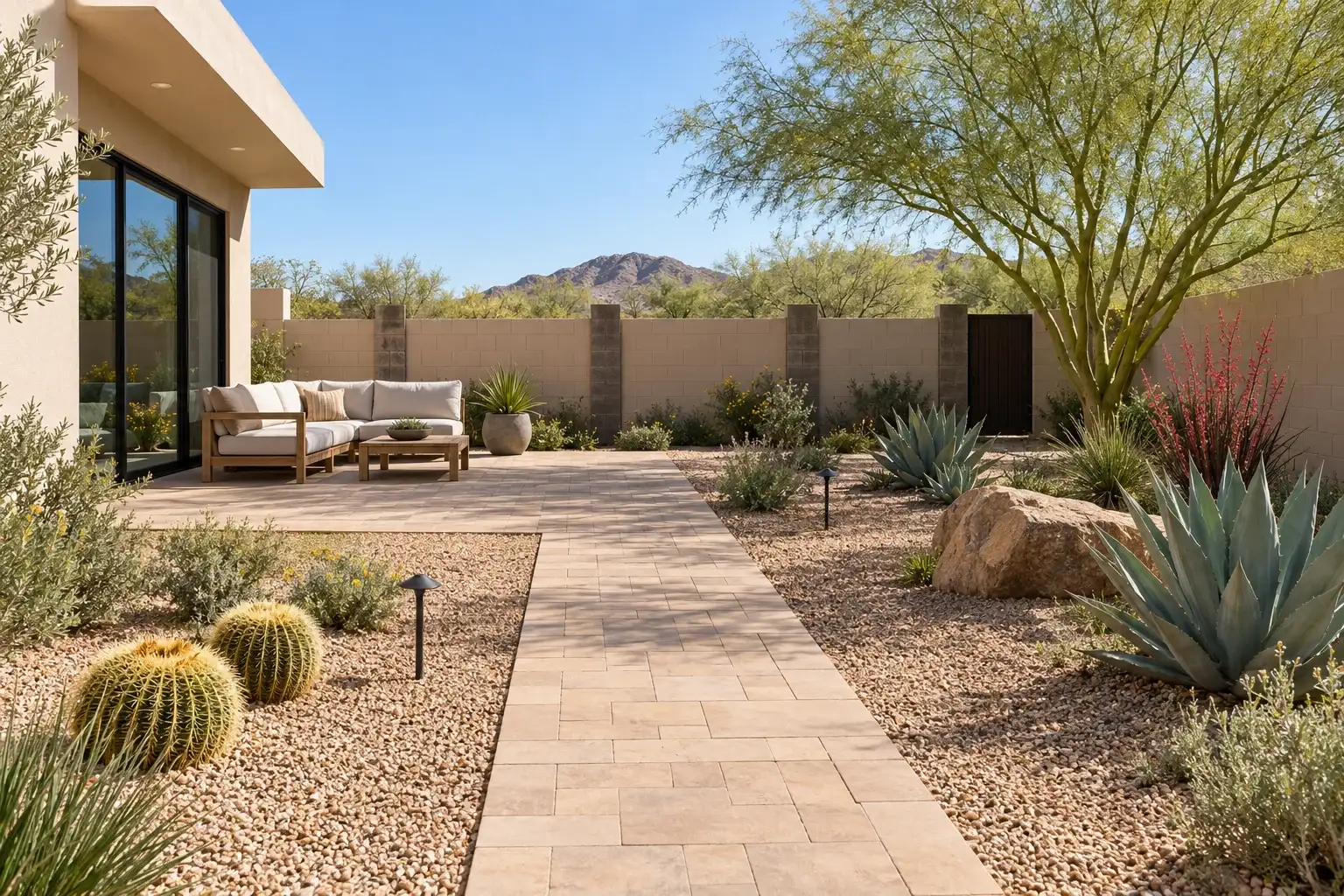
Ground
How does caliche change what can be planted?
Caliche is a cemented layer of calcium carbonate below the surface, and it decides what a yard can grow. It can restrict roots and drainage, so a shrub planted in a hole that stops at the layer sits in a bucket. Test before designing: dig a hole, partly fill it with water, and if the level drops at least 4 inches in 4 hours, drainage should be adequate (UA Extension, managing caliche (opens in a new tab)). If it does not, the plan changes. For lawn over caliche, the extension service calls for at least 8 inches of topsoil. For trees and shrubs, it says the planting hole should go completely through the caliche layer so water can drain, and be up to 3 to 5 times as wide as the root ball. Not every lot has caliche.
Ground
How is a yard graded for monsoon runoff and washes?
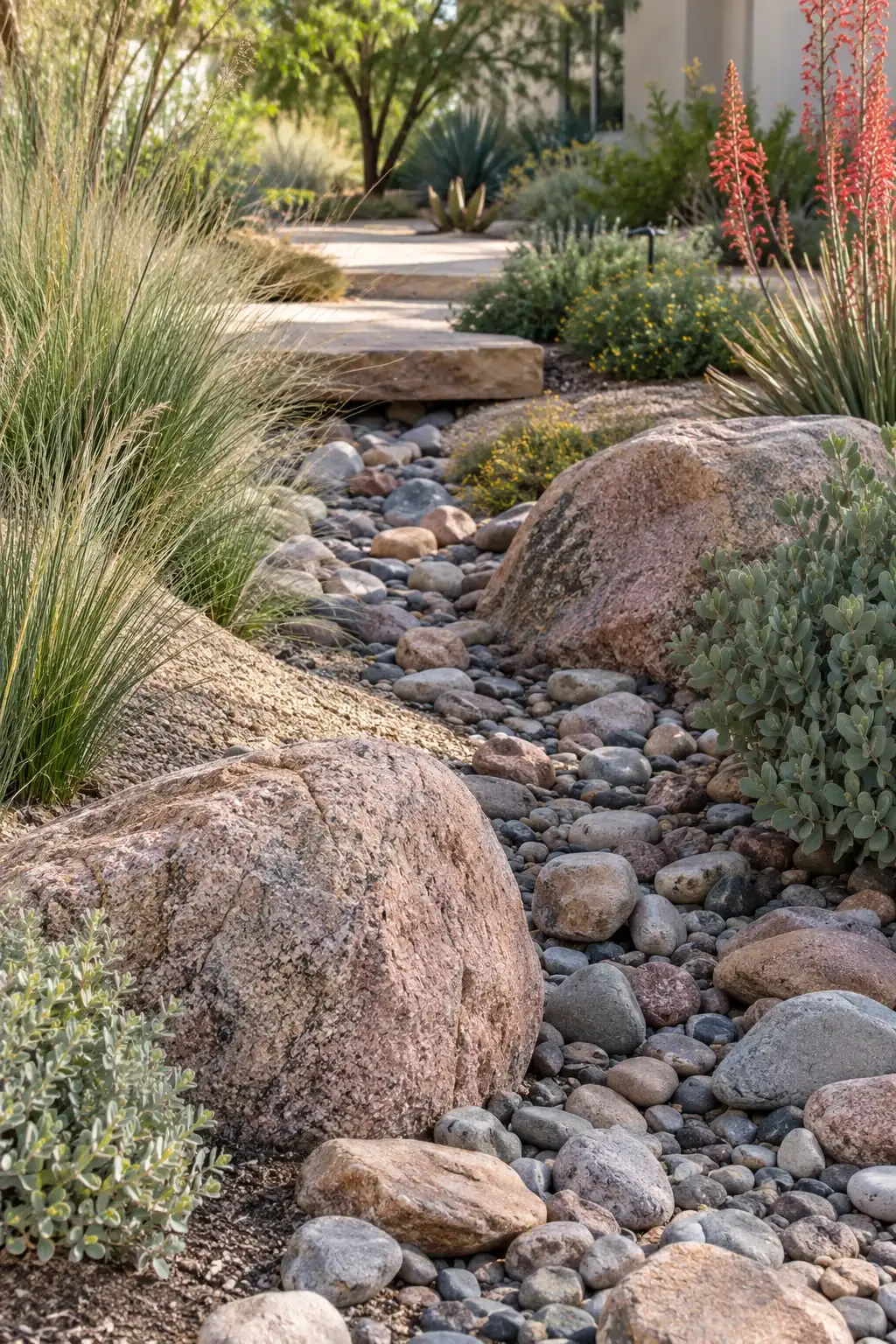
Grading decides where water goes, and the monsoon is the inspection. The season runs June 15 to September 30, and for most of the Desert Southwest about half of the year's rain falls from June through September (NWS Phoenix, monsoon season (opens in a new tab)). Scottsdale's 1991 to 2020 normal is 8.73 inches a year (NWS Phoenix, 1991 to 2020 normals (opens in a new tab)). A yard graded to fall away from the house sheds that water. A flat yard holds it against the stem wall. Washes are the other half of the question. In the northern areas of the city, Scottsdale prefers to keep washes in their natural state, and fill or a wall or fence across a wash can send stormwater outside its path, causing erosion and flooding (City of Scottsdale, wash ownership (opens in a new tab)). Running a wall or fill across a wash to gain a flat pad blocks that flow. The city asks homeowners to contact Planning and Development before filling or realigning a wash, or adding a fence or wall near one.
Planting
Which plants go on which side of the yard?
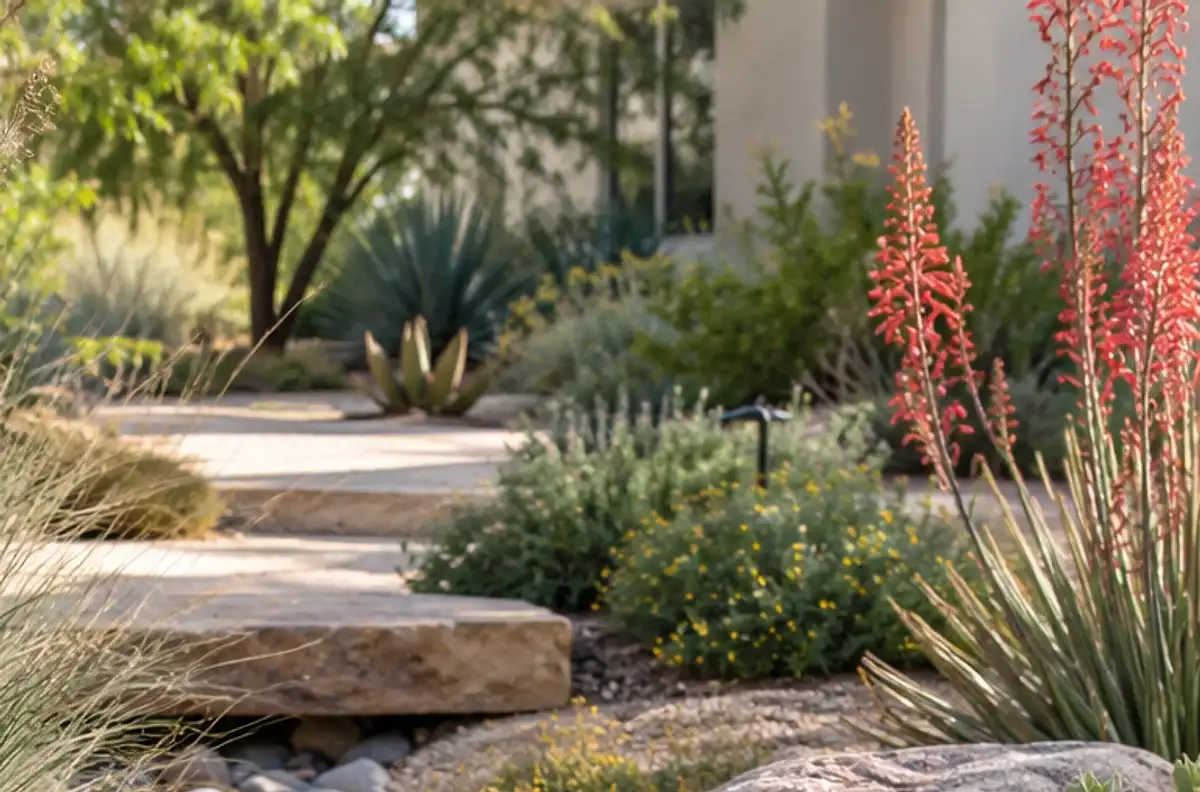
The plant list follows the exposure, not the catalog. West and south walls take reflected heat, so blue palo verde, velvet mesquite and ironwood go there, all very low water desert trees that AMWUA lists for full sun, with reflected sun noted for the palo verde and the mesquite (AMWUA, blue palo verde (opens in a new tab), AMWUA, velvet mesquite (opens in a new tab), AMWUA, ironwood (opens in a new tab)). Desert willow suits the low spot where runoff collects, and AMWUA lists it as low water, one step above the palo verde (AMWUA, desert willow (opens in a new tab)). Sweet acacia and leatherleaf acacia fill the middle layer. Sweet acacia has small thorns, so it does not belong beside a walkway, and leatherleaf acacia is listed as thornless (AMWUA, sweet acacia (opens in a new tab), AMWUA, leatherleaf acacia (opens in a new tab)). Fruitless olive is the evergreen option, listed as low water for full or partial sun (AMWUA, fruitless olive (opens in a new tab)). Citrus does best in a sunny, wind protected spot (UA Extension, protecting citrus from cold (opens in a new tab)), and it gets its own valve, apart from the desert trees. North and east beds run cooler and carry the softer plants.
Water
How many drip zones does a yard actually need?
A yard needs several zones, not one. A hydrozone is a group of plants with the same water need on the same valve, and pairing a citrus with a palo verde can leave one of them on the wrong schedule for its whole life. The gap is large: Bermuda with overseed takes over 55 inches of irrigation a year, while an average xeriscape takes under 18 (UA Extension, turf versus xeriscape (opens in a new tab)). That is a 3 to 1 difference sitting in one yard when turf and desert plants share a schedule. Separate the turf, the citrus, the desert trees, the cacti and the seasonal color. Each zone gets its own run time, and the controller gets checked 3 or 4 times a year. A schedule set once and left alone can waste water in winter and starve plants in June.
Turf
Should any turf stay, and where does it belong?
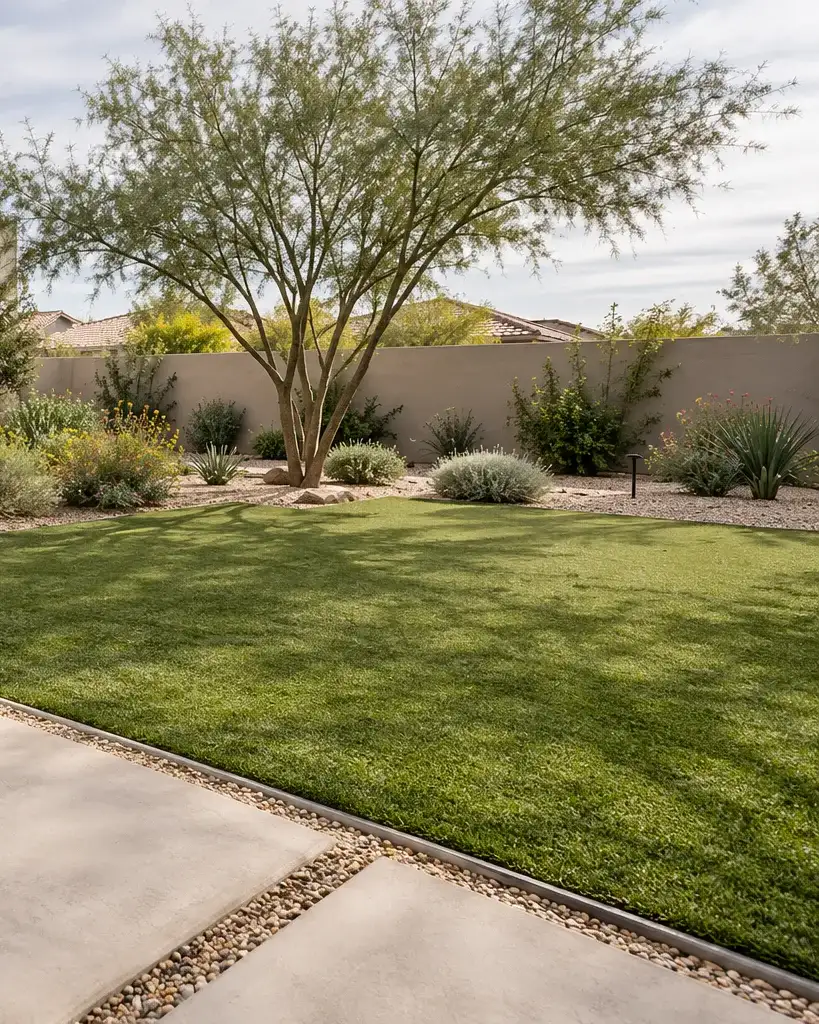
Keep turf where it gets used, and take it out where it does not. A rectangle the kids play on, a strip the dog runs, a patch that shades a west facing door: those earn their water. The front lawn nobody stands on can be the most expensive square footage on the lot, and Bermuda with overseed runs over 55 inches of irrigation a year before mowing (UA Extension, turf water use (opens in a new tab)). Where turf stays, keep the shape simple. One rectangle waters more evenly than 3 curving lobes, and it gets its own zone. Where it goes, the replacement is not gravel alone: graded soil, drip, 3 or 4 trees for shade, and enough plant density to cover the ground in time. Bare gravel can heat up and grow weeds.
Good to know
What is different about a front yard rebuild and a backyard?
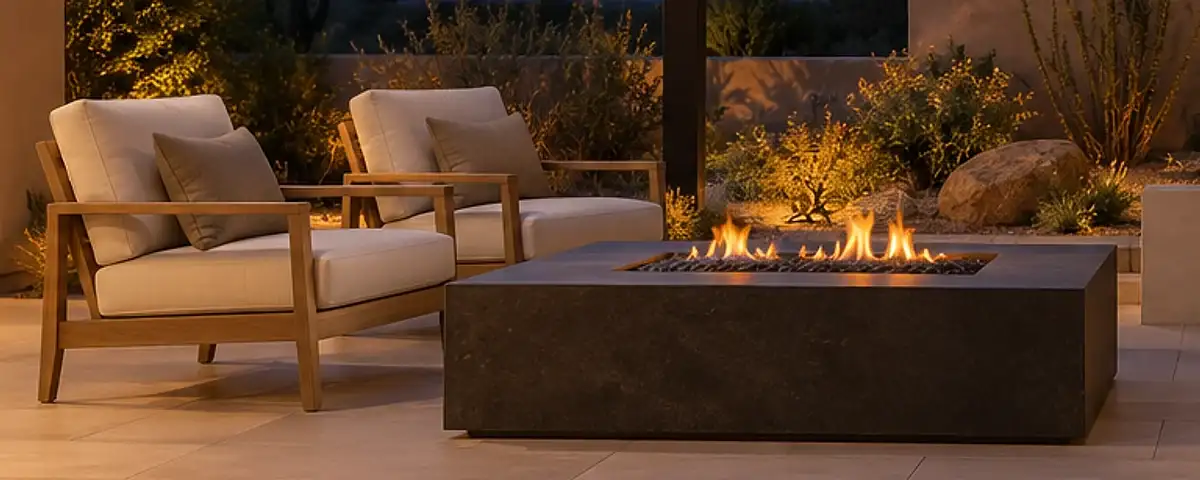
Front and back are different projects with different constraints. The front yard is public. It is what the street sees, what the HOA reviews and where the walkway, driveway edge and address visibility all meet. It is usually smaller and more visible, so a front rebuild is mostly demolition, grading, fresh surface and a new plant palette, which is why it costs less. The backyard is private and it is where the patio, ramada, kitchen, fire feature and lighting go, along with the gas and electrical trenches that feed them. Same sequence, larger scope. Budget the two separately, and if both are built at once, finish the front first. A front yard figure is a poor predictor of what the back will take.
Bids and scope
When does HOA design review happen?
Submit to the HOA before anything is ordered, and read the design guidelines before anything is drawn. The association has its own authority to enforce design standards in addition to city ordinances (City of Scottsdale, HOA resources (opens in a new tab)), and A.R.S. 33-1817 requires the architectural committee to include a board member as chair (A.R.S. 33-1817 (opens in a new tab)). Rejections are often not about taste. Common causes are plant lists off the approved list, gravel a shade off the spec, walls above the subdivision limit, and trees placed where they block a sight line. Approval can take a couple of weeks or longer, depending on how often the committee meets. Ordering a specimen tree or 3 pallets of pavers before that approval is how material can end up stored in a driveway for a month, or returned at a restocking fee.
Rules
Do walls and grade changes need a permit?
A fence over 3 feet needs a permit, and every retaining wall needs engineered plans, including a low one (City of Scottsdale, walls and fences (opens in a new tab)). Dry stack over 30 inches needs a permit, and walls up to 3 feet still go through courtesy site plan approval for zoning and stormwater. Footings bear at least 18 inches below undisturbed soil or engineer certified fill, and the city highly recommends a geotechnical investigation for foundation design (City of Scottsdale, retaining wall policy (opens in a new tab)). Site walls at the property line are generally capped at 6 feet in required side and rear yards, and a retaining wall sits 3 feet from the line or 1 foot for each foot of total height measured from the bottom of the footing (City of Scottsdale, site plan requirements (opens in a new tab)). Grade changes that push water onto a neighbor are another concern. Anything altering off site drainage needs a look before digging.
Timeline
What does the schedule look like across the 4 seasons?
The calendar has 2 strong planting windows and 2 workable ones. October through December is the best of them: soil is still warm, air is cool, and roots establish before the cold. January and February suit hardscape, bare root planting and pruning, with a frost night still possible. March through May is the second window and it closes when the century mark arrives, which in Phoenix averages around May 2 (NWS Phoenix, extreme heat (opens in a new tab)). June through September is still buildable. Summer planting works with shade cloth, a 5am start and water on the day of install, though new plants need watching. Hardscape runs normally in summer; only planting needs the shade and the extra water. Irrigation work runs in every season, because a line broken in July gets fixed in July.
Planning
What should be ready before day one?
Clear the access, and know where the water comes from. Before day one, have a gate code or a key ready, a parking plan for a truck and trailer, and a working hose bib. Move the cars, the cans and anything you want out of the demolition zone. Tie ribbon on plants you are keeping, because nobody can tell a prized specimen from a volunteer by looking. Note the dog, the irrigation clock, the pool equipment and any invisible fence wire. If a shared wall or a wash crosses the line, mention it on the call back. On demo day the noise starts early and the dust is real, so close the windows and move anything fragile off the shelves.
4 questions
Questions people ask
Still have a question? Call (747) 243-2089 and describe the yard.
How long does a landscape installation take?
A front yard rebuild is usually shorter than a full backyard with a patio, wall and lighting. Weather, inspection timing and HOA approval move the schedule more than the plant count does, so a sequence with stages is more useful than one completion date.
Can we stay in the house during the work?
Yes, many people do. Expect noise, dust and a driveway stacked with material for part of it. Keep a path to the door, move the cars before work starts, and expect the water off for a few hours on the day the irrigation main is tied in.
Is the old gravel and concrete hauled away?
Yes, when it is in the scope. Demolition debris goes to a transfer station and haul off is priced by the load. Old gravel is often the heaviest line.
What is the best month to plant in Scottsdale?
October and November. Soil is still warm from summer, the air has cooled, and roots get months to settle before the heat returns. March is the second best. Summer planting works when shade cloth and water are handled, but the margin for error is thinner and new plants need watching.
Keep reading
- Patios and Pavers: for the hardscape that goes in before planting.
- Irrigation and Sprinkler Repair: for zones, valves and controllers.
- Artificial Turf: for the base work under a putting green.
- Landscaping Cost: for every range on one page with its source.
- Blog: trees that grow in Scottsdale: for mature size and litter.
- Pavers vs Concrete Patio in Scottsdale:
- Landscaping Rock vs Mulch in Scottsdale:
- Landscaper never showed up in Scottsdale? Start here: