Service 03 of 06 · Scottsdale, AZ
Artificial Turf Installation in Scottsdale, AZ
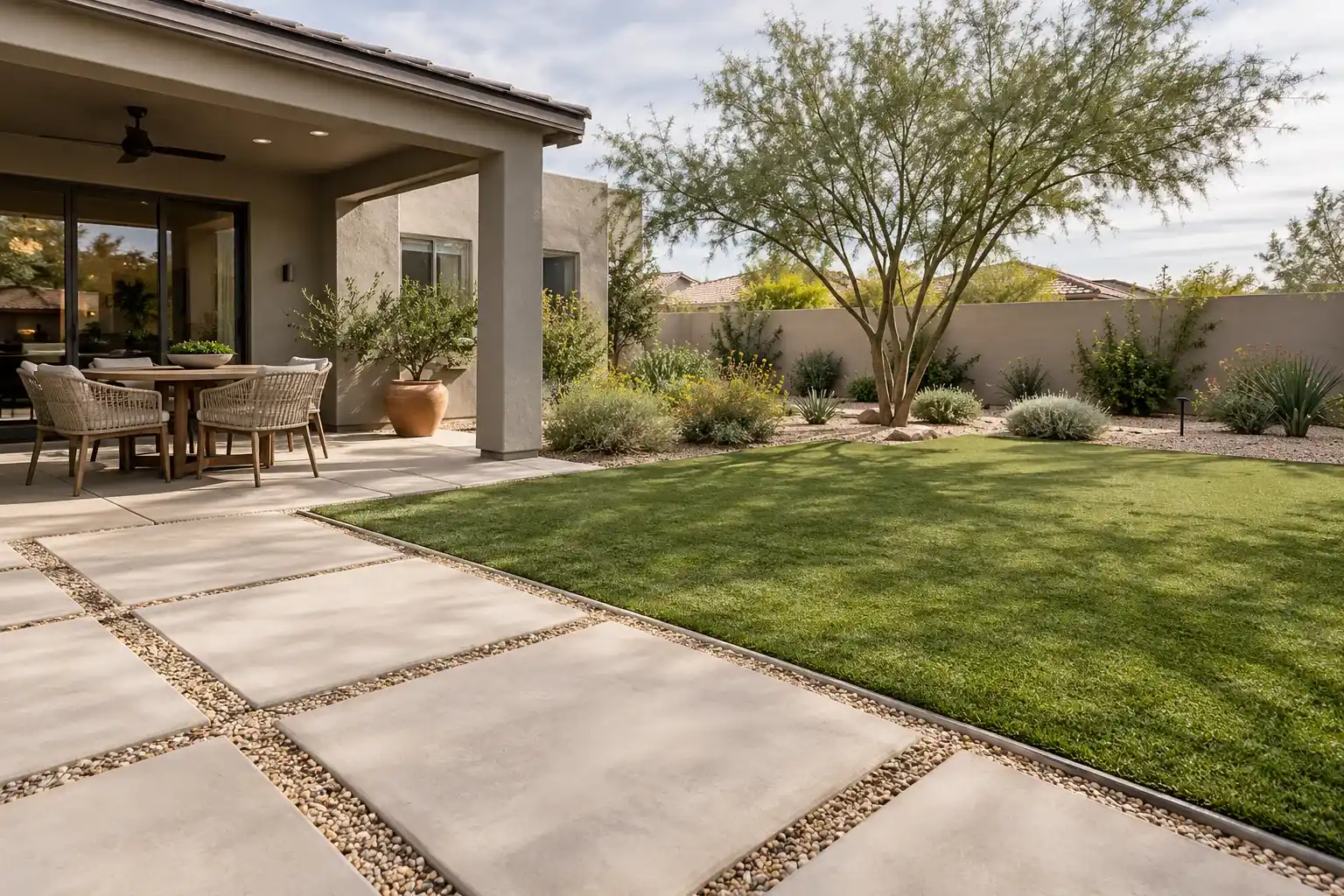
You want grass that stays green without a mower, or a putting green in the backyard. Tell us where it goes, and someone from our team will call you back to plan the base and the drainage.
What you get
Turf that stays flat and drains
Artificial turf in Scottsdale is a base project with grass laid on top, and the base and the drainage decide how long it lasts.
- A base of 3 to 4 inches of crushed aggregate, compacted in lifts under the grass
- A grade that falls away from the house, so storm water leaves the yard
- No mowing, edging, fertilizer or fall overseed
- Light colored turf for pool decks and dog runs, with an infill picked for pets
- HOA and city rules read before the turf is ordered
Check your yard
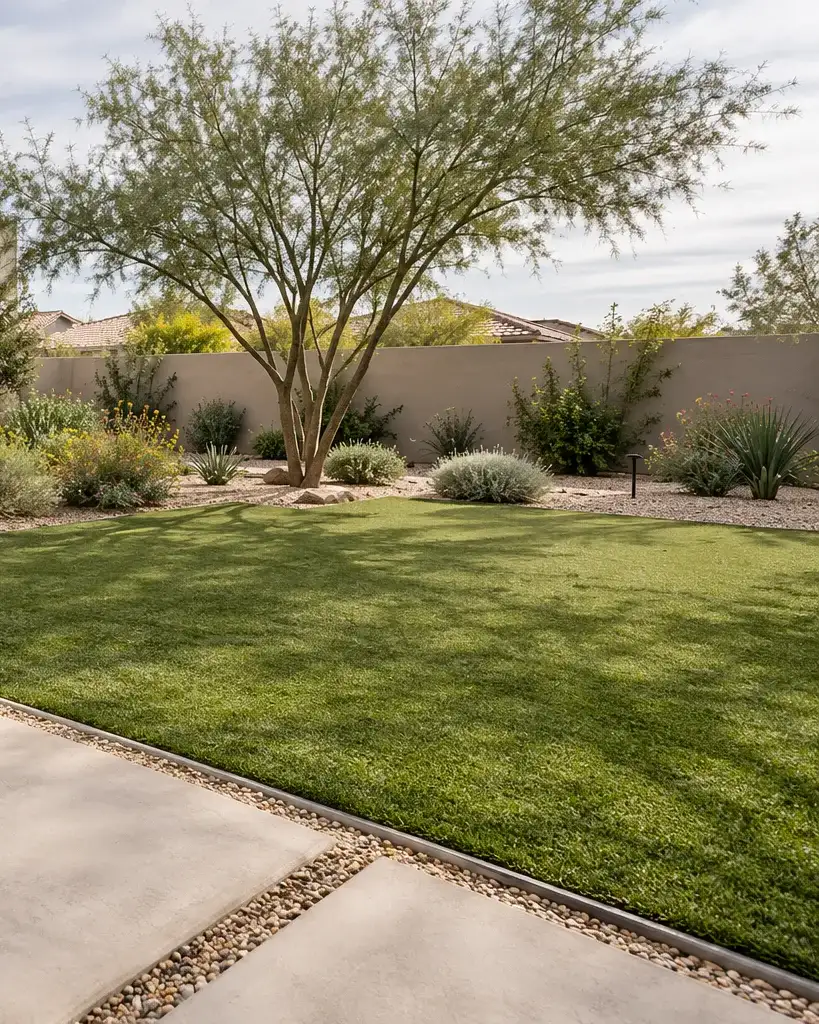
5 signs turf belongs in your yard
- A courtyard, side yard or parking strip too narrow to mow.
- A dog run, play area or pool surround that needs a clean, flat surface.
- A corner that never grew anything.
- A lawn that eats mowing, edging, fertilizer and a fall overseed.
- A lawn that is the thirstiest surface on the lot.
3 steps
How it works
Tell us what you need
Send the form or call. Give the address, the ZIP code and what the yard should do.
We call you back
Someone from our team goes over the project, the budget and the timing with you.
Your turf project gets planned
The base, the drainage and the price are set in writing and put on the calendar. HOA and city rules come before anything is ordered.
Costs
What does artificial turf cost per square foot in Scottsdale?
Installed turf runs $15 to $19 per square foot according to This Old House, and a national cost guide puts a typical job between $3,244 and $8,714, with $5,783 as the average. That rate buys more than the carpet. It carries removal of the old surface, 3 to 4 inches of crushed aggregate, compaction, a weed barrier, the turf, the infill and the haul off. Published market ranges, not a quote: the final price is set after an on-site assessment. Where the number moves: gate width, how much concrete or sod comes out, the base depth the soil requires, and whether the perimeter needs an aluminum edge or a curb. A 400 square foot dog run and a 1,500 square foot backyard share a rate, not a total.
Hardscape
What does the base work involve, and why is it a large part of the labor?
The base is 3 to 4 inches of crushed aggregate over a graded, compacted subgrade, and it is a large part of the labor because every inch of it is dug, hauled, spread and packed. The old surface comes out first: sod, gravel, sometimes a concrete slab. Then the subgrade is cut to the intended fall, compacted, and the aggregate goes in lifts, each one watered and plate compacted before the next load lands. A weed barrier goes over the aggregate, then the turf is rolled out, cut, seamed and nailed at the perimeter. On caliche the digging slows down, because that layer is cemented and restricts drainage (University of Arizona, managing caliche (opens in a new tab)). A base dumped in one pass and walked on once can move underfoot by the second summer. That failure can get blamed on the turf, not the base.
Ground
How does drainage work under artificial turf?
Turf drains through holes punched in the backing, so water still has to go where the yard already sends it. A flat plane that hides the low corner gives a surface that can pond in the first storm. The monsoon runs June 15 to Sept 30 and, across most of the Desert Southwest, brings about half the year's rain, against a Scottsdale annual normal of 8.73 inches (NWS Phoenix, monsoon (opens in a new tab), NWS Phoenix, Scottsdale normals (opens in a new tab)). The base is graded to a fall away from the house, and the turf follows the base. Where a wash borders the lot, keep the flow path clear, because obstructions can send stormwater outside its path, causing flooding and erosion (City of Scottsdale, wash maintenance (opens in a new tab)). A turf install that ignores existing flow can send the water into the neighbor's yard or the stucco.
Climate
How hot does artificial turf get in direct sun?
Hot enough to matter to bare feet. On a 110 F afternoon a synthetic surface in full sun runs well above air temperature, and dark infill makes it worse. Phoenix averages 111 days at 100 F or higher and 21 days at 110 F or higher in the 1991 to 2020 normals, so a 110 F afternoon is part of a normal summer (NWS Phoenix, extreme heat (opens in a new tab)). People notice it in 3 places: a pool deck where wet feet cross it, a dog run where pads take the heat, and a play area with no shade. Light colored turf and light infill run cooler than dark green with black crumb. A hose pass cools the surface for a short time. Shade from a tree or a ramada does more, and it lasts. Plan the dog's route through shade, not across an open lawn.
Rules
Is artificial turf allowed in Scottsdale, and what do HOAs say?
It depends on the lot and the HOA. A City of Scottsdale artificial turf policy, dated January 2011 and marked as in working review, highly discourages artificial turf as a substitute for a live lawn and does not allow it in city rights of way, drainage easements or retention basins (City of Scottsdale, artificial turf policy (opens in a new tab)). Inside a planned community, the association can also enact and enforce its own design standards in addition to city ordinances (City of Scottsdale, HOA resources (opens in a new tab)). The design review statute requires the architectural committee to be chaired by a board member (A.R.S. 33-1817 (opens in a new tab)). Read your own CC&Rs, because rules are written per association. 2 real examples show the range. On mapped hillside land in Paradise Valley, only desert landscaping is allowed and flammable grasses are prohibited (Paradise Valley, hillside review (opens in a new tab)). Cave Creek requires a 12 ft native habitat corridor inside every Desert Rural lot (Cave Creek, residential zones (opens in a new tab)). Neither is a Scottsdale HOA rule. They show how specific the language gets in practice.
Water
How does turf fit Scottsdale's water situation?
Turf cuts irrigation rather than removing the need to think about water. About 90 percent of the city's drinking water comes from the Central Arizona Project and the Salt River Project, with CAP alone near two thirds (City of Scottsdale, water supply (opens in a new tab)). Scottsdale is in Stage One of its Drought Management Plan, which is monitoring rather than cutbacks, and the plan lists watering day limits only at Stage 2 and Stage 3 (City of Scottsdale, drought plan (opens in a new tab)). A smart controller rebate of up to $250 is on the books (City of Scottsdale, rebates (opens in a new tab)). Turf deletes a lawn's irrigation schedule, but it still wants a rinse and occasional topping up. What it really deletes is mowing, edging, fertilizer and the fall overseed.
Turf
Where does turf belong, and where does it not?
It belongs in small courtyards, dog runs, pool surrounds, shaded play areas, parking strips too narrow to mow and corners that never grew anything. It does not belong inside a Natural Area Open Space easement, where no grading, filling, clearing or excavation is allowed (City of Scottsdale, NAOS guide (opens in a new tab)), or in a Cave Creek habitat corridor. It does not belong on a steep slope without a designed edge, because the base creeps downhill. It does not belong under a velvet mesquite that drops litter every season. It also does not belong over tree roots that need air, so an old shade tree and turf rarely share a square. And it does not fix a grade problem: laying turf over a low spot preserves the low spot under a surface that will not absorb it.
Costs
What changes in a putting green build, and what does it cost?
A putting green runs $15 to $40 per square foot installed, or $3,500 to $9,000 for the job, and the rate falls with size: $25 to $40 under 400 square feet, $20 to $30 from 400 to 2,000, and $15 to $25 above 2,000, according to a national cost guide. Published market ranges, not a quote: the final price is set after an on-site assessment. The build changes in 4 ways. The base is shaped rather than flat, with contours, a crown and a tie in to the surrounding grade. The turf is a denser, shorter pile made for a ball to roll. Cups need sleeves set into the base. And the fringe is cut from a second material. The shaping is handwork and the cups are set one at a time, so the rate runs above a flat lawn.
Turf
Which infill should I pick for pets, and will it smell?
Infill holds the fibers upright, and the choice matters more in a yard with dogs. Silica sand is affordable and works in most yards. Acrylic coated sand resists compaction and has antimicrobial properties. Zeolite and mineral blends adsorb ammonia, which addresses odor instead of masking it. Infill is broadcast and brushed in, and it needs topping up over the years as it migrates toward the low corner. Odor often comes from urine held in a base that does not drain, not from the turf itself. A rinse with a hose helps a pet area, and so does a base that falls to a drain or to the street. A pet area on a flat base with no fall can smell by July. A thin layer of infill over a firm base does not hold a fiber up.
Timeline
How long does turf last, and how does it fail?
Its life depends on its base, which is the part nobody sees from the patio. What fails first is often a seam, an edge or the grade underneath. The failure modes look like this. A seam opens because the pieces were not cut straight and nailed to a board. Wrinkles can show up within a few years where the aggregate was not compacted in lifts. A dip forms at the gate where foot traffic met soil that was never moved. Pile flattens into a shiny path where everyone walks. Weeds appear at the perimeter where the barrier was not overlapped. Infill drifts to the low corner. Faded color is normal and slow. Early failures often trace back to the excavation. A patch is possible: cut out the damaged square, re-stretch it, seam it, and brush the infill back in.
Costs
Is artificial turf really cheaper than real grass?
Often not on day one. Over many years the water figure is what shifts the comparison: Bermuda with a winter overseed takes more than 55 inches of irrigation a year in Arizona, while an average xeriscape takes under 18, and converting turf to xeriscape can cut outdoor water use by about 50 percent (University of Arizona, turf versus xeriscape (opens in a new tab)). A lawn is the thirstiest surface on the lot, and both turf and plants beat it. Turf is not xeriscape, though. It builds no soil, feeds no insects and cools no air, and a tree over gravel does all 3. If the goal is water per dollar at the low end, plants and aggregate win. If the goal is a clean, flat surface for dogs or a pool deck, turf does something plants cannot. Overseed adds to a lawn's water bill.
4 questions
Questions people ask
Still have a question? Call (747) 243-2089 and describe the yard.
Can turf go over an existing concrete slab?
Not as a rule. Concrete does not drain, it can crack, and turf stakes will not hold in it. A slab is often broken out and hauled off, then the base goes on bare soil. Haul off costs money, so the concrete moves the price.
Will weeds come through artificial turf?
Rarely through the field, often at the edges. A barrier over compacted aggregate stops many. Weeds tend to show where the barrier was not overlapped or soil blew in. Windblown seed is a common source. Spot treatment works; pulling the weed and leaving the hole does not.
Does turf need water in Scottsdale?
A rinse occasionally, not an irrigation schedule. Dust settles on it, pet areas need flushing, and a pass cools the surface on a hot day. Cap the old heads or convert the zone to drip, because a sprinkler running under turf soaks the base and can cause wrinkles.
How does turf handle a dog that digs?
Better than grass, worse than gravel. A dog can work a seam loose or pull an edge, and the repair is a re-stretch rather than patching sod. A dug hole can mean the dog is after cool soil, so shade and water treat the cause.
Keep reading
- Landscaping Cost: for the published ranges.
- Landscape Installation: for grading and planting.
- Patios and Pavers: for the hardscape edge.
- Irrigation and Sprinkler Repair: for capping a lawn zone.
- Turf in the Arizona heat: for surface temperature.
- Artificial Turf in Phoenix: for the Phoenix version.
- Artificial Turf vs Real Grass in Scottsdale:
- Artificial Turf vs Sod in Scottsdale: