Guide 01 · 5 min read
Artificial Turf vs Real Grass in Scottsdale, AZ
Artificial turf saves water and keeps the lawn green through an HOA turf limit, but laid over unexcavated caliche with no drainage it turns into a hot plate, while real grass dies the moment the water stops. Here is how the choice plays out on a Scottsdale lot.
Good to know
The short answer
Turf wins on water and in front yards where the HOA caps grass. Real grass wins on surface temperature and on upfront cost, if you are willing to pay for water, mowing, and overseeding every year after. The right choice depends on the soil, the exposure, and what the design review board and the HOA will actually approve, so do not pick a winner before those three are known.
Turf
Artificial turf: what it actually is
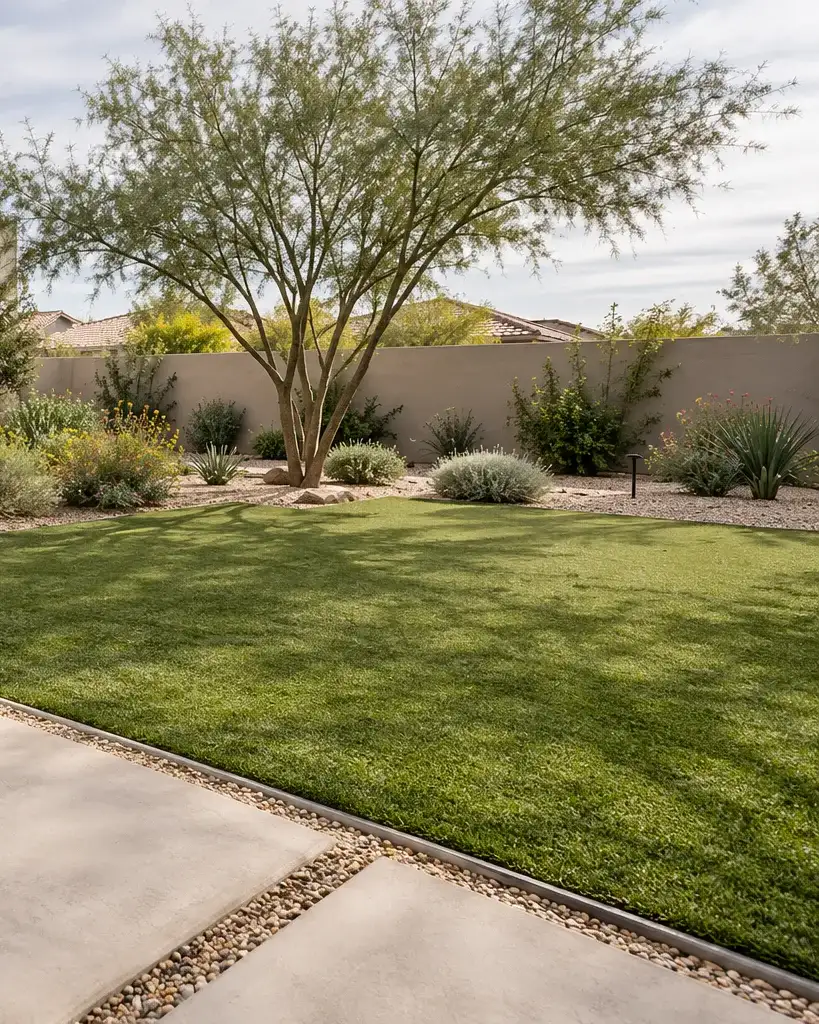
Artificial turf is plastic blades sewn into a backing with drainage holes, laid over a compacted base of crushed rock and pinned at the edges. The green comes from fiber, not from anything living. Nothing transpires, nothing roots, nothing shades itself. In a zone 9b summer that distinction matters, because a living lawn cools itself by releasing water and turf does not. What you get is a zero-mow surface that holds its color, at the price of a surface that stores every bit of afternoon sun.
The part nobody sees is the base. Turf over a properly excavated base lets monsoon water drain down through the backing and away. Turf over compacted caliche with no excavation traps that water under the fiber, and the first sign of trouble is weeds pushing through the seams, because the root zone under the fiber was never removed.
Turf
Real grass: what it actually is
Real grass in Scottsdale means warm season turf, bermuda being the workhorse, with winter rye overseeded on top if you want green in January. It grows in two windows, spring and late summer, and it goes straw colored in the cold months without the overseed. It needs mowing through the growing season, fertilizer that works on alkaline soil, and a water schedule that spikes hard from June through September.
A healthy bermuda lawn does one thing turf cannot. It transpires, and that evaporation keeps the surface noticeably cooler than any plastic equivalent. It also repairs itself, filling a worn patch from the rhizomes instead of needing a seam fix.
Turf
Where artificial turf fails here
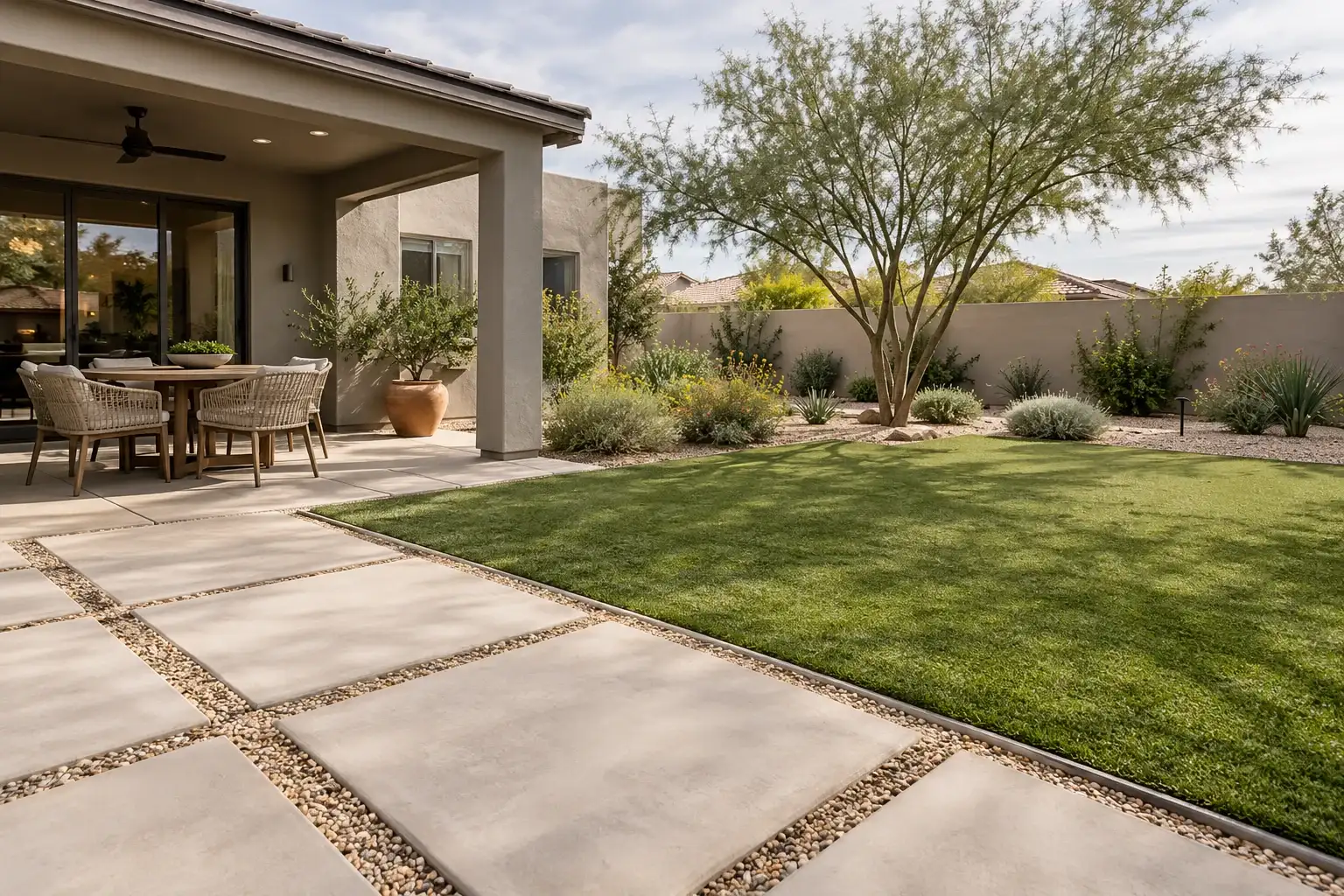
Scottsdale has the strictest design review in the Valley, and a front yard turf install is exactly the kind of change that gets looked at. Most yards in north Scottsdale sit behind an HOA, and plenty of those HOAs like turf precisely because it reads as tidy and green with no water. Approval comes before work, not after. The bigger risk is not rejection. The bigger risk is the yard itself.
Summer surface heat is the complaint homeowners actually make. Air temperature in July runs past triple digits, and any surface in full sun runs well above air temperature, the same reason pool decks burn. Dark turf fiber holds that heat, so bare feet and dog paws suffer in the afternoon, and west and south exposures are the worst of it.
Caliche is the second failure. Much of the East Valley sits on a cemented calcium carbonate layer that stops water infiltration. If the base is not excavated through it, irrigation overspray and monsoon rain have nowhere to go. Water sits under the backing, the seams loosen, and weeds come up through them. That is the main reason a two year old turf yard looks tired in Scottsdale: the base was compacted, not built.
Turf
Where real grass fails here
Water is the whole story. HOA turf limits exist because water is the whole story. A bermuda lawn in zone 9b drinks through summer, and every July the bill shows it. Hard water compounds the problem, leaving mineral salts in the root zone that no hose schedule washes out. If the lawn keeps failing anyway, the usual next question is whether the yard is better off as rock and mulch.
Monsoon is the other failure. Water arrives faster than desert soil can absorb, so it runs to the low points and pools against walls and patios. A lawn graded wrong turns into a pond for an afternoon, and the turf scalds in the standing water.
Then there is winter. An overseeded rye lawn needs the seed, the water, and the mow on top of the bermuda underneath. Skip the overseed and the yard goes straw colored from November to March, which is exactly when an HOA is most likely to notice.
Costs
What it costs and what drives the number
Turf installed in Scottsdale usually runs anywhere from the low teens to the low twenties per square foot, and the spread is driven almost entirely by base work. Excavation through caliche, a drainage layer, and edge restraint are what separate a cheap quote from one that holds up. Real grass costs far less to establish, but it never stops costing. Water, mowing, overseed, and fertilizer recur every year, and over a decade the two curves cross, usually sooner than the homeowner expects.
The honest comparison is over ten years, not over the first invoice. Turf front-loads the money. Grass spreads it out. See how the full cost of a Scottsdale landscaping project breaks down before you commit.
Good to know
What good work looks like in Scottsdale
- The base gets specified before the price. Caliche depth, drainage, and edge restraint go into the scope, not into the assumptions.
- HOA and design review paperwork is checked before any work starts, so the plant list and the turf limit are settled up front.
- The yard is planned as one drainage system, so monsoon water runs away from the house and the neighbor, not toward them. The landscape installation sequence puts grading before surface.
- Plant choices come from the drought-tolerant lists, because turf is only ever part of a Scottsdale yard, never all of it. The services page shows the full set of options.
6 questions
Artificial Turf vs Real Grass: your questions
Still have a question? Call (747) 243-2089 and describe the yard.
Is artificial turf allowed in Scottsdale HOAs?
Most allow it and some prefer it, but approval comes before work, not after. The plant list and turf limits are the governing documents, and a yard put in without approval can be flagged and torn out.
Does real grass survive a Scottsdale summer?
Bermuda survives and thrives if the water and mowing hold up. It goes dormant when water is cut, which is the plant doing what the desert asks of it.
Does turf really get hot enough to hurt?
Yes. Surfaces in full summer sun run well above air temperature, and turf stores that heat. Light colored fiber and afternoon shade help at the edges, but the physics stays the same. Read why artificial turf gets too hot.
Will weeds grow through artificial turf?
They do when the base was never excavated. Weed barrier over compacted soil is not a base. Weeds come up through the seams because the root zone under the fiber was never removed.
Can I switch from grass to turf without touching the sprinklers?
Leaving lawn sprinklers in place is the classic mistake. The lawn zones drown the new planting on one side and starve the other. Any conversion means reworking the irrigation, usually to drip. If you are choosing between turf and sod, the same rule applies.
Which costs more over time?
Grass costs more over a decade on most lots once water, mowing, and overseed are added. Turf costs more in year one. The number that matters is the total, not the first invoice.