Guide 07 · 5 min read
Why Does Artificial Turf Get So Hot in Scottsdale, AZ?
You walk onto the new turf on a July afternoon and the heat comes up through your shoes. That moment is the complaint every Scottsdale turf owner discovers in the first summer, and it is not a defect in the fiber you bought. It is what plastic does in full desert sun. Here is the mechanism, what makes it worse, and what actually helps.
Turf
Real grass cools itself, turf cannot
Real grass is alive, and the first thing living grass does in heat is release water. Transpiration pulls moisture up from the roots and lets it evaporate off the blades, and evaporation is cooling, the same physics that makes a damp cloth feel cold in the wind. A bermuda lawn in zone 9b spends its water budget on exactly that.
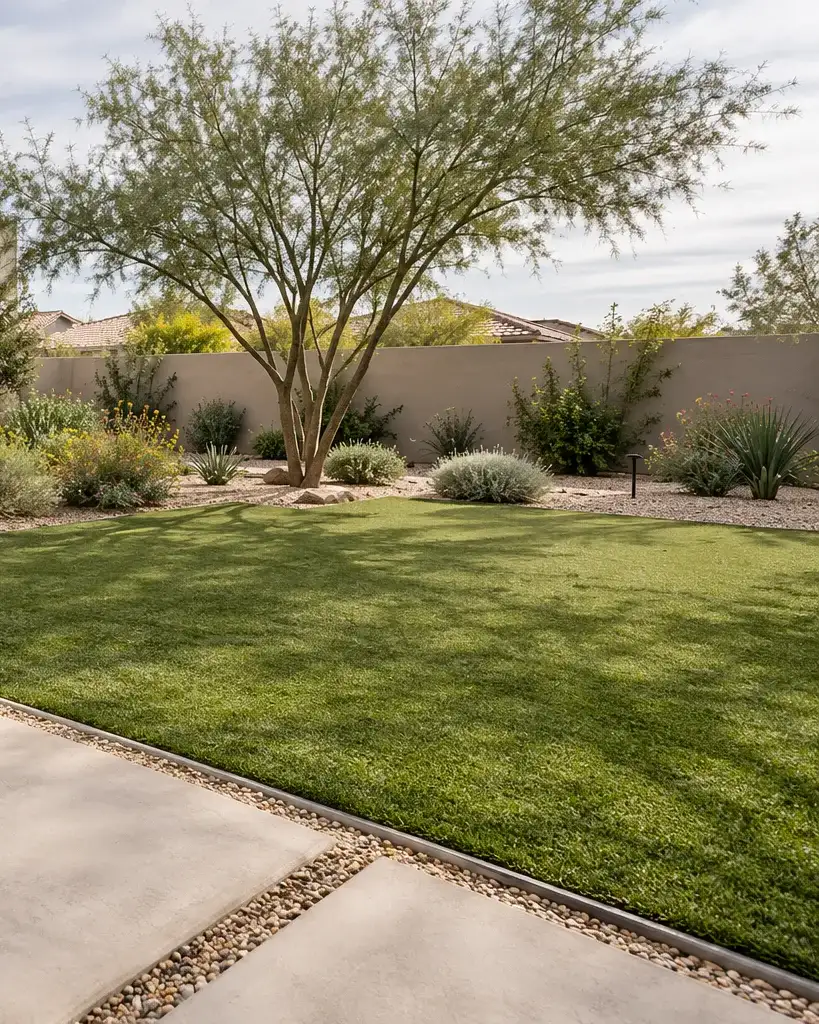
Turf has no water to release. It is plastic fiber over an infill, and plastic does not transpire. The sun's energy lands on the surface and stays there as heat. Air temperature in July runs past triple digits here, and any surface in full sun runs well above air temperature, the same reason a pool deck or a paver patio burns. Turf is just another surface in that class, except people walk on it barefoot.
Climate
The fiber and the infill hold the heat
Two parts decide how hot a given turf gets: the fiber color and what sits in it. Dark fiber absorbs more radiation than light fiber, and most turf sold for the look of real grass is a dark green. The infill, usually sand or rubber granules, holds heat too, because it is a mass of small particles that warms in the sun and releases it slowly. Between the dark blades and the heated infill, the surface keeps giving heat back long after the sun drops.
The phrase to keep in mind is heat storage. Real grass stores almost nothing and sheds what it gets through evaporation. Turf stores the afternoon and pays it out through the evening. On a west facing yard, the payoff runs until after dark.
Hardscape
The base underneath makes it worse
The ground under the turf matters as much as the fiber on top. Much of the East Valley sits on caliche, a cemented calcium carbonate layer that stops water infiltration. A turf install that never excavated through it has no drainage, so the little water the yard does get, irrigation overspray, a hose down, sits on top of a sealed layer instead of soaking in.
Dry ground under hot plastic is the worst combination. Wet soil cools. Dry, sealed soil does not. That is why a turf yard installed over compacted caliche runs hotter and stays hot longer than the same fiber over a real base with a drainage layer. The base is the difference between a surface that sheds water and one that sits on a hot plate.
Climate
What the heat actually does to the yard
The heat does three things. It makes the surface unpleasant underfoot, and bare feet and dog paws are the ones that find out first. It shortens the useful part of the day, because the yard is only comfortable in the morning and after sunset from June through September. And it hits the plants around the turf, because the surface re-radiates into the beds at its edges, and a plant adapted to zone 9b heat is not adapted to a root zone that never cools.
None of this means turf fails. It means the yard has to be designed around the heat, and most quick turf installs are not. See the full turf versus real grass comparison for the whole tradeoff in one place.
Planning
What to check before you buy, and after
If turf is on the table, check these before the fiber goes down.
- Fiber color. Lighter fiber stays cooler than dark, and if the HOA allows it, the lightest color you can live with is the right one.
- The base spec. Excavation depth, a drainage layer, and what sits below the caliche. Write the spec before the quote, because this is where cheap installs die.
- Shade. A yard with afternoon shade from a tree or a shade structure runs a different temperature than a bare south facing yard. Shade is part of the design, not an afterthought.
- Where the turf goes. Turf in the front yard where the HOA wants green, with the living parts of the yard elsewhere, is a different proposition than turf wall to wall. The base work and drainage show up in the cost of the whole project, and it is worth seeing the number before the fiber is ordered.
After the install, the honest fixes are limited. Watering the surface down cools it for a short while, at the cost of the water the turf was supposed to save. Replacing infill and fiber means redoing the surface. The time to fix the heat is before the base is built.
Contact
When turf is still the right call
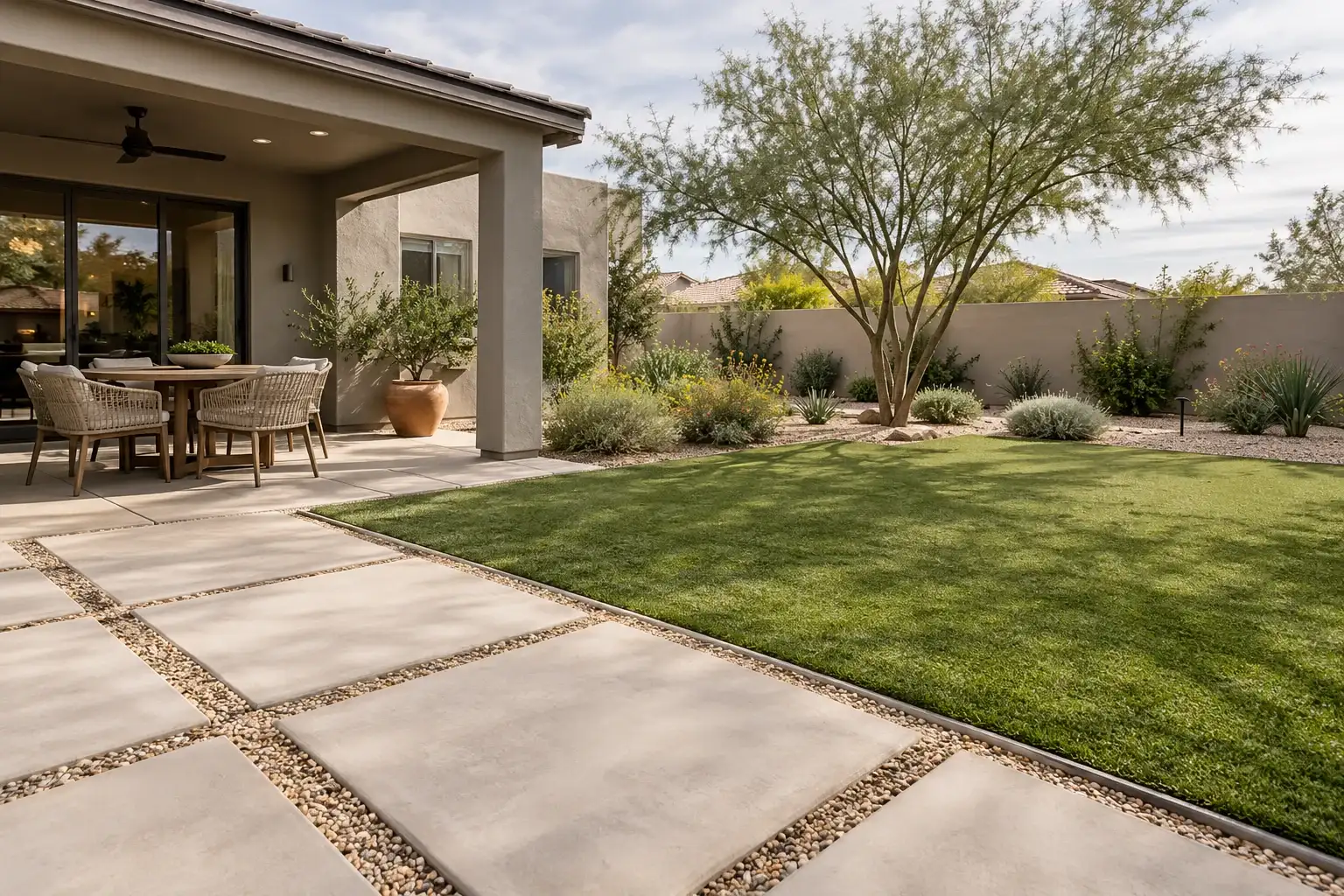
For a lot of Scottsdale yards, turf is still the right call, and the heat does not change that. It answers the HOA turf limits, it satisfies the xeriscape expectations a bare dirt yard would fail, and it kills the water and mowing bills in one move. The catch is that it has to be planned like a Scottsdale surface, not bought like a rug.
The yards that work put turf where it earns its keep, keep real planting around it, and build the base the way the lot asks for. The yards that fail treat it as a zero maintenance green rug and find out about the heat in July. If the comparison in your head is turf against sod, the heat is the line where real grass wins, and most everything else is the line where turf wins. A planned landscape installation sorts out which line your lot falls on.
6 questions
Why Does Artificial Turf Get So Hot: your questions
Still have a question? Call (747) 243-2089 and describe the yard.
How hot does artificial turf get in Scottsdale?
Hot enough to be unpleasant under bare feet by mid afternoon. Any surface in full summer sun runs well above air temperature here, and turf stores that heat into the evening, so the yard stays warm after the air cools.
Can I cool artificial turf down?
Partially. Lighter fiber, afternoon shade, and hosing the surface down all help, but none of them change what the material is. The biggest lever is the design, decided before the fiber is ordered.
Is turf too hot for dogs?
Paws feel it first, same as bare feet. If a dog uses the yard in the afternoon, plan shade and a cooler route across the surface. Morning and evening are fine. The afternoon is the problem window.
Does turf get hotter than concrete?
They are in the same class in full sun, and both run well above air temperature. Turf holds the heat longer into the evening, which is the difference people notice.
Why did my old yard feel cooler than the new turf?
Because grass transpires. The old lawn was releasing water into the air and cooling itself, and the new turf has no water to release. The temperature difference is the grass doing its job, not the turf failing.
Is there turf that stays cool?
Lighter colored fiber and different infills reduce the heat, but in a Scottsdale summer every plastic surface in full sun gets hot. Watch any product promising a cool lawn in July. The material does not work that way.