Landscape Lighting · Phoenix
Landscape Lighting Installation in Phoenix, AZ
Landscape lighting in Phoenix comes down to what the city code asks of a fixture and a system sized so the last light on the run still works. Bring the count of lights you want and where the transformer can sit. Call (747) 243-2089 and describe the walk, the trees and where power is available.
Costs
What does landscape lighting cost in Phoenix?
According to a national cost guide, a typical system lands between $2,000 and $6,000, with $3,500 as the average and single fixtures running $100 to $500 installed. A small job of 4 to 8 fixtures usually falls between $800 and $2,000, and a permit runs up to $300 where one is required. A second guide puts a system of 8 LED step lights and 12 hardscape lights around a pool at about $3,000, inside a $2,000 to $4,000 band, and prices path lights at $50 to $150 each against $100 to $400 for a tree. Published market ranges, not a quote: the final price is set after an on-site assessment. What moves the number here is run length, trenching across finished paving, fixture grade and whether the transformer needs a new circuit.
Rules
What does the City of Phoenix lighting code require of a yard fixture?
It requires shielding or filtration on the lamp types in its table, and it defines what shielding means. Phoenix City Code 23-100 says the purpose is to keep outdoor lighting from interfering with a neighbor's use of their property while minimizing atmospheric light scattering, and it defines fully shielded as light projected below a horizontal plane through the lowest point where light leaves the fixture (Phoenix City Code 23-100 (opens in a new tab)). The table names high pressure sodium, metal halide, fluorescent, quartz and incandescent over 150 watts. Each needs shielding or filtration unless the fixture has an automatic shutoff and stays dark from 11 pm to sunrise. Installing mercury vapor fixtures for outdoor use after January 1, 1985 is prohibited. LED lamps are not named in the table. The practical read is that a bright unshielded lamp at a property line is the kind of problem the code's purpose statement describes, and a fixture shielded so that light leaves below the horizontal plane fits the definition of fully shielded.
Hardscape
Why does uplighting a palm or a wall go wrong?
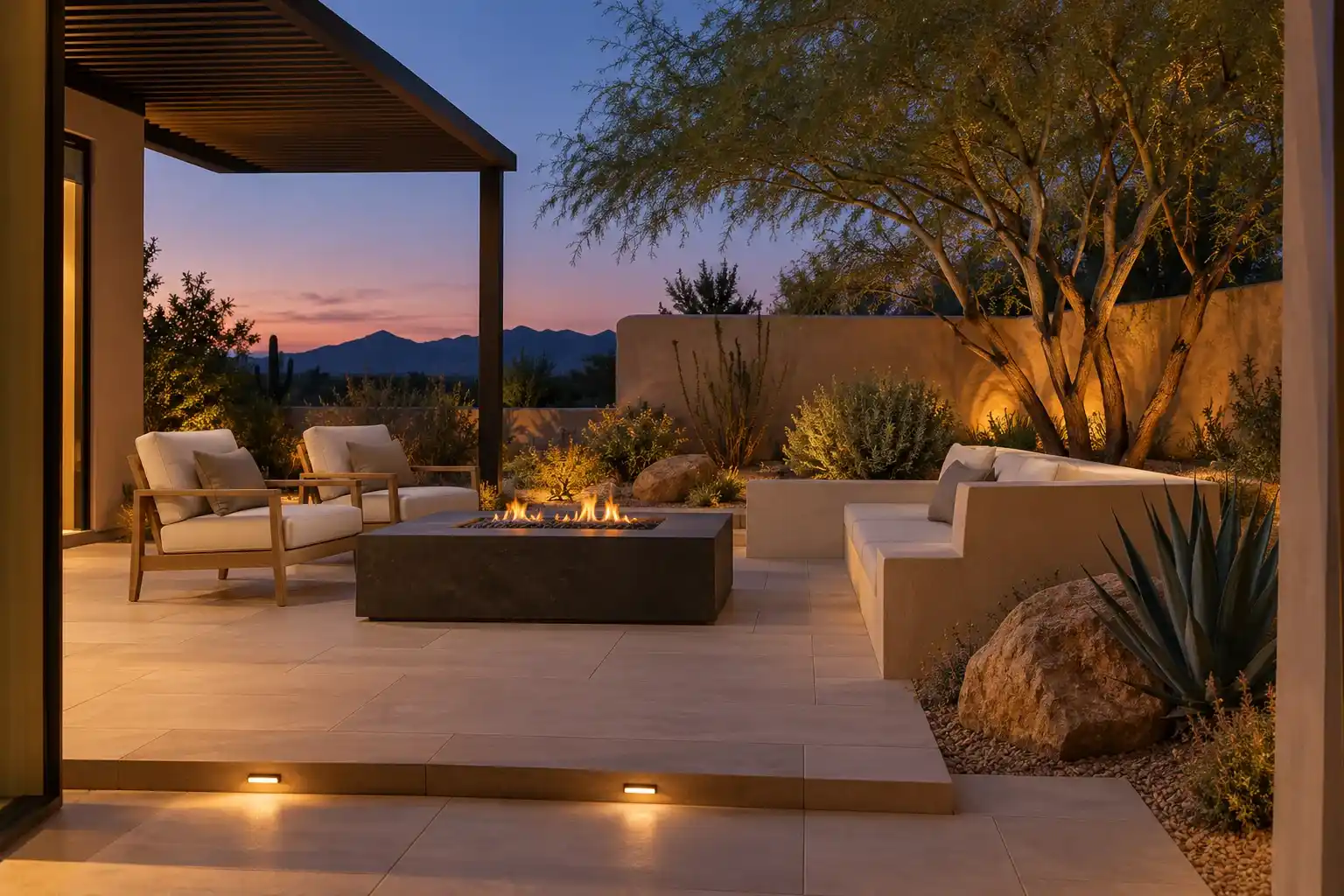
Because the light leaves the fixture at eye level and lands where nobody wants it. An uplight at the base of a palm sends a cone up the trunk and straight past the canopy, so the brightest surface in the yard becomes the frond undersides and the sky above them, while the ground stays dark. This Old House recommends a 12 degree beam on bullet fixtures aimed at architectural corners, and it notes that trees under 20 feet usually need 2 uplights of about 20 watts while larger trees may need 3 to 5 at 35 to 50 watts. Aiming both trunk and canopy is what keeps a tree from looking like it floats. On a wall, a wide wash at 6 feet reads better than a tight beam at 18 inches, which produces a hot stripe and a hard shadow. Narrow the beam, drop the wattage, shield the lamp.
Good to know
Is low voltage or line voltage the right choice for a Phoenix yard?
Low voltage is the default for a residential yard, and line voltage earns its place in specific spots. A 12 volt system steps 120 volts down through a transformer, which lowers shock risk, according to This Old House. It also keeps fixture sizes small, which matters on a path light or a well light. Line voltage makes sense where the load is heavy, the run is very long, or the fixture is a security flood on a wall circuit. Many yards mix the two: low voltage in the planting, line voltage at the house and the patio cover. The decision changes the trench, the transformer and the permit path, so it belongs in the plan rather than in a supply house conversation.
Costs
How much power does an LED fixture actually draw?
Far less than the halogen it replaced, which changes both the transformer and the wire. This Old House puts LED landscape fixtures at 1 to 11 watts against 20 to 60 watts for halogen, with a life of up to 40,000 hours, or about 20 years of regular use. Color temperature matters as much as wattage: early LEDs at 6,000K read blue against stucco, and 3,000K reads warm. The other number is lumen maintenance. An LED typically does not burn out, it dims, and rated life is a prediction of when output falls by about 30 percent, with heat generally the largest factor in how fast that happens (ENERGY STAR, LED lighting (opens in a new tab)). A 4 watt fixture and a 10 watt fixture can look identical in a catalog and behave very differently at year 8.
Service area
How do you size a transformer for a Phoenix lot?
Add the load, then leave headroom, and put the box where it can breathe. Add the volt amp rating of every fixture to get the system total, and keep that total at or under the transformer's watt rating, according to a lighting manufacturer's guide. This Old House sizes the same box at total wattage times 1.25 to allow for fixtures added later. The same guide gives these location points: within 8 feet of a GFCI outlet, at least 12 inches above grade, on its own circuit where possible, and at least 10 feet from a pool or a pond. On a large Phoenix lot the box often ends up at the side yard, which is fine for the wire and bad for the shrub bed, so settle the spot on the plan.

Good to know
Why do the far fixtures go dim on a long run?
Because voltage falls along the cable, and the last fixture gets whatever is left. The drop is calculated as 2 times the cable length times the total volt amps on the run, divided by a cable constant, and the end fixture voltage is the transformer tap minus that drop, per a lighting manufacturer's guide. Long runs on thin wire are where this shows up: the first 3 lights look right and the last 3 look tired. The fix is a hub layout, with a heavier gauge trunk to a junction box and equal length branches from there, keeping branch runs under 50 feet, per This Old House. On a deep lot with a detached ramada, that means 2 runs and 2 home runs rather than 1 long loop.

Good to know
How deep does the wire go, and where does conduit belong?
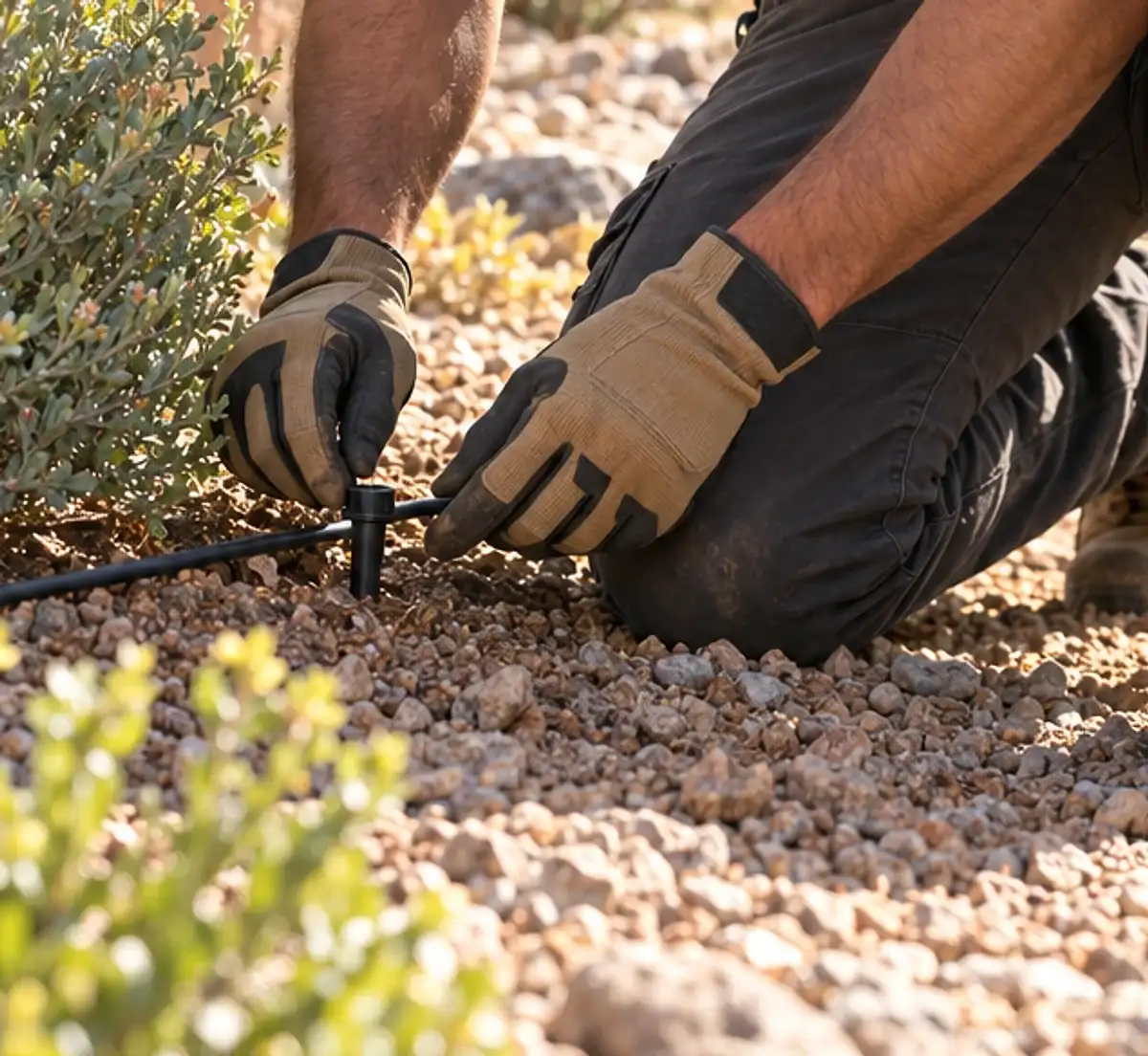
Low voltage cable sits shallow, and anything crossing a hard surface needs a sleeve. This Old House puts low voltage cable at least 6 inches deep, and a lighting manufacturer's guide gives the same 6 inch figure for the conduit that runs from the transformer to the ground. Line voltage work follows the electrical code's deeper cover requirements, which can raise the cost per foot of a 120 volt run. Under a driveway, a walkway or a paver patio, the cable goes in conduit with a pull point at each end, because a failed run under finished paving has to be cut out. Mark the route on a drawing before the trench closes, since the next person to dig in that bed will not see the wire.
Climate
Does 120F heat shorten the life of a fixture?
Yes, because heat is what wears an LED product down. Thermal management is generally the single largest factor in how an LED product performs over its life, and the hotter it runs, the faster output falls (ENERGY STAR, LED lighting (opens in a new tab)). A black metal housing in full afternoon sun in Phoenix sits well above air temperature, and the LEDs inside it run hotter than the air around the fixture. Fixtures mounted in gravel against a west wall run hotter than the same fixture under a shrub. Copper and brass housings are a common choice over painted steel, and a bronze finish can hide the chalk that sun brings out on powder coat. Keeping the driver out of direct sun and the lens clean can help a fixture last.
Climate
Should the lights run on a photocell, a timer or a smart control?
Any of the 3 works, and the choice is about who adjusts it and when. A photocell turns the system on at dusk and off at dawn with no programming, which is the simplest option and the least flexible. A mechanical timer holds a schedule, a digital timer sets a program for each day of the week and adjusts for daylight saving, and a smart control puts the schedule on a phone, according to a lighting manufacturer's guide. The code gives a reason to care: a fixture with an automatic shutoff that stays dark from 11 pm to sunrise can skip the shielding requirement for the lamp types in the table (Phoenix City Code 23-100 (opens in a new tab)). A system that runs to 11 pm and then goes dark also annoys fewer neighbors. Smart controls help most where the yard is used in seasons rather than nightly.
Outdoor living
What should a lighting plan show before anyone digs?
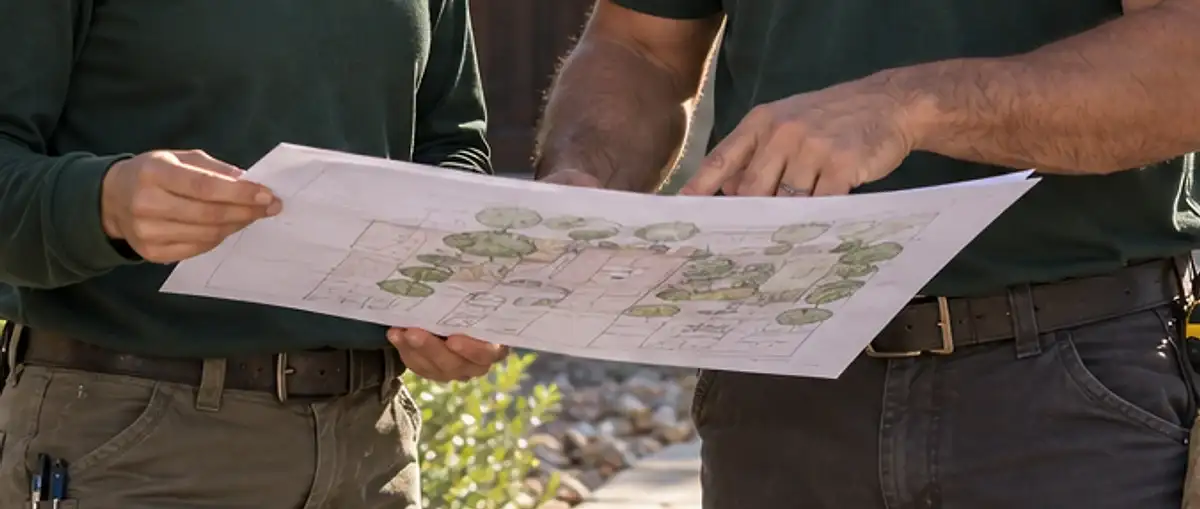
It should show the fixture schedule, the beam spread at each location, the zones, the transformer spot and the control point. A plan starts with a map of the property with the house, walks, trees and the features worth lighting, which This Old House describes as the blueprint for placing lights. Each run then gets a load and a voltage drop figure, so the far fixture is checked before the cable is bought. Beam spread belongs on the drawing too, since a 12 degree beam and a wide wash solve different problems at the same spot. Add the circuit the transformer will use and whether a GFCI outlet exists. A plan with no voltage drop numbers is a sketch.
Outdoor living
What changes when the lighting is around a pool?
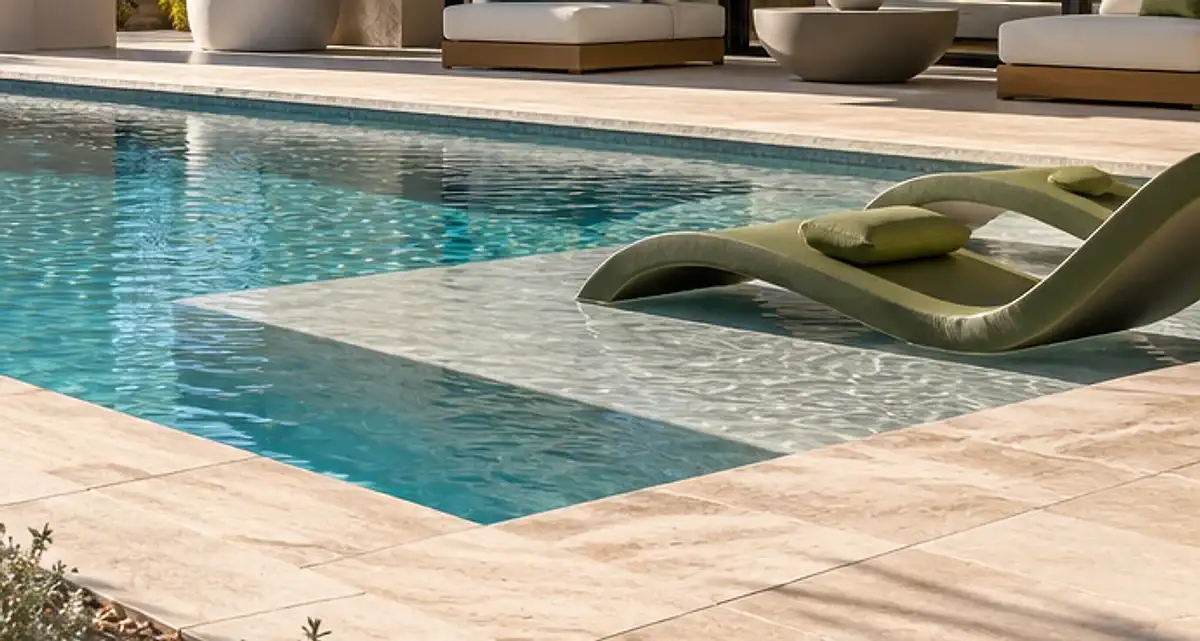
The electrical rules tighten, and so does the aiming. Chapter 42 of the Phoenix Residential Code 2024 covers the wiring, fixtures and electrical accessories for swimming pools and spas, and its overview says it focuses on protecting occupants from electrical shock around water and wet or grounded surfaces. A lighting manufacturer's guide puts a transformer at least 10 feet from a pool or pond and at least 12 inches above grade, with a GFCI outlet within 8 feet. Fixtures at a pool deck want to be low glare and aimed away from the water surface, because a bright source reflected in a pool is worse than no light at all. Step lights and a soft wash on the surrounding wall do more than an uplight at the coping. Keep connections out of the splash zone entirely.

3 questions
Questions people ask
Still have a question? Call (747) 243-2089 and describe the yard.
Do I need a permit for landscape lighting in Phoenix?
Permit rules follow the wiring, not the fixture count. A plug in transformer on an existing GFCI outlet is a different job from a new 120 volt circuit, a subpanel or a transformer on its own breaker, and a permit where one applies runs up to $300, according to a national cost guide. Ask before the trench opens, since inspection happens before backfill.
How many fixtures does a front yard need?
A national cost guide describes a small project as 4 to 8 fixtures along key walkways or entries and a medium project as 9 to 16 fixtures covering front and back yards. A corner lot or a long driveway pushes the count up. The count should follow the views you want after dark, not the shape of the bed.
Can lights be added to an existing system later?
Often yes, if the transformer was sized with headroom and the runs were kept short. This Old House sizes the box at total wattage times 1.25 for exactly that reason. Past that margin, the answer is a second transformer rather than a bigger one on the same wire.