Guide 06 · 5 min read
Pavers vs Stamped Concrete in Scottsdale, AZ
Stamped concrete gives you the look of stone in one pour, and pavers give you real individual units with joints that move. In Scottsdale the choice turns on what happens when the clay swells and the sealer bakes. Here is how each one ages on a Scottsdale patio.
Good to know
The short answer
Stamped concrete wins on cost and on a clean, continuous look. Pavers win on movement and on repairs that do not show. The right choice depends on the slab, the soil, and how much afternoon sun the patio takes.
Good to know
Stamped concrete: what it actually is
Stamped concrete is a single poured slab textured with mats while it is wet, then colored and sealed, so it reads as stone, brick, or tile without real joints. It is still one continuous piece of concrete, which is the whole story. Every stamp line is cosmetic, and the slab underneath behaves like any other slab: it cracks when the ground moves, and the pattern cannot hide it.
The sealer is the part Arizona punishes. Heat and UV age sealers faster than the national average assumes, so a stamped patio in full sun loses its color and sheen earlier than the brochure expects, and the fix is reseal, not repour. The stamp itself ages too: edges soften, the pattern loses its crispness under the UV, and what read as stone in year one reads as concrete with lines by year five.
Hardscape
Pavers: what it actually is
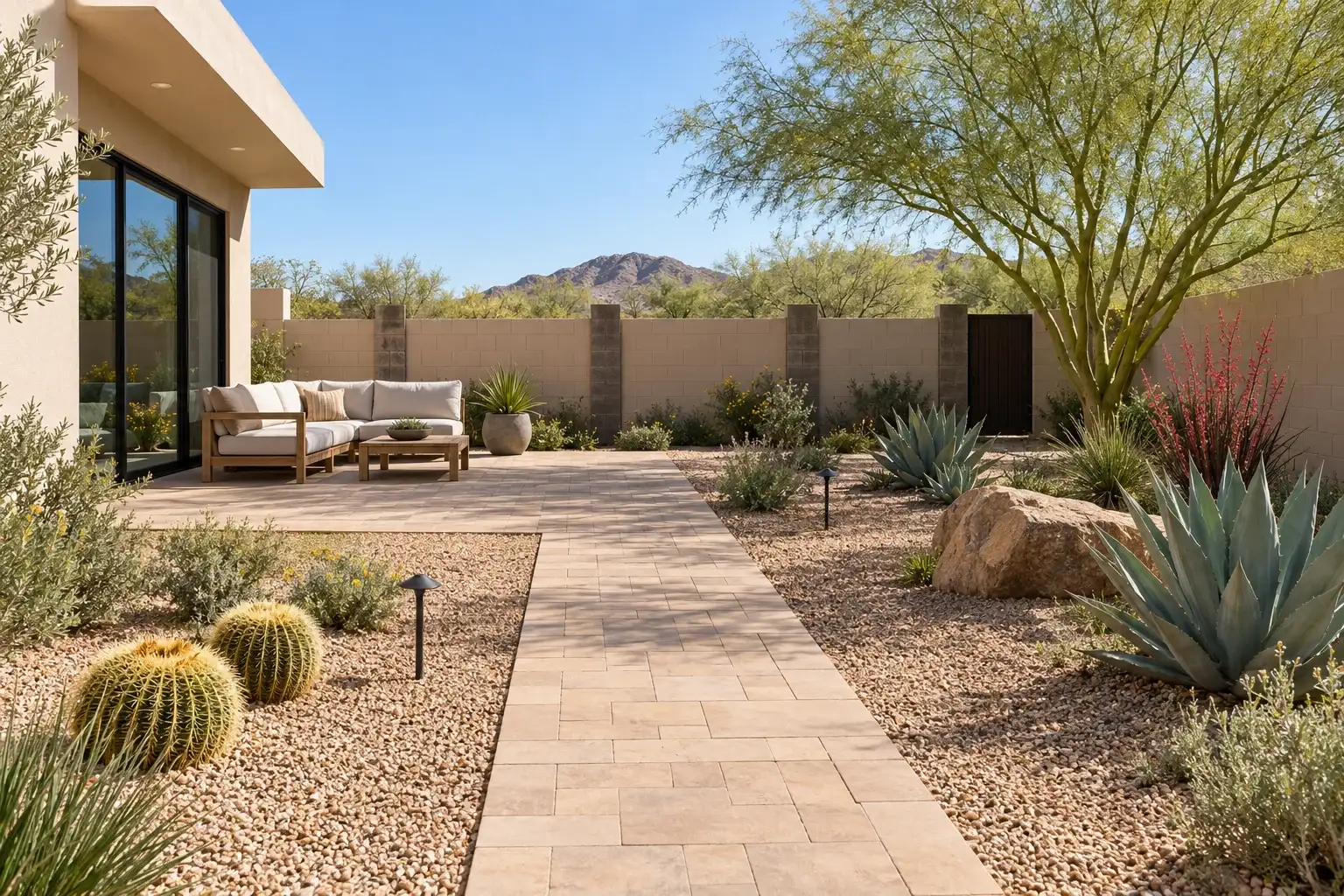
Pavers are individual units, concrete or stone, set over a compacted base with sand in the joints. The surface is made of pieces, and that is its entire advantage. Movement in the ground gets absorbed at the joints instead of tearing the surface, and a damaged unit lifts out and gets swapped without touching the field around it.
The base is what carries the whole thing. Excavated properly, compacted in lifts, it stays level through monsoon and dry spell. Thin base over caliche, and the patio dips and the joints open, which is a base problem wearing a paver disguise.
Mistakes
Where stamped concrete fails here
Expansive clay is the first failure. Parts of the Valley sit on clay that swells when wet and shrinks when dry, and monsoon rain followed by desert heat is the exact cycle that moves a slab. When a stamped patio cracks, the crack runs right through the pattern, and there is no way to hide it. The patch reads as a patch forever, because the stamp never matches.
Caliche adds a second one. The cemented calcium layer under much of the East Valley stops water infiltration, so water that gets under the slab edge has nowhere to go. It softens the subgrade in one spot, the slab settles unevenly, and the crack that follows is the slab pointing at the water. Drainage that was never planned pushes monsoon water toward the house or the neighbor, and the stamped finish does not care; the damage happens underneath. The crack also never stays alone. One crack invites water in, the water works the subgrade wider, and the second crack follows the first within a season or two.
Heat and UV are the third. Scottsdale sun bakes the sealer, the color fades and chalks, and a patio that looked deep and rich in year one looks tired by year three. Resealing is part of ownership, and the cost of doing it right every few years belongs in the comparison. Design review matters here too. Scottsdale runs the strictest design review in the Valley, and a colored, patterned slab in a front yard or entry often needs approval before the pour. A patio that faces west and takes the full afternoon is the one to design around, because no sealer built for a national average holds up the way the manufacturer hoped it would here.
Hardscape
Where pavers fail here
Caliche excavation is the cost problem. The same cemented layer that stops water also dulls trenchers, and a proper paver base means digging through it, compacting in lifts, and hauling the spoils. That is the expensive line in a paver bid, and cheap bids exist because that line gets cut. A paver patio over a thin base dips within a season or two, and the joints open like a cracked slab, just slower.
Monsoon works on the joints. Water arrives faster than desert soil can absorb, sheets across the patio, and finds the sand joints. A patio sloped wrong or built without a drainage plan washes the base out from under the units, and the field starts moving. A raised paver patio is the worst offender, because it turns sheet flow into a channel aimed at the house or the neighbor.
Heat does not spare pavers either. They store the afternoon sun and re-radiate it into the evening, and a dark paver in full sun is a hot surface. The difference from a stamped slab is small. The difference that matters is what each surface does when the ground moves, which is the whole argument on the pavers vs concrete patio page.
Costs
What it costs and what drives the number
Stamped concrete usually runs below pavers per square foot, and the gap grows with fancier patterns and borders. The drivers are the same as any patio: access for the truck or the machine, caliche excavation, base depth, and slope. The part people skip is the life of the finish. A stamped slab carries resealing every few years and the risk of an unrepairable crack, while a paver patio carries the excavation up front and cheap repairs after. The honest spread between the two quotes on the same lot is the cost of the movement insurance, and the question is whether you want to pay it once up front with pavers or a little at a time with the slab.
Compare the decade, not the invoice. The landscaping cost page breaks down what moves a Scottsdale patio quote, and the patios and pavers page shows how a patio fits the rest of the yard.
Good to know
What good work looks like in Scottsdale
- The base is specified to caliche depth before the price, so the excavation is priced, not skipped.
- Drainage gets planned with the patio, and monsoon water gets a route away from the house and the neighbor.
- Color and pattern go through design review before anything is ordered or poured.
- The comparison is priced over ten years, including reseals and what a crack costs on each surface.
6 questions
Pavers vs Stamped Concrete: your questions
Still have a question? Call (747) 243-2089 and describe the yard.
Is stamped concrete cheaper than pavers?
Usually, yes, per square foot up front. The gap shrinks when you add resealing over the years and account for what a cracked slab costs to repair.
Does stamped concrete crack in Arizona?
It can, and when it does the crack runs through the pattern. Expansive clay and monsoon water are the usual causes, and the patch will not match the stamp.
Can you repair one paver?
Yes. One unit lifts out and gets replaced, and the rest of the field is untouched. That is the main reason people choose pavers on moving soil.
Do pavers get as hot as stamped concrete?
Close to it. Both store heat and re-radiate it in the evening. Color and shade matter more than which surface you pick.
Will the HOA approve stamped concrete?
It depends on the neighborhood and the area. Front yard and street visible hardscape goes through design review in most Scottsdale HOAs, and approval comes before the pour.
How often does a stamped patio need resealing?
More often in Scottsdale than the national average, because heat and UV age sealers faster. Full sun exposure is the main driver.