Patios and Pavers · Phoenix
Pavers in Phoenix, AZ: Patios, Base Work and Permits
Pavers in Phoenix are decided by what the caliche layer does to the base and by which walls and structures need a permit. The invisible half of the job, the base, is where the money and the failures sit.
Costs
What does a paver patio cost per square foot in Phoenix?
A national cost guide puts a paver patio at $8 to $25 per square foot, with an average of $3,800 for a 280 square foot patio. Material sets part of that rate: concrete pavers $8 to $15, brick or clay $10 to $20, natural stone $15 to $50 per square foot in the same guide. Labor runs $50 to $80 an hour, or $4 to $11 per square foot. A second national guide prices a full patio build at $3,000 to $8,000 with a $6,000 average, and gives a $6 to $30 per square foot band across all materials. A 300 square foot patio takes 35 to 40 hours of crew time, which is why the labor line dominates a small job. Site access and demolition move the total more than the pattern does. Published market ranges, not a quote: the final price is set after an on-site assessment.
Ground
Why does caliche change the base work on a Phoenix lot?
Caliche decides how deep the excavation runs and how fast water leaves the base. It is a layer where calcium carbonate has cemented sand and gravel, sometimes into a slab several feet thick, and it restricts both root growth and water movement (University of Arizona, managing caliche (opens in a new tab)). On a patio the result is a base that cannot drain, because water perches on the layer instead of passing through it. A test hole is the check: fill it with water, measure after 4 hours, and a drop of 4 inches passes. A hole that still holds water needs an outlet or a raised section, not more aggregate. Cutting the subgrade to a fall is slow work in cemented soil, so excavation and haul off can carry more hours than the pavers themselves.
Rules
Do I need a permit for a paver patio in Phoenix?
A building permit is generally not required for a paver patio at grade with no roof over it, and Phoenix's work exempt list covers it. Platforms, sidewalks and driveways no more than 30 inches above grade are exempt, and the commentary adds decks, sport courts and other similar uses with no roof covering (City of Phoenix, work exempt from permit (opens in a new tab)). Walls are a different file. A fence over 3 ft needs a permit, and a retaining wall over 3 ft, measured from the top of the footing to the top of the wall, needs one too (City of Phoenix, residential fences and walls (opens in a new tab)). Zoning also limits a retaining wall to 40 inches in a front or street side yard and to 6 ft in an interior side or rear yard (Phoenix Zoning Ordinance, section 703 (opens in a new tab)). A patio can still trigger drainage review when it changes where stormwater leaves the lot. Settle the wall height and the grade before anyone calls the patio permitted.
Timeline
How hot does a paver surface get in a Phoenix summer?
Hotter than the air, and the color of the paver decides how much hotter. A pilot study in Arizona measured conventional paving such as asphalt at up to 152 F at mid-day, with cool pavements running 10 to 16 F lower (EPA, cool pavements (opens in a new tab)). Phoenix logged 47 heat warning days in 2026 through October 17, so a 110 F afternoon is an ordinary working condition here (NWS Phoenix, heat (opens in a new tab)). Light travertine, light flagstone and pale concrete reflect more, so they stay closer to air temperature than charcoal or black granite. The gap shows up on a pool deck, where people cross wet and barefoot, and on a west patio used at 4pm. Put the dark material where a wall or a tree shades it. Test 2 samples with a hand at 3pm in July before the order goes in.
Hardscape
Which paver holds up best on a Phoenix pool deck?
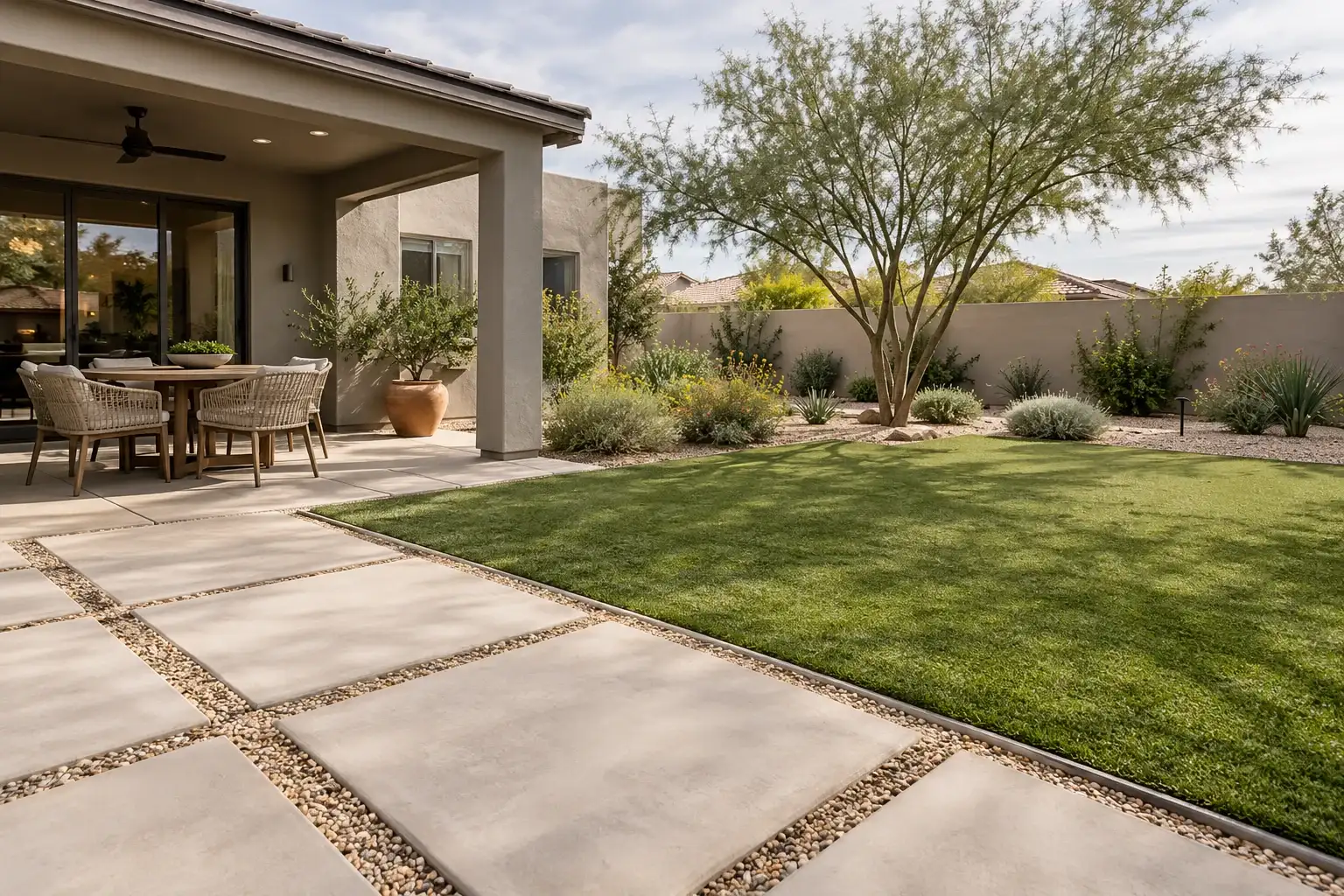
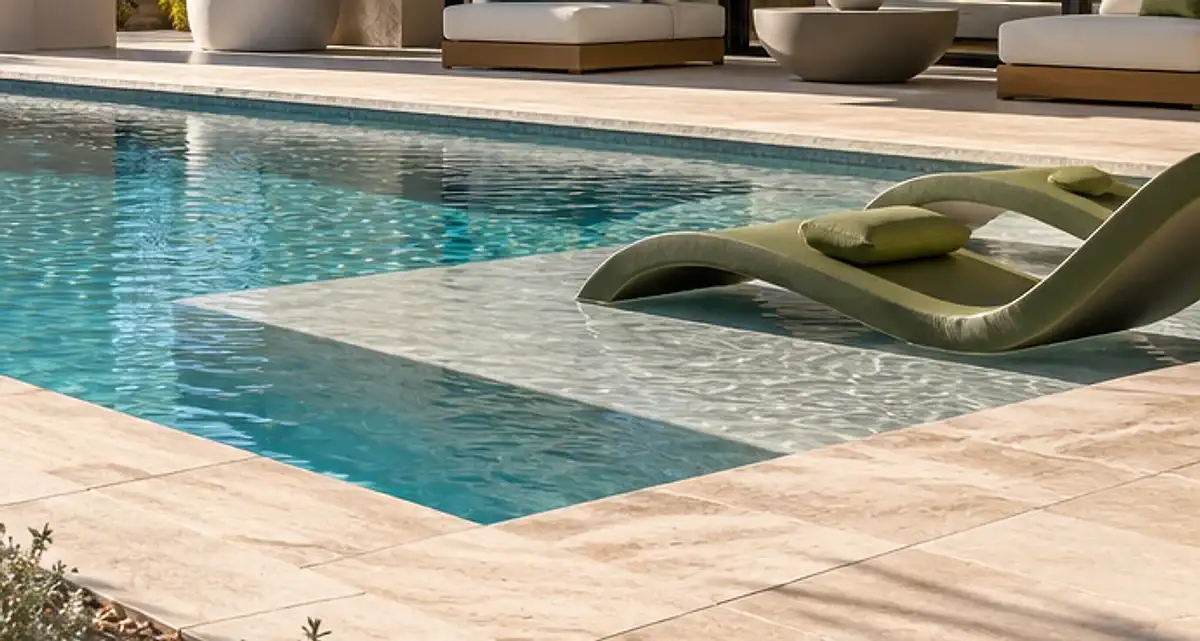
Light stone and pale concrete do better on a pool deck than dark, dense material, and the joint matters as much as the surface. Travertine and light concrete run cooler underfoot, and a sand or polymeric joint lets water pass instead of sheeting across the deck. Chlorine and salt both work on a sealer, so a pool deck wants a breathable product or none at all. Slip resistance comes from texture rather than from a finish name, and a honed travertine is safer wet than a polished one. Price follows the same split as the rest of the patio, with concrete pavers at $8 to $15 and natural stone at $15 to $50 per square foot in a national cost guide. Coping is quoted with the deck and adds a second cut line and a second material. Published market ranges, not a quote: the final price is set after an on-site assessment.
Ground
How does a paver patio drain in a monsoon storm?
A paver patio drains to wherever the lot already sends water, and Phoenix expects it to stay on the property. The on-lot retention rule applies to single-family lots exempt from a grading plan, and it sizes a basin from lot area and a design rainfall depth, with 2.7 inches in the worked example (City of Phoenix, on-lot retention (opens in a new tab)). A patio changes the surface water crosses, so the fall must run away from the house toward the low corner or basin. Flat is not level: 2 percent is the working fall. Never build across a wash, a natural drainage path or a drainage easement (City of Phoenix, residential fences and walls (opens in a new tab)). Water that leaves the lot becomes the neighbor's problem first. Slope and outlet belong on the drawing before the first pallet lands.
A base and slope question is worth a call before the pavers are ordered: (747) 243-2089.
Service area
Can a crew get a truck to the back yard on an older lot?
Access moves the price more than the paver choice, and an older Phoenix lot usually offers 2 routes. The first is a side gate, and a 3 ft gate means every pallet and every bucket of base travels by wheelbarrow. The second is the alley, which in Phoenix serves as an access point for utilities and solid waste pickup. Gating an alley is a city program, and the petition needs signatures from 50 percent plus 1 of the property owners along both sides, with installation that may take 6 to 9 months (City of Phoenix, gated alley program (opens in a new tab)). On an open alley a truck can set pallets at the back fence. Phoenix zoning also lets an attached open porch or carport project to the rear lot line where a rear alley exists (Phoenix Zoning Ordinance, section 701 (opens in a new tab)). Measure the gate, the turn and the overhead line before the bid is written.
Service area
What is different about a 1950s lot and a new north Phoenix lot?
An older lot is often narrower, and the zoning numbers set what fits on it. Phoenix grew from 106,818 people in 1950 to 439,170 in 1960, and many older Phoenix lots date from that decade (Census Bureau, 1950 urban places (opens in a new tab), Census Bureau, 1960 urban places (opens in a new tab)). Where the lot is zoned R1-6 and was subdivided before May 1, 1998, the standard sets a 60 ft minimum width, a 94 ft minimum depth, 20 ft front and 25 ft rear setbacks, and a 50 percent coverage cap, or 60 percent with an ADU or an attached shade structure (Phoenix Zoning Ordinance, section 613 (opens in a new tab)). A parcel legally established below today's minimum still counts as a building site (Phoenix Zoning Ordinance, section 701 (opens in a new tab)). District is the other difference: a north Phoenix subdivision may sit in a PUD, which carries individually tailored standards, or in a PAD, a district the city no longer offers for new rezoning, instead of the R1-6 defaults (Phoenix, zoning district descriptions (opens in a new tab)). Read the lot record for width, district and coverage before the patio is sized.
Hardscape
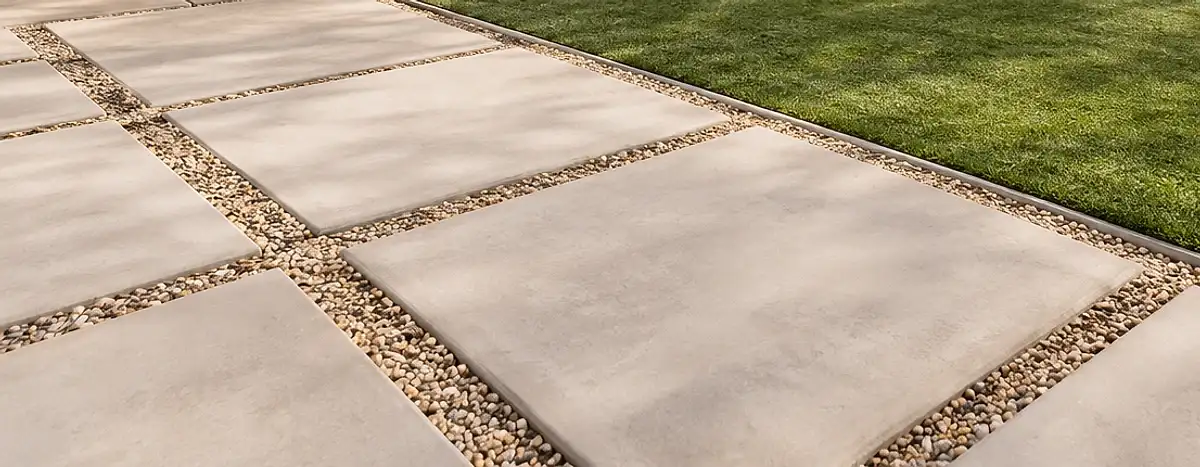
What goes under the pavers, and how deep does it go?
4 inches of compacted crushed rock is the usual base, placed in 2 inch lifts and packed before the next load arrives. The subgrade below it is cut to the intended fall, and on a caliche layer that cut is the slow part of the job. Above the base sits 3/4 to 1 inch of bedding sand, then the pavers, then an edge restraint that stops the field from spreading. The restraint is the piece most often left out and the piece that fails first: without it the outer course creeps outward and the joints open. Base depth grows where the soil holds water or the surface takes a vehicle, so a driveway section is deeper than a patio section.
Costs
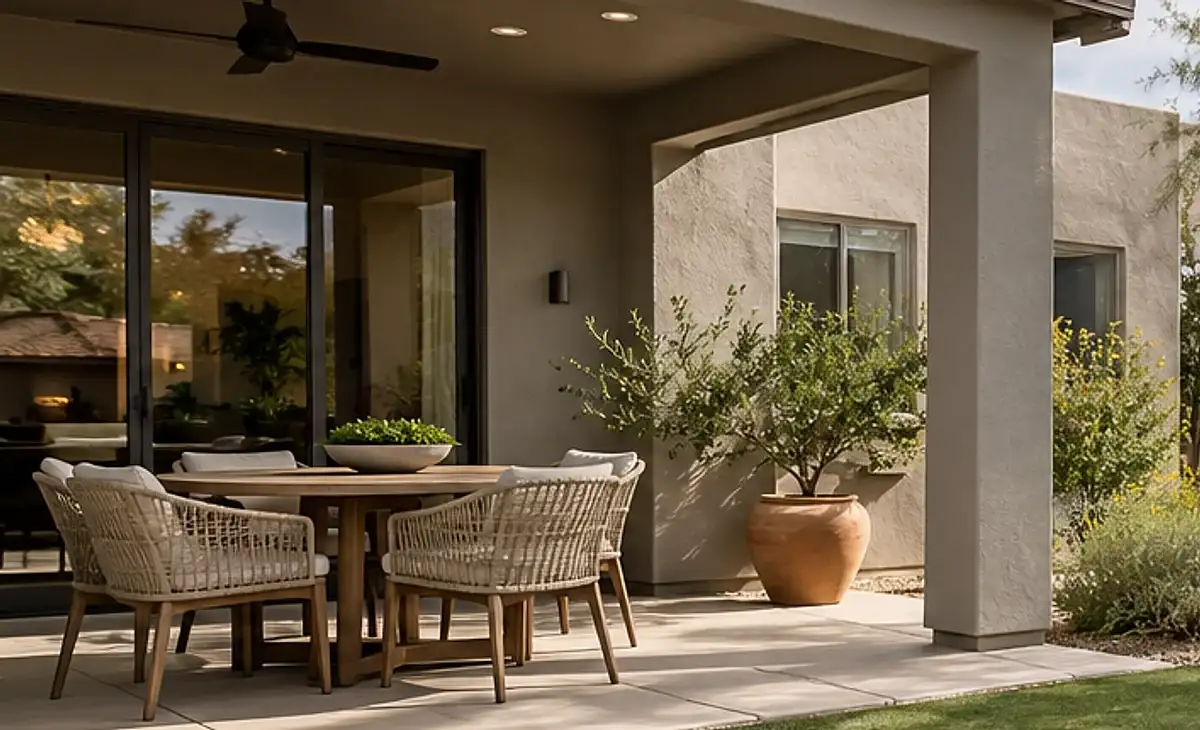
What does a retaining wall or seat wall cost per linear foot?
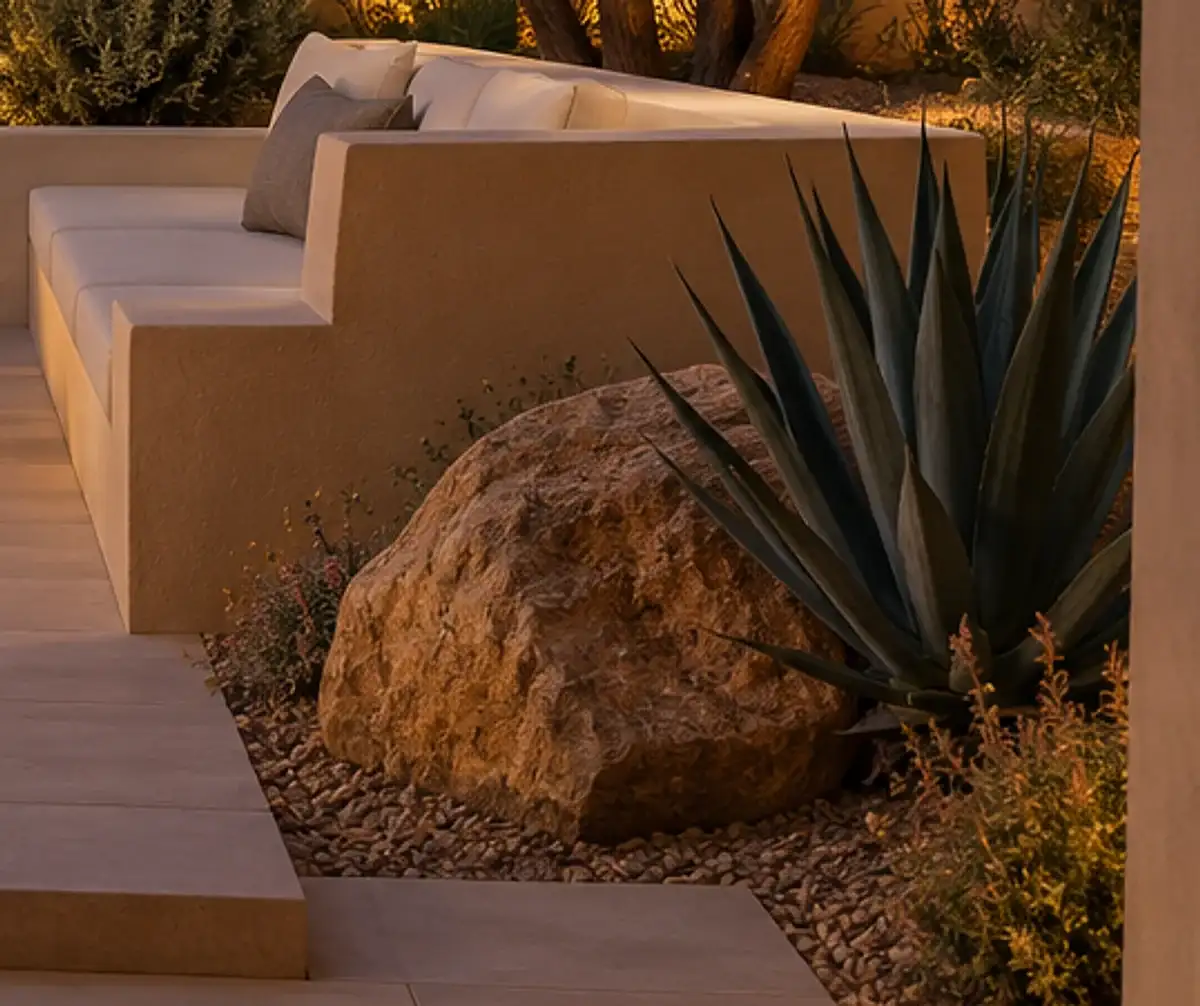
A retaining wall is priced by height and by linear foot, and a low seat wall is priced the same way. The price index lists a retaining wall at $40 to $360 per linear foot depending on height (landscaping cost). A patio sitting wall, the low wall around a counter or a fire feature, runs $40 to $60 per linear foot in a national cost guide. Height drives both numbers: a 2 ft wall holds less soil, needs a smaller footing and moves fewer blocks than a 6 ft wall. In Phoenix a retaining wall up to 3 ft is generally exempt from a building permit and anything taller needs one, and zoning adds height limits by yard. Engineering is the other line, because a wall that holds soil uphill needs a design, not a stack.
Costs
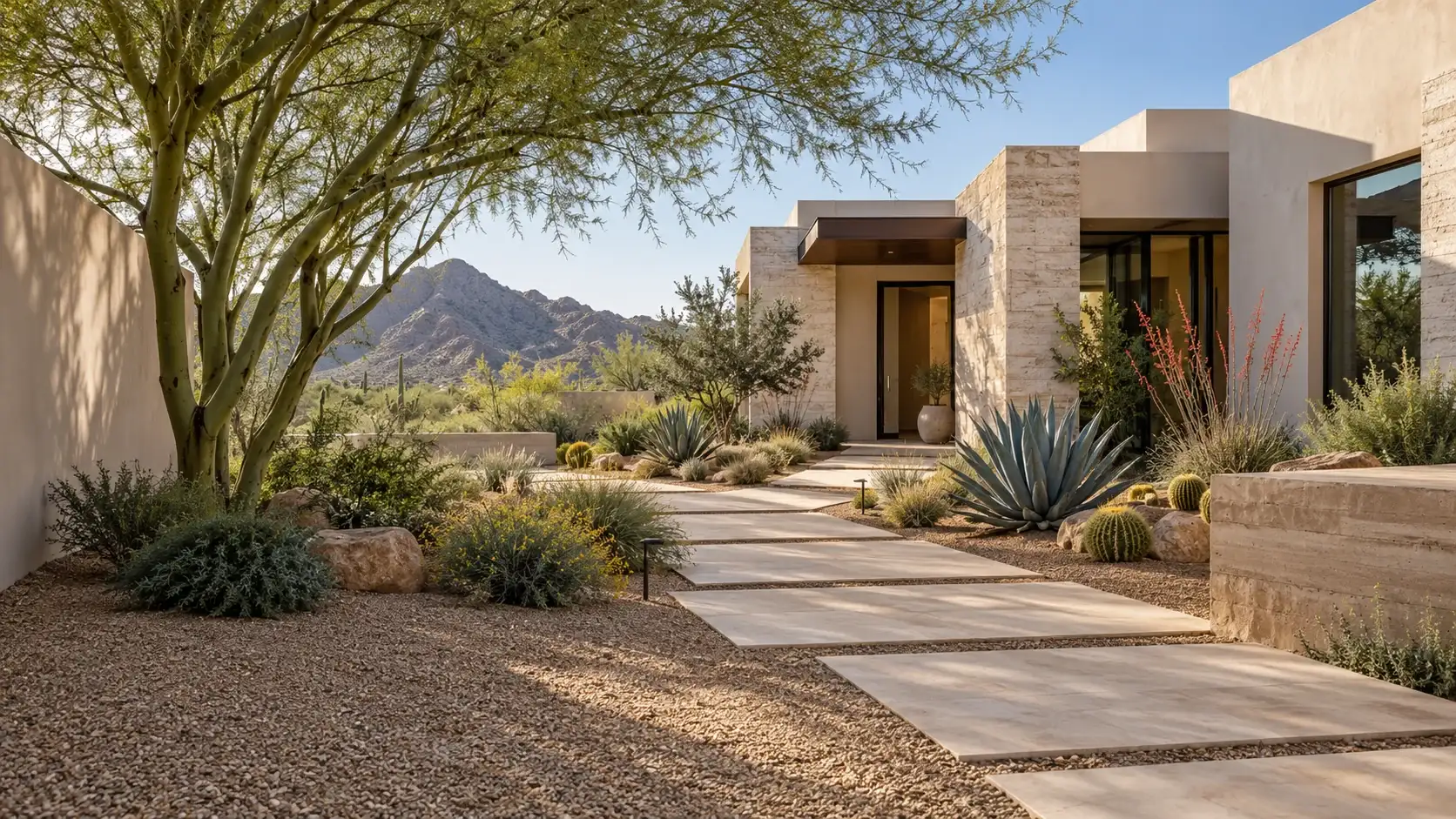
Does the paver pattern change the price?
Yes, and the pattern usually costs more in hours than in material. A running bond or a herringbone is the simplest way to cover ground, because the cuts are straight and the crew keeps a rhythm. Circles, spirals and mosaics need layout lines, more cuts and more handling, which is why national guides flag intricate patterns as a labor premium. A border course, a soldier course and a mitered corner each add detail that shows up on the labor line. On a narrow lot with a 3 ft gate, the access premium is usually larger than the pattern premium, so choose the pattern second.
Hardscape
When is the best time of year to build a patio in Phoenix?
Late October through April is easier on the crew and on the materials, and summer work is possible with a changed schedule. The 2026 season opened with a heat warning on March 19, the earliest start on record for Phoenix (NWS Phoenix, heat (opens in a new tab)). Base compaction and bedding sand behave the same in July, but a crew working in 110 F starts earlier, breaks more and finishes less per day. Polymeric sand and sealers want temperatures inside a published range, and a July surface can sit above it. Concrete for footings and wall cores cures fast in heat and needs water. Book a large patio for late fall, and expect a shorter working day between June and September. Deposit and lead time decide more than the calendar in a busy spring.
3 questions
Questions people ask
Still have a question? Call (747) 243-2089 and describe the yard.
How much does a 400 square foot paver patio cost in Phoenix?
A national cost guide prices a 20 by 20 ft patio, 400 square feet, at $3,200 to $10,000, with a high case near $20,000. That is the published market band, not a quote for a specific yard. Access, base depth and material grade decide where a real number lands.
Do pavers crack in Phoenix heat?
The pavers themselves rarely crack. A concrete paver is a small unit with joints on 4 sides, so ground movement shows up as a joint that opens rather than a crack that runs. A crack through the middle of a paver usually points to a base failure, a vehicle load the section was not built for, or a paver laid tight against a wall with no room to move.
Can pavers go over an existing concrete slab?
Sometimes, if the slab is sound, pitched to drain and thick enough to hold the added height. The constraints are the door thresholds, the pool coping and the fall to the outlet. A slab that has cracked or settled should come out, because a paver surface laid over it will copy the movement within a season.
Same service in other cities